
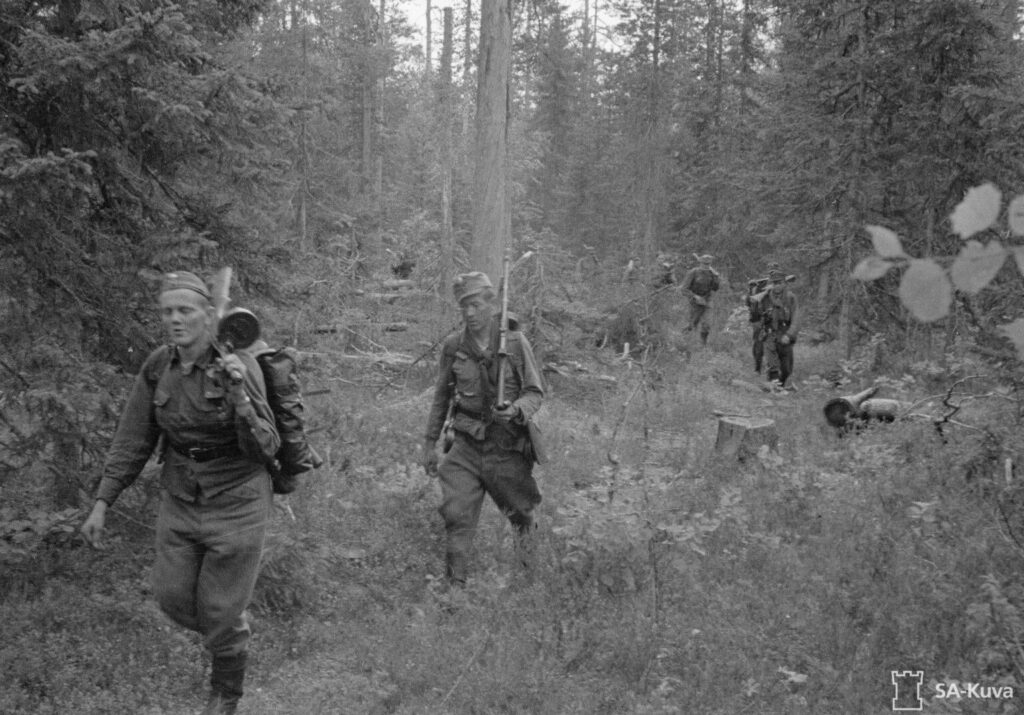
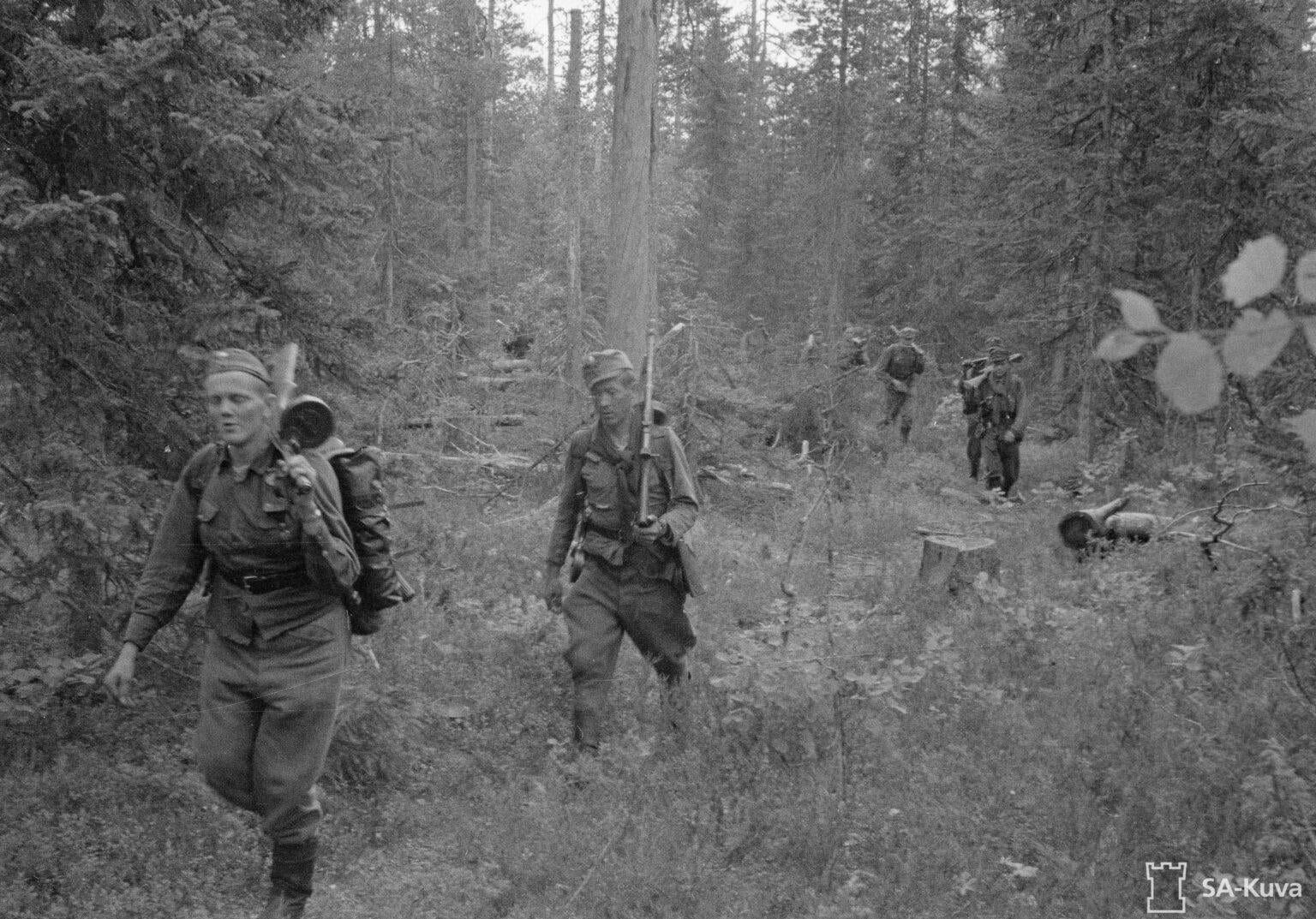
Hello, I’m curious to know the experiences your relatives had during WW2 in Finland as a soldier fighting for Finland. If I start, my grandfather fought in both the Winter war and the Continuation war. I’m not 100% sure in what position he was during the Winter war but he was probably something akin to a regular foot soldier fighting in the frontlines of upper Ladoga.
During the Continuation war, he joined a specialized long-range reconnaissance unit lead by Pauli Marttina and was tasked with intel gathering and sabotage, specially around the Murmansk railway at around the middle of Finland. He already passed away a long time ago but according to my father he didn’t talk that much about the war but said that he saw many of his friends get shot or blown up by mines/grenades.
One encounter he remembered sadly very well was when his best friend in a pothole in front of him got reduced to only a foot and shoe. As he felt sad about it for his friend’s son, he became the son’s godfather after the happening. After the war, he got invited to stay in the military as a Sergeant Major but refused to go back. He also had grenade pieces stuck in his fingers and would playfully pinch my dad with them.
https://i.redd.it/rtz7o5q85ong1.jpeg
Posted by TenTakaron
13 Comments
If you like, you can order his kantakortti from Kansallisarkisto. That’ll show you where he served and what battles he took part in.
Both my grandpas were war veterans, too.
My great-grandfather was an officer in the artillery, we have some old stuff of his but I don’t really know about his experience since he passed away when I was 6
Detachment Marttina is legendary. If you can claim a legitimate reason you can get his service records. DM me if you want more info. I am not a historian but I did it for my grandparents
My father was put on the front line as a member of an anti-tank artillery squad in the Lumisuo area at the 1939 border when the 1944 Soviet summer offensive began. He told me his company had gotten surrounded by a larger Soviet company, but his company managed to avoid complete encirclement, surrounded the enemy company instead, and took them all out. He later was deployed at Kuparsaari along the V-K-T line. He got furloughed, and when he returned from furlough, the fighting with the Soviets had ended. He served out the remainder of his service without having to join in the Lapland War. He passed away in 2011. I’m in possession of his military passbook.
My fathers grandfather died in Winter war. His father, my grandfather, fought in Lapland war. My mothers Grandfather died in Continuation war.
Onko oikeutta julkaista tätä kuvaa?
My grandfather Runar had two brothers: Wilhelm and Johannes. Wilhelm was a rifleman, got swallowed whole by the dark forest during the beginning of the winter war. Johannes was a part of the edge of the spear, kp-31 gunner. Got his leg blown off by mortar fire during the continuation war. Runar was a driver, part of the logistics during the entirety of both wars. Runar and Johannes came back to Ostrobothnia and raised families after the war. Peace be upon their memory.
Great thread.
My maternal grand father fought in Raate/Suomussalmi as a Lahti-Saloranta M/26 light mg gunner.
He had finished his (two year?) military service just before the war. He was granted a leave to go home to bury his father and then back to the Additional Refresher Training he went.
He lost two mag carriers assigned to him but didn’t get a scratch himself in the battles. He took part in the battles where they stopped the vehicles at the Raate road, the sweeping of the forests and the motti battles. When they finally received the tents he was wounded from a russian heavy mortar shell shrapnell that missed his carotid artery by an inch. The artery was visible from the wound. He received a vapauden mitali second class from the battles.
After he got out of the va-hospital, he was recruited to the border guard battalion. So he started the continuation war as a professional soldier. They were sent to the Lappi and fought alongside the germans. He didn’t have much respect for the gerries but when his unit was almost surrounded and only four of the men got back, two of them wounded with gunshot wounds to the hip and another shot through the lung, and the germans flew them to Norway to get the needed operation, he was thankful for both of them survived.
He was later wounded again as his team mate set off a land mine on a patrol. Whilst the other man was killed from the mine, my grandfather lost his eye and received lots of shrapnells to his side, arm and head. A couple of years before he died, an x-ray image was taken from his head and there were 37 individual shards of shrapnell encapsulated in his head.
He suffered from ptsd years after the war. Nightmares and shards of shrapnell extractibg his body tore the shirts and linen, which aggravated my grandmother to no end. He medicated himself with alcohol and wasn’t the best husband or father at times. He never spoke about the war to his wife or daughter. He only started to speak about these things to me, his grandson, around the time I entered my military service. He was 80 years old then.
When I was going to college, I started to take care of him. I remember that I would visit him and stay there until he got out of the bath. I’d cut off his toe nails and apply lotion to his feet, and he would tell me stories from his youth and the wars.
He was a good man, at least then, and I’m glad that I got to do those little things for him.
My great Grandfather was a sergeant during the Winter War 1939-1940 he would die in Impilahti on the 6th March 1940 his body was never recovered.
My girlfriend’s great-grandfather fought in the Winter War as a sergeant in the 4th division. I don’t know much about his experiences in the Winter war, however I do know much more about what he did in the continuation war.
That’s because he in fact joined the Finnish Volunteer Battalion of the Waffen SS in early 1941. As he was an experienced war veteran he skipped a lot of the SS training and went straight to the front in summer 1941 just before operation Barbarossa, becoming part of the SS regiment Westland, 5th SS Panzer Division Wiking. In july 1942 he was awarded the iron cross second class and in september 1942 he was promoted to SS-Rottenführer, a lance-corporal.
He fought with the SS-Wiking until his and the other Fins’ Waffen SS contracts ran out in summer 1943. He had a brief stay back in Finland before he decided to secretely jump on a German ship and arrive back in Germany, where he then re-inlisted into the Waffen SS. This time he was attached to the newly formed 11th SS Panzergrenadier Division Nordland, in the 11th pioneer battalion. He fought at the battle Narva, where he was wounded and was sent to a lazarett in Vienna before returning to the front in summer 1944. He was sometime in late 1944 promoted to SS-Unterscharführer and awarded the wound badge in bronze.
In April 1945, after getting word that the Nordland division would be heading towards Berlin to defend it, he deserted his unit and headed west where he surrendered to the British army. He was kept for a few months before being returned to Finland, where he was prosecuted and sentenced for treason and defying the Moscow peace accord by fighting against the Red Army.
One anecdote he told my girlfriend’s mother once was that he started the war knowing only Finnish, and ended the war being able to partially speak and understand German, Norwegian, Dutch, Estonian and Danish. This is because the units he was apart of had a relatively high number of Dutch, Danish, Norwegian and Estonian volunteers in them with which he had to communicate with of course and, in his words; “it’d be easier for me to learn their language than for them to learn Finnish.”
He also had a brother who was born in Germany as an ethnic Fin and also member of the Waffen SS, however I haven’t recieved his file yet from the Bundesarchiv so I don’t know a whole lot about him. I do know that he was a Rottenführer in an artillery regiment and that he died in February 1945 in Pommerania but that’s it.
Both my grandfathers fought in the war, and both my grandmothers were active in the Lotta movement.
My paternal grandfather was some form of intelligence officer, and one thing he did during the war was drive around on the karelian front on a motorcycle delivering keycodes to descramble communications. One thing we discovered after he died, was that he had received a medal from the Germans during the war. He spoke German, so had acted as a translator and liaison officer. For this he was awarded a (if I remember correctly) Kriegsverdienstkreuz second class. This he never really told anyone, and kept it hidden, but did not throw it away. At some point growing up my dad found the medal and tried to ask about it, but did not get an answer and grandpa made it quite clear that this is not something we talk about. There was also a document attached to the medal with Hitlers signature on it.
My maternal grandfather was in the suojeluskunta during the winter war, and an artilleryman on the Hanko front during the continuation war, stationed in Bromarv. He mostly shared funny stories from the war, he was a bit of a prankster and always up to some shenanigans, so had plenty of those stories. Since he was in the artillery and the Hanko front was quite stationary, I don’t think he really saw any close quarters combat, atleast he never told any stories of such.
Funny thing is that my paternal grandfather had a summer house on an island that was just on the other side of the border, that they had to abandon when the Russians took over Hanko. That island was quite heavily manned by the Russians, and therefore also targeted by the Finnish artillery. So my maternal grandfather has fired artillery on my paternal grandfathers summer place, before either knew the other existed, and then 30 years later their kids got married. We still have a sofa that was left in the old house, that had one armrest kicked off by some Russian so that they could sleep on it. The armrest was fixed after the war, but you can still see the crack where it was broken off.
Neither grandmother ever told any stories from the war. I just know that they were active, and both had some Lotta medals.
My grandfather fought from 1939 to 1944 in both wars. 2 medals for bravery he was a machine gunner. Hard to say how many he killed but he estimated at likely a 1000 kills he said once that they kept climbing from their trenches and climing over their comrades. Didnt really speak all that much about his experiences there but sometimes he did
All i heard was tvat he volunteered to cross a frozen river during an advance & the soviets thought they encountered a madman, and fired a warning shot.
The company apparently had never seen anyone ski as fast as he did when returning under fire.