
The sound of The Killers’ song The Man was blaring at Adelaide’s Hackney hotel as Steven Marshall waded through a throng of supporters to celebrate a drought-breaking triumph for the South Australian Liberal party.
Marshall had defeated Jay Weatherill’s Labor government and seen off the threat of Nick Xenophon’s SA Best, to end the party’s 16 years in opposition.
“A massive thank you to the people of South Australia who have put their trust, their faith in me and the Liberal team for a new dawn, a new dawn for South Australia,” Marshall told the crowd late in the evening of 17 March 2018.
Sign up: AU Breaking News email
Four years later and the Marshall government was wiped out in a Labor landslide led by Peter Malinauskas.
Now, another four years has passed and the optimism of 2018 has been replaced with a mix of trepidation and resignation as catastrophic opinion polling puts the Liberal party in a battle for its continued existence on 21 March.
Some downcast party insiders fear Ashton Hurn’s Liberals could be reduced to fewer than five of the 47 lower house seats, and wiped out in metropolitan Adelaide in a political earthquake on the scale of their Western Australia’s counterparts’ landslide defeat in 2021.
The party that produced such stalwarts as Alexander Downer and Christopher Pyne is already without any federal lower house seats in Adelaide after losing Sturt and failing to regain Boothby at the 2025 national poll.
Downer’s old seat of Mayo – once Liberal heartland – was lost to Rebekha Sharkie in 2016 and is now safely independent.
Crowded out of the political middle-ground by a centrist Labor government and under siege on their right flank from the Cory Bernardi-led One Nation, the state Liberals risk being squeezed into irrelevance.
Premier Peter Malinauskas and Ashton Hurn during a South Australian leaders debate. Photograph: Matt Turner/AAP
The decline is attributed to a combination of distinctly local factors, ranging from leadership churn and scandal, internecine factional warfare, Alex Antic and the religious-right’s takeover of the rank-and-file, and the extraordinary popularity of Malinauskas.
But its predicament presents an intriguing case study for the rest of Australian politics.
Could South Australia be the canary in the coalmine for a party teetering on the brink of collapse nationwide?
‘The party has not been forgiven’
Hurn dialled into Adelaide’s 5AA radio this week to spruik the chances of a rank underdog in an upcoming contest.
“Anything is possible – that’s a motto that I’m holding close to my heart,” she joked.
The 35-year-old was ostensibly talking about the season ahead for the lowly West Coast Eagles, the AFL side that her brother, Shannon, captained to the 2018 premiership.
But she was very clearly drawing parallels with her own against-the-odds fight.
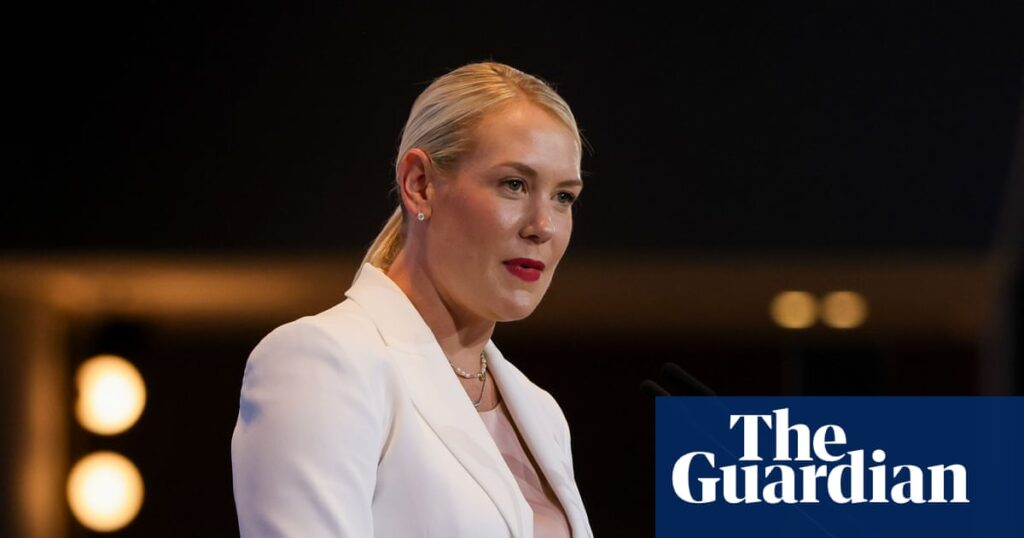
Drafted in as opposition leader roughly 100 days out from polling day to replace the underwhelming Vincent Tarzia – making her the party’s fourth leader in four years – Liberals variously describe Hurn as “terrific”, hard-working” and the “future of the party”.
But all accept she is about to lead the Liberals to their heaviest election defeat, worse even than Labor’s landslide loss after the collapse of the state bank in 1991.
After Newspoll last month showed the SA Liberal primary vote at just 14%, Victorian federal senator, James Paterson, said no person “in their sane mind” would’ve put their hand up to the lead the party.
“At the end of the day, she is trying to whip a team that has done nothing for four years – she has done what she can,” one senior Liberal said.
The Liberals entered the 2026 campaign with 13 seats, 12 fewer than Marshall won in 2018.
Hurn is expected to retain her seat of Schubert in the Barossa Valley wine region while the party can bank on keeping the Riverland seat of Chaffey.
But beyond that, senior party figures struggle to agree on other guaranteed holds – much less the gains needed to form government – as the Liberals face a pincer movement from Labor in metropolitan Adelaide and One Nation and independents in the regions.
Former federal Liberal senator Corey Bernardi is leading One Nation’s South Australian leader. Photograph: Mike Bowers/The Guardian
The challenge is a microcosm of the bind the Liberal party finds itself in nationally: Where does it fit – if at all – in the modern landscape of Australian politics?
Major party strategists expect One Nation to win two upper house seats but wouldn’t be surprised if it doesn’t win any lower seats, despite several opinion polls putting its primary vote in the 20s.
The bigger threat to the Liberals in the regions might come from independents, although strategists concede the possible four-cornered contests are near impossible to predict with the uncertainty over how preferences will flow.
‘A disappointment to the people’
Senior Liberal sources say the looming disaster can be traced back to that triumphant night eight years ago.
“Instead of building trust with the electorate and investing in advanced campaigning capabilities, ministers simply enjoyed the fruits of high office,” one Liberal said of the Marshall government.
“The Marshall government was a disappointment to the people. This resulted in significant damage to the Liberal brand. The party has not yet been forgiven by voters.”
As complacency manifested in Liberal ranks after the 2018 election, Labor used a rare term in opposition to renew and rebuild.
That included replacing the retiring Weatherill with the 37-year-old Malinauskas, a disciple of right-faction powerbroker Don Farrell who ran the socially conservative shoppies’ union before entering state parliament.
As other premiers consolidated power during the Covid-19 pandemic, Marshall eventually squandered his political capital by allowing the state’s police and health chiefs to front the response while he alienated Adelaide’s business community.
At the same time, Malinauskas actively courted the private sector – a conduit to traditional Liberal voters – while still running a traditional Labor agenda on health and education.
Hurn was at the centre of the Marshall regime as the premier’s media director.
Labor rocketed back to power in one term after winning eight Liberal-held seats at the 2022 election, including several in once-safe conservative seats.
Behind the scenes, senator Alex Antic was reshaping the division as a flood of new members – many from local churches – helped him install hard-right figures in key positions, entrenching his influence and control.
While the right has established organisational control, the party’s past four parliamentary leaders – Marshall, David Speirs, Tarzia and now Hurn – are moderates or centrists.
One right faction powerbroker argued the party had drifted too far to the left in recent years, creating the vacuum that One Nation was filling.
The South Australian Liberals needed to “hit rock bottom”, they argued, in order to rebuild as a true “centre-right party”.
Marshall did not respond to Guardian Australia’s request for comment.
‘Disoriented, outgunned and bewildered’
Senior Liberal sources believe the party is at serious risk of losing its remaining six seats in Adelaide, including Bragg, if One Nation sufficiently erodes its primary vote.
Three of its metropolitan seats – Colton, Morialta and Unley – are held by well-known retiring MPs, making them even more vulnerable to falling to Labor.
If the party was wiped out in Adelaide, one Liberal feared the organisation “may be at risk of total collapse”.
Other Liberals are less pessimistic, predicting the opposition will end up with 10 or so seats.
Ryan Liddell, a former chief-of-staff to Bill Shorten who is now based in Adelaide as managing partner of Principle Advisory, said Malinauskas had a rare ability to appeal to one rusted-on Liberal voters.
“He’s like a heat-seeking missile for the political centre – always bringing the conversation back to the economy,” Liddell said.
“You almost feel a bit sorry for the Libs down here. They’re up against a once-in-a-generation talent who’s carving up the centre.
“They look to the right and there’s One Nation. They look to the left and they’re left of Labor. They look disoriented, outgunned and bewildered.”
As Malinaukas has cemented Labor’s stranglehold of the centre ground, the Liberal brand has been tarnished by rolling scandals – including former leader Spiers’ arrest and conviction on drugs charges.
“Three leaders in four years with one prosecuted for drug offences. The hard right views of certain federal members, especially on the environment,” one Liberal said.
“It all adds up to making the party unattractive to voters.”
The extent of that unattractiveness will be tested on 21 March.
The verdict will be watched well beyond the borders of South Australia.