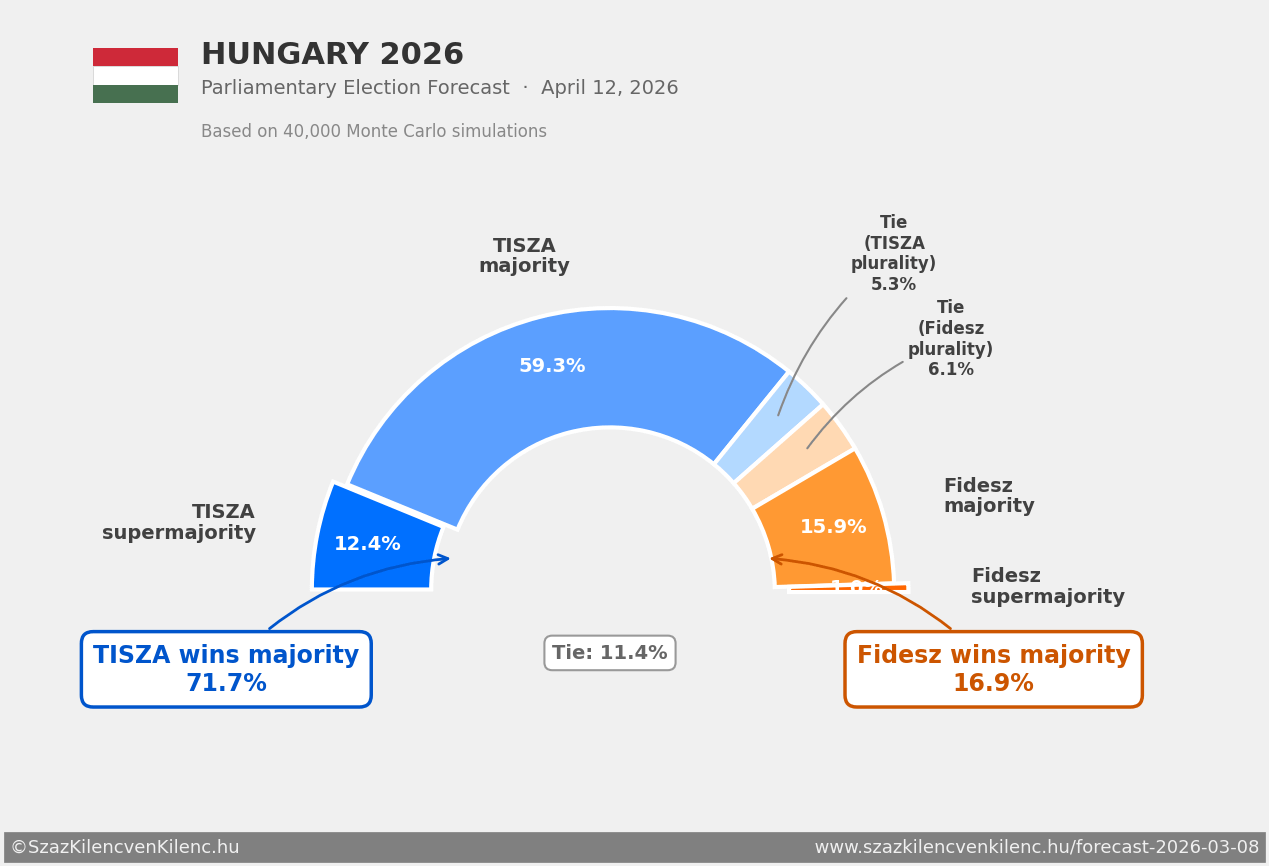
Last month I posted my 40,000 Monte Carlo simulations of Hungary’s upcoming election. It was 50/50. One month later, everything has changed. [OC]
Posted by Exciting-Lab1263

![Last month I posted my 40,000 Monte Carlo simulations of Hungary's upcoming election. It was 50/50. One month later, everything has changed. [OC]](https://www.byteseu.com/wp-content/uploads/2026/03/8qrozzsjyung1-1024x699.png "Last month I posted my 40,000 Monte Carlo simulations of Hungary’s upcoming election. It was 50/50. One month later, everything has changed. [OC]")
Last month I posted my 40,000 Monte Carlo simulations of Hungary’s upcoming election. It was 50/50. One month later, everything has changed. [OC]
Posted by Exciting-Lab1263
7 Comments
A month ago I shared my election forecast here and it sparked a lot of debate. Since then, new polls came in, the model was updated (Chronicler-v2 → v3, soon to be open-sourced), and the election got one month closer.
The shift:
||Feb 9|Mar 8|Change|
|:-|:-|:-|:-|
|TISZA (opposition) majority|50.6%|71.7%|+21pp|
|Fidesz (Orbán) majority|45.0%|16.9%|-28pp|
|Deadlock|4.4%|11.4%|+7pp|
|Mi Hazánk enters parliament|26.4%|72.8%|+46pp|
It’s no longer a coin flip, TISZA wins the most seats in 77% of simulations. But the wild card is Mi Hazánk (far-right): if they cross the 5% threshold, they become a potential kingmaker and the deadlock probability nearly triples.
**Tools:** Python, PyMC, matplotlib.
Data: from the Vox Populi polling database [www.kozvelemeny.org](http://www.kozvelemeny.org)
Full analysis: [https://www.szazkilencvenkilenc.hu/forecast-2026-03-08/](https://www.szazkilencvenkilenc.hu/forecast-2026-03-08/)
Methodology: [https://www.szazkilencvenkilenc.hu/methodology-v2/](https://www.szazkilencvenkilenc.hu/methodology-v2/)
Previous forecast: [https://www.reddit.com/r/dataisbeautiful/comments/1r4pi48/i_ran_40000_monte_carlo_simulations_of_hungarys/](https://www.reddit.com/r/dataisbeautiful/comments/1r4pi48/i_ran_40000_monte_carlo_simulations_of_hungarys/)
Happy to answer questions about the model, the methodology, or Hungarian politics.
Thanks for sharing, and good luck for the long overdue Fidesz dumpster slamdunk.
Got to fish a bit of context, and… what the duck
So, you can choose between Orban, his KDNP friends, far right NHM, a small center-left party but allied with former-far-right-into-center-right Jobbik, and the leading guys are a center right party led by… a former Orban friend.
Any left left, depressing pun intended?
That´s if the election happens without corruption/interference …
Great to see an update on this!
I don’t know much about how this kind of modelling works but I am keen to understand more. Since you seem to be sharing this with [a dissemination mindset](https://www.szazkilencvenkilenc.hu/methodology-v2/) (and not just another “election poll”), I think it would be a boon to your work to add more details to the methodology page. In particular:
– Explain the how the hierarchical Bayesian model works in your case. An illustration could strengthen the case here.
– Explain the time-series model.
– Give details about the parameters and choices (e.g., the house-effect prior, the bias, why the Dirichlet observation model).
About the simulation and the result I found confusing that the methodology is to first generate a possible election result and then run the election system and seats: isn’t the election result and the seats the outcome of the election system?. It would be nice to clarify this and what are the stochastic inputs to the Monte Carlo simulation itself.
Ultimately sharing the code itself would make all this more understandable.
Thank you for your time in making this 🙂
I find this presentation a little confusing? It looks exactly like how legislative results are displayed, I’ve never seen it used to express probabilities. Initially I thought the opposition was on track for a supermajority.
What happened to give TISZA now a polling lead?
Are plurarities better for tisza or fidesz?
If fidesz gets a plurality will tisza still be able to get coalition gov?