
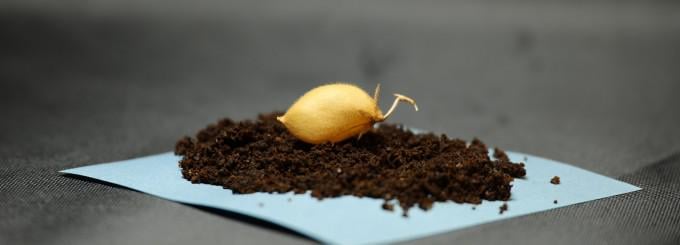
A new study published in Scientific Reports suggests a viable path for sustainable food production on the Moon. Researchers at Texas A&M University have successfully cultivated and harvested the 'Miles' variety of chickpeas using a mixture of simulated lunar regolith and organic amendments.
To overcome the harsh, nutrient-deficient nature of lunar soil—which often contains high levels of heavy metals—the team utilized two key biological helpers:
- Vermicompost: Produced by earthworms from mission waste (food scraps, cotton clothing, etc.) to provide essential microbes and nutrients.
- Arbuscular Mycorrhizal Fungi (AMF): A symbiotic fungus that assists plant growth while reducing the absorption of toxic metals like aluminum and zinc.
The Result: Plants treated with both fungi and compost flowered and produced chickpeas even in a mix of 75% lunar simulant. Their growth was comparable to a control group grown in commercial potting mix. This indicates that Earth-based organic farming strategies could be effectively adapted for extraterrestrial environments.
The next phase of research will focus on analyzing the nutritional content and checking for any heavy metal accumulation to ensure the chickpeas are safe for human consumption.
Reference: https://www.dongascience.com/en/news/76630?utm_source=reddit&utm_medium=social&utm_campaign=space
https://i.redd.it/s0sje8z56xng1.jpeg
9 Comments
This is a big important step. Taking a dead space body and turning it into viable soil is key to space colonization. But it also means worms, bugs fungus and a whole host of bacteria will need to become aatronauts as well. I have always imagined an entire section of a potentual station as a bio-recycling facility. Mechanical life support alone is not enough.
Link to (paywalled) publication https://pubmed.ncbi.nlm.nih.gov/41786794/
Really interesting work. Regolith isn’t easy to work with much less grow in, its that nasty. Always figured it was good for nothing except melting and separating in bulk.
That’s incredible, hopefully next they’ll try to grow a garbanzo bean
I wonder if the texture of true lunar regolith was taken into account in any capacity. It’s incredibly sharp and abrasive, I wonder if that would score or otherwise cause damage to root radicles, or any of the microbiota. I wouldn’t doubt it would act like diatomaceous earth for tiny soil critters that come in with the compost they helped process.
No real surprise to find out that you can use moon grit as a soil filler. The removal of heavy metals isn’t really that difficult, but it’s nice to now they have a plan for it. I wonder, though, how they’re going to overcome the obstacles of gravity differences.
Never thought I’d see a chickpea in space in my lifetime.
No poop needed? This is so disappointing as martians aside, it’s what space colonies will have plenty of.
Moon hummus. Alright then.