
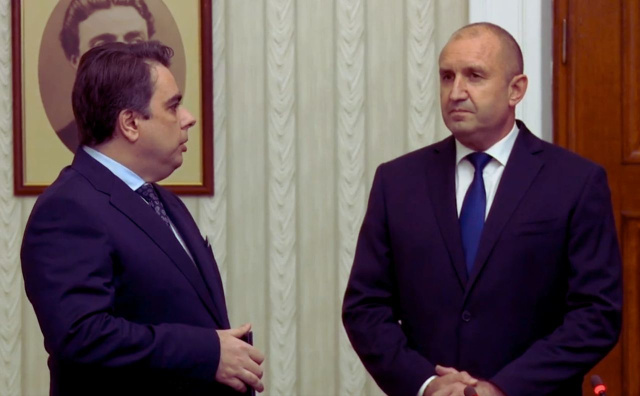
Vassilev (left), Radev (right)
Asen Vassilev, leader of We Continue the Change (WCC), did not rule out a potential partnership with Rumen Radev’s political formation to advance judicial reform and elect a new Supreme Judicial Council.
Addressing questions about possible coalition partners in the next parliament, Vassilev emphasized the need for 121 votes from Bulgarian citizens. He noted that whether these votes are granted depends entirely on the electorate, adding that Bulgaria requires deep reforms that cannot be achieved through traditional coalitions. “We need true justice. To achieve this, a Supreme Judicial Council must be elected with 160 votes, without the involvement of GERB and DPS. Here we can now work with President Radev,” he explained.
When asked if reaching 121 MPs was realistic or more of a goal, Vassilev insisted it was an achievable target. “If we want Bulgaria to finally move forward and dismantle the system that fosters corruption and poverty instead of justice, this is the way,” he said.
On financial matters, Vassilev reaffirmed WCC-DB’s support for extending the Budget Law. He described it as a straightforward measure with just four paragraphs, ensuring continuity until a new budget is adopted. The extension allows the caretaker cabinet to sign contracts, including for EU defense funds under the SAFE mechanism, which will later require ratification by the next parliament. “If it is adopted by March 31, we are on schedule. Its approval is realistic,” he concluded.
Meanwhile, former Bulgarian President Georgi Parvanov (2002–2012) sharply criticized President Rumen Radev’s conduct, describing him as silent, condescending, and lacking character. Parvanov suggested that Radev’s restrained approach during the campaign may yield short-term gains but is unfit for leadership. He referenced Radev’s participation in March 3 celebrations in Stara Zagora with local officials, framing it as a display of subservience inappropriate for the head of state.
Parvanov also reflected on coalition governance, noting that today’s political environment differs significantly from the era of the triple coalition he experienced. While he personally supports coalition governments, he highlighted that modern coalitions lack the culture of compromise and collaboration he remembers. He warned that the caretaker cabinet appears structured to favor one party, which could make it difficult to remove party-aligned officials from key positions in future governments.
On the fairness of upcoming elections under caretaker Prime Minister Andrey Gyurov’s administration, Parvanov expressed skepticism. He cited actions within the Ministry of Interior as a source of concern, suggesting that the current setup may undermine electoral integrity.