
https://www.theguardian.com/commentisfree/2013/jan/30/women-childcare-liz-truss
"And since the government appears to favour European examples, let’s give some. In Finland and Norway parents are entitled to a universal cash-for-care benefit if they care for young children at home rather than use publicly funded daycare. In Norway, 68% of parents with under-threes welcomed this as freedom of choice even when they didn’t apply themselves. In Finland, more than 50% of mothers with children under three apply for the benefit."
So for context: the author Selma James is an advocate for "Wages For Housework" in which women are compensated for domestic labour in a relationship. She argues this is preferable to daycare, and this would lessen the power imbalance between the man and the woman in a relationship. She doesn’t cite the statistics she mentions though.
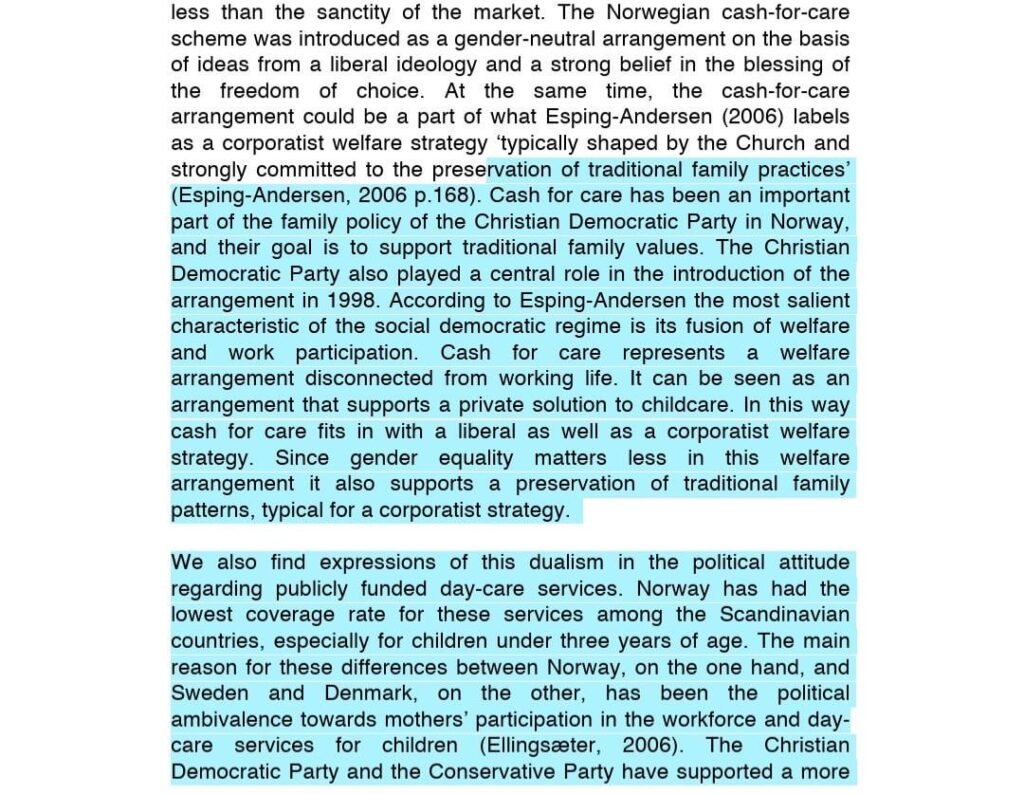
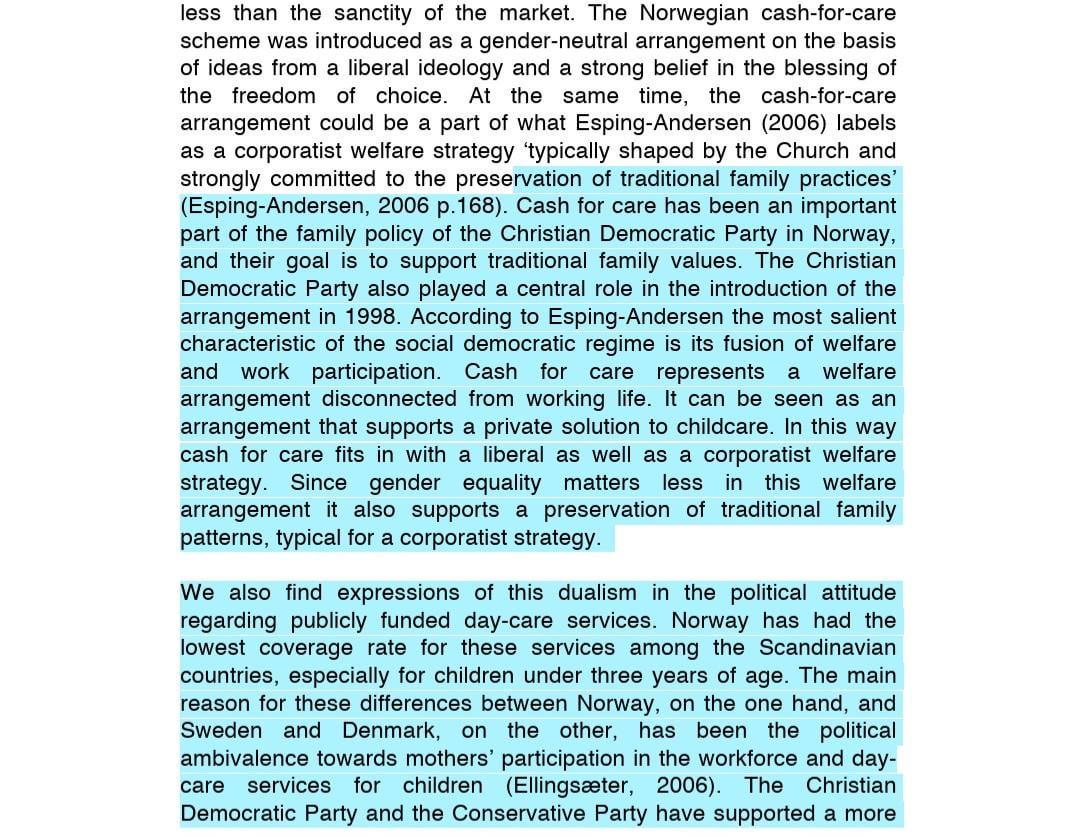
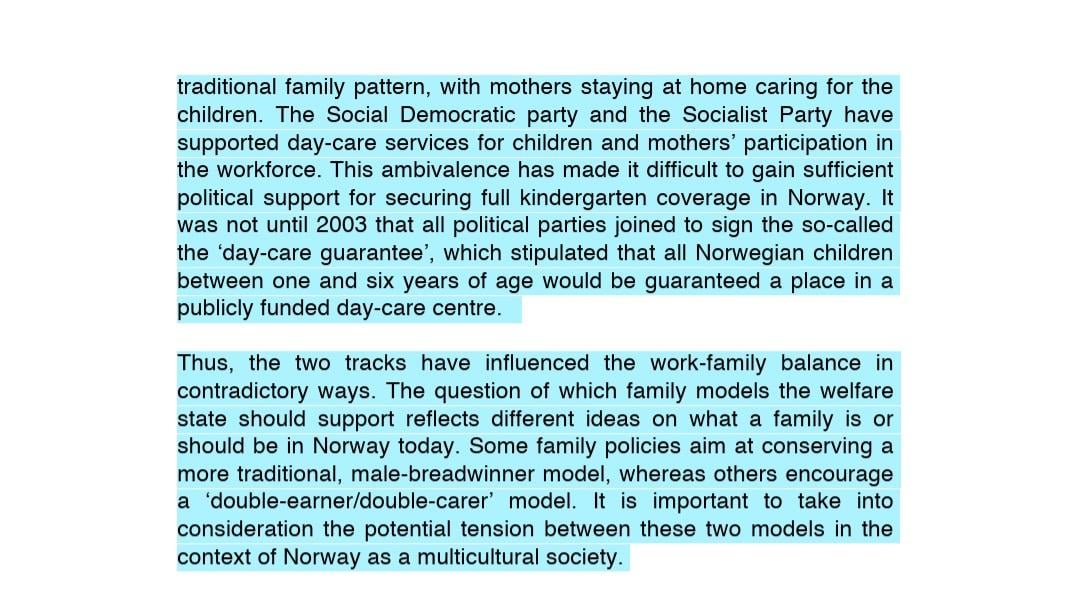
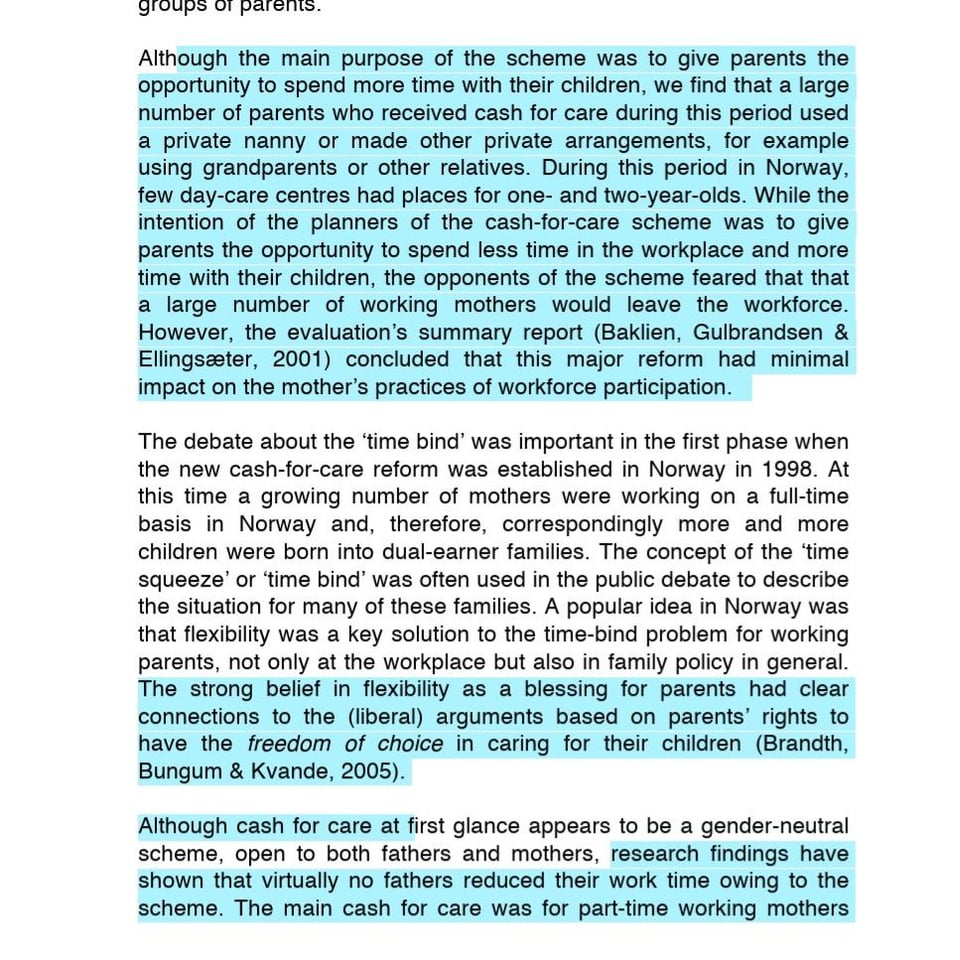
However, a study I found called: "The rise and fall of cash for care in Norway: changes in the use of child-care policies" claims this reinforces gender roles and is used by women mostly despite the gender neutral intention.
https://www.scup.com/doi/10.7577/njsr.2065
So what is the truth? Is this scheme still used?
https://www.reddit.com/gallery/1rotaxf
Posted by confusionandconflict
5 Comments
This is sort of correct. You can choose to receive money instead of using subsidized child care. However, this is not common and is only by approximately 12% and has been decreasing substantially.
There is such a scheme called “kontantstøtte” [https://www.nav.no/kontantstotte](https://www.nav.no/kontantstotte)
It seems to be limited to children between 13 and 19 months,
They have changed it several times, and it seems to have been much more favourable previously.
> So for context: the author Selma James is an advocate for “Wages For Housework” in which women are compensated for domestic labour in a relationship. She argues this is preferable to daycare, and this would lessen the power imbalance between the man and the woman in a relationship. She doesn’t cite the statistics she mentions though.
> However, a study I found called: “The rise and fall of cash for care in Norway: changes in the use of child-care policies” claims this reinforces gender roles and is used by women mostly despite the gender neutral intention.
Yes, terms of the debate in Norway, the provision of cash support is criticised on the grounds that encouraging women to be out of employment for longer periods exacerbates gender inequality (and presumably power imbalances in relationships). As you write, while the policy is in theory gender neutral in practice it’s very rarely used by men. The cash support tends to be advocated by conservative and Christian parties.
There is though wider support now for it to be used as a bridging benefit if the parents have to wait long periods for a kindergarten place to be available.
This anachronistic family scenario, the man as the breadwinner and the woman at home, is very outdated in both Norway and Finland.
All tasks are shared equally, shopping, cleaning, cooking, by two parents who both work.
It has to be this way, because a single income is no longer sufficient. Both have to bring home money.
The anachronistic family was brought back by two groups:
1. Norwegian Christian traditionalists who want to turn back time.
2. A large number of MENA immigrants who start out with a lot of help from the state, and also manage a more frugal lifestyle.
The “cash for care scheme ” (kontantstøtte, lit. cash support) was proposed by the Centre-Right Bondevik I government in 1998, from the principle set out in its accession declaration that families should have choice in how to care for their preschool children, and that the government should not only fund the option the government preferred.
As originally envisioned, the state would pay the family the equivalent to the government support for one full-time space in a kindergarden (in 1998 approximately 36 440 NOK per year), for children between 1 and 3 years of age. The scheme has been severely limited from its original vision and is now more or less envisioned as a stopgap measure between the end of new parent benefits and the earliest opportunity for the child to start in kindergarden.
The scheme has, as is the norm for such schemes, mainly been used by women. Approximately 18 % of current recipients are men. The number of total recipients has been reduced by more than 70 % over the last ten years.
Wages for Housework is an interesting argument. However, if you’re arguing that the _state_ should provide the wages in question, rather than the person who actually benefits from the housework, you are rapidly heading into the territory of gender-based UBI.