
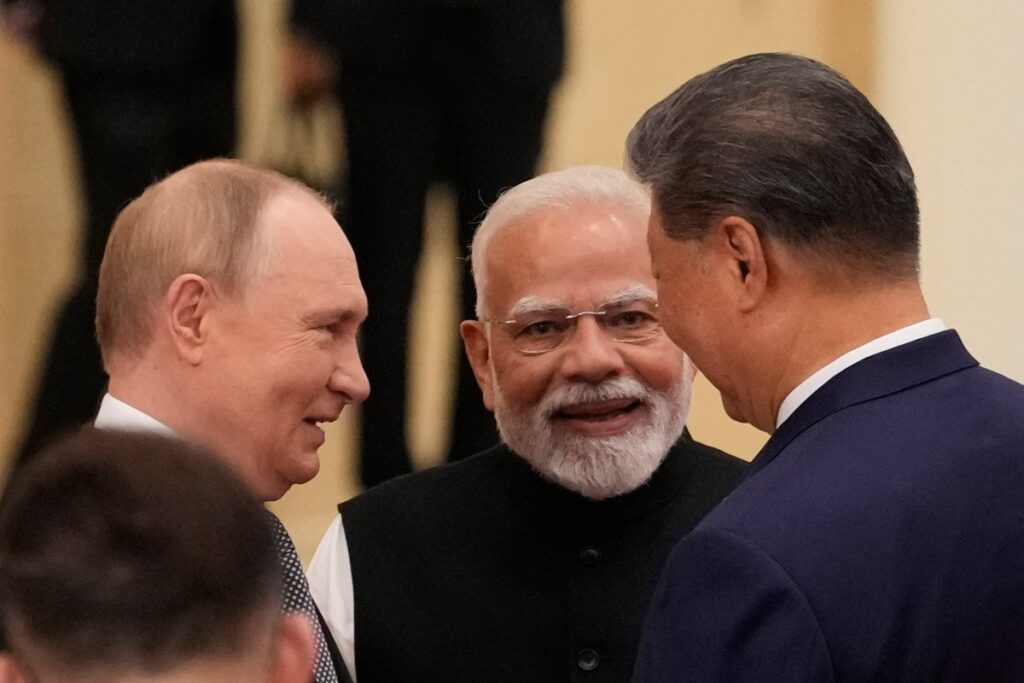
When the United States and Israel launched strikes on Iran, the reaction from the countries often described as part of a rising anti-Western bloc led by Russia and China was strikingly uneven.
Under India’s chairmanship, the BRICS grouping, which has expanded to 11 members including Iran, failed to produce a unified response to the conflict.
Russia and China responded with strong rhetoric but offered no coordinated action. Moscow condemned the attack as an “unprovoked act of armed aggression” and called for diplomacy, while Beijing warned that the war “should never have happened.”
India, which chairs the BRICS group this year, took a different stance. New Delhi avoided criticizing the U.S. and Israel’s strikes while expressing concern about Iran’s retaliatory attacks. South Africa was also cautious, warning about escalation without naming any country.
The absence of a coordinated BRICS position was particularly notable because Iran joined the bloc in 2024.
The Russia-China-led geopolitical axis remains far looser than its rhetoric suggests, while Donald Trump’s confrontational foreign policy has repeatedly revealed the structural limits of that alignment—here’s how:
1. BRICS Is No NATO
Since its creation in 2009, BRICS has often been portrayed as the foundation of a rising anti-Western coalition. In reality, it is nothing like NATO. The group has no collective defense pact, no joint military command and no shared foreign policy. It was designed primarily as an economic forum for emerging markets, not a security alliance capable of responding to wars or crises.
The limits of that structure have been clear during the U.S.—Israel war with Iran. While some BRICS members condemned the strikes and others called for dialogue, the bloc has been unable to take any coordinated action. The conflict has even exposed tensions inside the group itself. In a striking irony, Iranian missiles and drones have hit the United Arab Emirates—another BRICS member—while the wider conflict has disrupted key regional trade routes and put the energy security of several members at risk.
BRICS may talk about reshaping the global order, but it lacks the unity and institutions needed to defend one.
2. Divergent National Interests
A major weakness of the Russia-China axis is that its members have very different priorities. China’s global strategy depends heavily on economic growth and stable trade. When geopolitical crises escalate, especially those involving sanctions or military conflict, Beijing tends to act cautiously to protect its access to global markets. Trump’s readiness to impose sanctions or threaten military action has often pushed China into a defensive position. Instead of strongly backing Russia or other partners, Beijing has usually focused on avoiding economic shocks that could harm its own economy.
Russia’s situation is very different. Moscow has tried to present its partnerships with China, Iran and others as a powerful counterweight to U.S. influence. But when tensions with Washington rise, those partnerships often show their limits. For example, Russia has struggled to rally strong support from its BRICS partners during its war on Ukraine.
Many countries that criticize Western power still avoid actions that could trigger U.S. sanctions or diplomatic retaliation.
India, for example, has responded cautiously to the Iran war. New Delhi has largely complied with U.S. pressure to stop buying Iranian oil and has also reduced imports of Russian crude in recent years. It has also stepped back from deeper economic cooperation with Iran, including plans linked to the Chabahar port project, amid concerns about U.S. sanctions.
Brazil condemned the strikes on Iran and is urging diplomacy, while avoiding direct alignment with either side in the conflict.
These different priorities make it difficult for the group to act together. Russia may seek geopolitical confrontation, while China focuses on economic stability, and other partners prefer to avoid direct conflict.
3. US Global System Still Dominates
Despite Russia’s aims of creating a “multipolar world,” many countries that oppose U.S. influence remain tethered to the global system led by Washington and its allies. The U.S. dollar still dominates international trade, and Western financial networks control much of the world’s payments and sanctions enforcement.
BRICS countries have discussed creating alternatives, such as new payment systems that avoid the dollar, but progress has been slow. Because of this, many governments critical of the United States avoid actions that could trigger sanctions or financial isolation.
4. Trump Deploys American Military and Economic Might
The United States still holds a major advantage in global power, combining military strength with financial leverage. Trump’s strategy relied heavily on this imbalance, using sanctions, military deployments and economic pressure to confront rivals. With nearly $1 trillion in annual defense spending and a global network of hundreds of overseas bases, the U.S. military remains by far the most powerful in the world.
In the build up to the Iran war, Washington moved carrier groups, bombers and other forces into the Middle East to strike Iranian targets and control key sea lanes. At the same time, the administration was tightening pressure elsewhere. The U.S. imposed a naval blockade on Venezuelan oil shipments and increased sanctions and restrictions targeting both Venezuela and Cuba.
The message was clear: the United States can act quickly and independently across multiple theaters. Russia and China, by contrast, lack a formal alliance system capable of coordinating a unified response.
5. The “Axis” Often Consists of Weak States
Much of the broader anti-Western camp aligned with Russia and China, countries such as Iran, Venezuela and Cuba who have all been directly targeted by Trump’s pressure campaigns, consists of heavily sanctioned or economically fragile states. Their cooperation often centers on evading sanctions, using shadow shipping networks and offering diplomatic support, rather than building any real military alliance.
Instead of forming a rival global system, these countries often function as survivalist economies linked mainly by pressure from Trump’s sanctions and military threats, or even action.
Iran War Shows Limits of Russia-China Axis
Taken together, the response to the Iran war highlights the limits of the so-called Russia-China axis. When the United States and Israel struck Iran, BRICS could not produce a unified response, even though Iran itself is now a member. Some countries condemned the strikes, others called for dialogue, and several avoided taking sides altogether.
That division shows that BRICS is no NATO. The group has no collective defense pact, no joint military command and no common foreign policy. It was created as an economic forum for emerging markets, not a military alliance.
Its members cooperate when their interests overlap, but quickly diverge when conflicts threaten trade, energy supplies or relations with Washington. For all the talk of a “multipolar world,” the bloc remains a loose economic grouping of states, not a unified strategic coalition.
Hey gang, Carlo Versano here. I hope you enjoyed this article. As Newsweek’s Director of Politics and Culture and editor of the 1600 newsletter, I’m keen to hear what you think. Now, Newsweek is offering a new service to allow you to communicate directly with me in the form of a text message chat. You can sign up and get a direct line to me, as well as the reporters who work for me. You can shape our coverage.
As a Newsweek member, we’re offering this service to you for free. You can sign up below, or read more about how it works here. Let’s talk!