
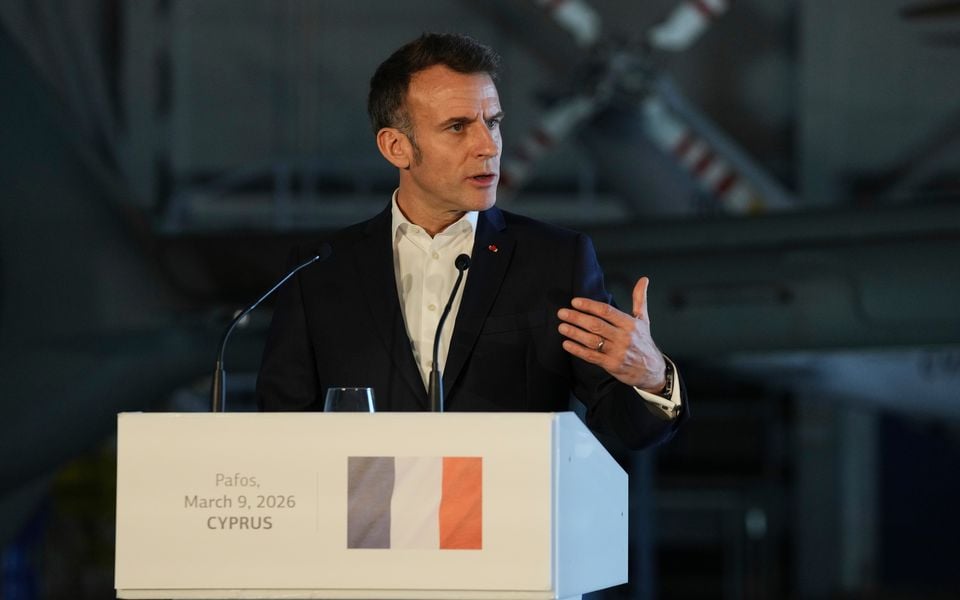
French President Emmanuel Macron speaks during a news conference joined by Cyprus President Nikos Christodoulides and Greece’s Prime Minister Kyriakos Mitsotakis at Andreas Papandreou Air Base in Paphos, Cyprus, on Monday. [AP]
The leaders of France and Greece, meeting with the Cypriot president on Cyprus, pledged Monday to defend the European Union island republic against any attack amid the US and Israeli bombardment of Iran.
French President Emmanuel Macron voiced “full solidarity” with Cyprus, where a suspected Iranian retaliatory strike with a drone hit a British military base this month causing minimal damage and no injury.
In response to the drone hit, Greece and France have sent warships and other military assets to the eastern Mediterranean island, while other EU members have pledged similar support.
“When somebody attacks Cyprus, they attack the whole of Europe,” Macron said after his talks in the western port city of Paphos with Greek Prime Minister Kyriakos Mitsotakis and Cypriot President Nikos Christodoulides. “We stand at your side.”
Mitsotakis said the three leaders’ meeting “sends a joint, clear, loud and decisive message of unity and solidarity.”
“Cyprus, which is part of the European family, is not and never will be left alone,” he added. Greece has sent two frigates – including the newly-delivered, French-built Kimon – and four F-16 fighter jets to Cyprus, the first of the country’s EU partners to send military assets, and the nearest.
“It is a matter of historic significance that the Kimon’s first mission should be here,” Mitsotakis said.
Macron, whose navy already provides one warship to t the EU naval mission Aspides in the Red Sea, said there would be two in total, but that in all France would deploy eight warships, an aircraft carrier group and two helicopter carriers to the region.That could ultimately include the Strait of Hormuz to support commercial vessels, Macron said.
“We are in the process of setting up a purely defensive, purely escort mission, which must be prepared together with both European and non-European states, and whose purpose is to enable, as soon as possible after the most intense phase of the conflict has ended, the escort of container ships and tankers to gradually reopen the Strait of Hormuz,” Macron said, without elaborating.
He added that France would seek common action at the G7 group of leading economies to address worries about the emerging energy crisis as oil prices spike among the war in the Persian Gulf.
Mitsotakis voiced concern over the potential effect of the fighting on migratory flows towards Europe, as Greece is on key illegal migration routes from Turkey – as well as from north Africa – towards the continent. He also stressed the need to support the government of Lebanon, among Israeli attacks on the war-weary country, and said large-scale ground operations in southern Lebanon should be “avoided.”
Cyprus’ Christodoulides insisted that his government would not become involved in military operations.
“For the past 52 years, our country has paid the price of war, we are the victim of an illegal invasion,” he said, referring to the Turkish invasion in 1974 which followed an abortive coup by supporters of union with Greece. Ever since, the island has been ethnically divided, with the internationally-recognized Greek-Cypriot government in the south and a breakaway Turkish-Cypriot state in the north.
“Our every step aims at security, peace and prosperity,” Christodoulides added.
This story has been updated.