
On March 9, 2026, Pope Leo XIV received in an audience the members of the tripartite presidency of Bosnia and Herzegovina, composed of Croatian Željko Komšić, current chairman of the presidency, Bosnian Denis Bećirović, and Serbian Željka Cvijanović. They then met with Archbishop Paul Richard Gallagher, Secretary for Relations with States, in the absence of Cardinal Pietro Parolin, who is currently on a trip to Burkina Faso.
During the talks held at the Secretariat of State, “the parties expressed their satisfaction with the good bilateral relations” between the Holy See and Bosnia and Herzegovina, according to the Vatican. The participants agreed on “the need for inclusive and constructive dialogue in order to ensure the stability of the country and the juridical and social equality of all its constituent peoples.”
“Lastly, there was an exchange of views on several regional and international matters, including peace and security in the Western Balkans and the repercussions of the ongoing conflicts in Ukraine and the Middle East,” the statement added.
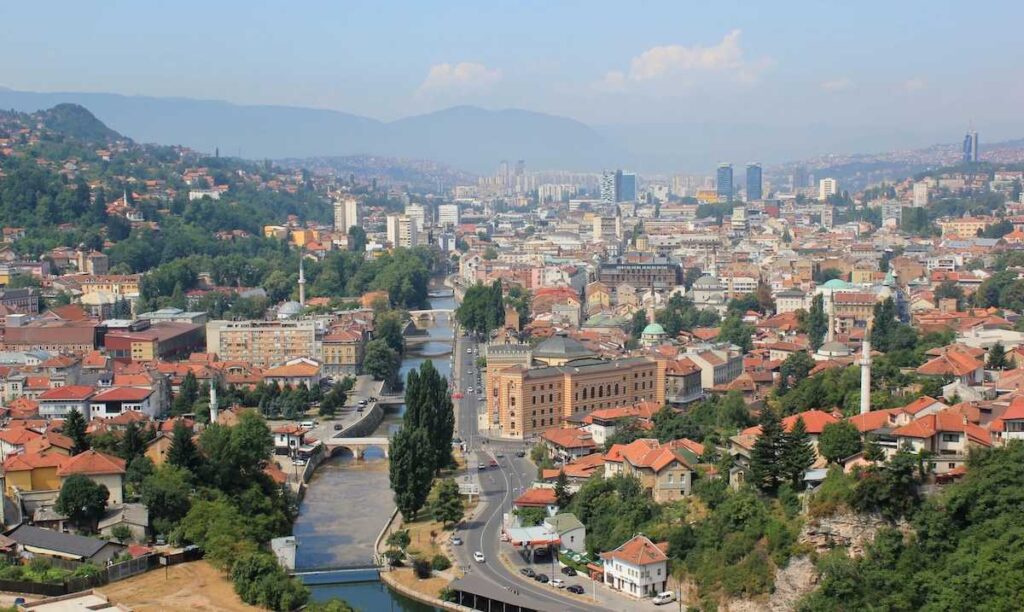
The Balkan countries are the subject of particular attention from the Holy See, which continues to encourage their stabilization and European integration. Papal diplomats frequently travel to the region. On June 6, 2015, Pope Francis visited Sarajevo, the capital of Bosnia and Herzegovina.
The nation is the home of the popular Marian site Medjugorje.
A complex political system
Since the Dayton Accords ended the Bosnian war in 1995, this country, which emerged from the former Yugoslavia, has been ruled by a tripartite presidency intended to represent the country’s different ethnic and religious groups. Each of its members takes turns as president for very short eight-month terms in order to avoid any concentration of power.
The profiles of the current leaders show the nuances that can exist in terms of ethnicity: for example, the Serbian representative Željka Cvijanović, who was previously president of the Serbian Republic of Bosnia, herself has a Serbian mother and a Croatian father. President Željko Komšić, who represents the Croatian side, generally associated with the Catholic Church, claims to be a non-believer.
This system of executive power sharing has so far prevented the country from plunging back into war and violence. However, many observers believe that it also causes political deadlock and prevents the emergence of true leaders capable of making structural decisions for the future of this multi-ethnic country.
Bosnia and Herzegovina, which has been experiencing a steady decline in population since the end of the war, continues to be marked by high levels of emigration among young people, particularly to Germany, Austria, Croatia, and Slovenia.
The local Catholic Church, long led by Cardinal Vinko Puljic, who was Archbishop of Sarajevo from 1991 to 2022, has been particularly affected by this demographic erosion. Bosnian Catholics, whose numbers have halved since before the war, currently represent around 15% of the country’s population.