
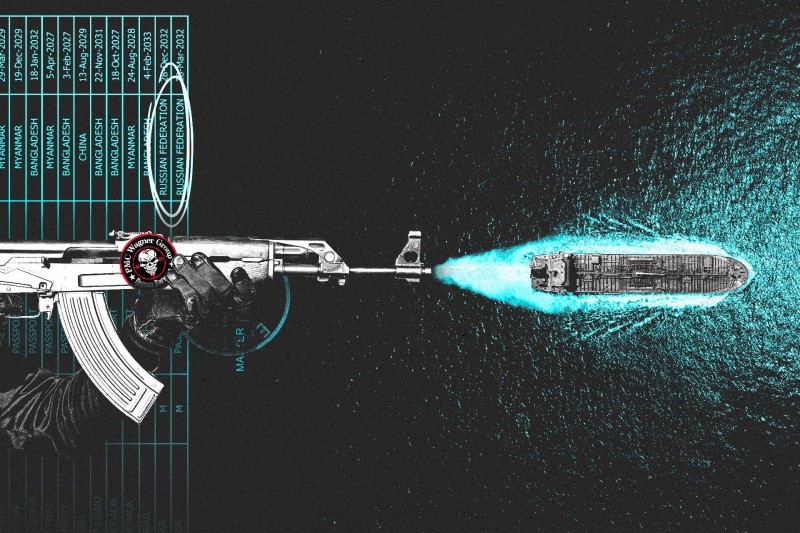
An analyst with the Finnish Security and Intelligence Service (SUPO) said that these Russian security teams are likely tasked with preventing the rest of their ship’s crew from complying with foreign authorities.
“The guards are likely on board to ensure that other Baltic Sea countries do not take control of these ships too easily,” the analyst told Helsingin Sanomat on the condition of anonymity.
They also may act as “liaisons” for those who hired them, the analyst added. “It can be assumed that if, for example, Russian military forces and naval vessels are operating in the same area and escorting these ships, then the task of these men may be to facilitate communication.”
Ukraine’s Foreign Intelligence Service told reporters these men are typically hired by the Russian private security companies RSB Group and Moran Security Group.
RSB Group, whose website says it has “protected tens of merchant and scientific Russian and foreign vessels,” employs former Russian intelligence officers and other combatants, and has trained units for the war in Ukraine, according to EU and U.S sanctions notices. Moran Security, which also offers a variety of maritime protection services on its website, has also been sanctioned by the U.S. for providing services to Russian state enterprises.
The companies did not respond to requests to comment.
Raising the Stakes
The deployment of these covert security agents on commercial vessels comes amid a marked increase in Russia’s direct military presence in the Baltic.
Last May, the Estonian Navy escorted the EU-sanctioned oil tanker Jaguar out of Estonian economic waters after it was found to be sailing without a valid flag.
Russia responded by sending a fighter jet that violated Estonian airspace.
“Russia sees the shadow fleet as a very important economic lever,” said Estonian Navy Commander Ivo Värk, adding Russia’s naval presence in the Baltic has quadrupled since 2022.
“For them, it is a matter of high national interest. Russia is prepared to protect this by all means.”
A high-ranking European intelligence officer who spoke on the condition of anonymity said the presence of security officials on the ships raises the stakes of any efforts to intervene in Russia’s oil trade.
“Two potentially armed individuals certainly changes [our] risk calculus when we must decide whether to stop or seize the tanker. Russia believes this makes NATO member states along the Baltic Sea more cautious,” the official said.
For Sean Wiswesser, a former CIA senior operations officer with a specialization in the Russian intelligence services and military, the trend suggests Moscow is also using its shadow fleet vessels as platforms for “sabotage” and “other intelligence operations, like potentially deploying drones.”
“It’s definitely not just about protecting Russia’s oil,” he said. “Nowhere else in the world have there been as many cable cuts, and in a short time, as there have been in the past two years in the Baltic Sea.”
Additional reporting by Kaur Maran, Greete Palgi, Marta Vunš (Delfi).