
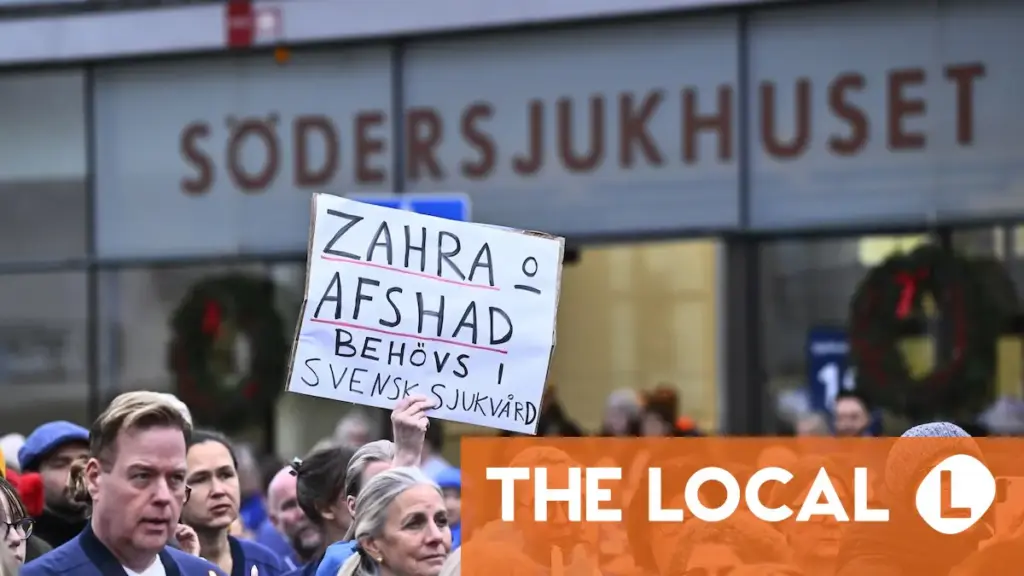
Readers of The Local have given the government’s agreement to reduce deportations a cautious welcome, although several expressed anger that it had taken so long to act and questioned how many people facing deportation would be allowed to stay.
Sweden’s Prime Minister Ulf Kristersson on Friday announced that the government had struck an agreement with the Sweden Democrats on a series of measures to reduce deportations of young adults and deportations of employed foreigners as a result of the abolition of the track change law.
“It’s a step in the right direction,” said a person who works in IT at Nordea bank, answering The Local’s survey. “It’s good because it will allow people who applied under track change to no longer be stripped of their rights.
“They came back to their senses,” said Khalid, who lives in Jönköping, adding that the decision would come as “a relief” to hard-working foreigners in Sweden.
“People who have lived all their lives in Sweden who have no real attachment to their parents’ homeland can now stay in their real home,” said Ernesto, a father of two who also lives in Jönköping.
As part of the deal, the parties agreed to include a “safety clause” in a coming law on family reunion whieh Kristersson said would stop the deportation of young adults who are still at upper secondary school.
The Migration Agency on the same day announced it would freeze rejection decisions for people up to and including the age of 21 who came to Sweden as dependents.
At the same time, it announced that people who have lost their right to renew their work permit due to the abolition of the track change law will be able to apply for a new work permit from within Sweden.
Advertisement
‘Too little, too late’
Other respondents, however, were more critical, with many arguing that the government was simply trying to neutralise a difficult issue ahead of the election campaign.
“It hardly gladdens the heart,” said an energy professional living in northern Sweden. “Too little empathy and humanity, delivered too late.”
“It’s good they have changed, but I think it is just a cynical ploy as it’s an election year,” said a retiree from Västerås. “There is no guarantee you will get residency and the Sweden Democrats are still trying to find ways to revoke permanent residency.”
“I’m glad to see temporary relief for affected families,” said Eric, a software engineer from the USA living in West Sweden. “I’m skeptical that there will be any long-term, fair solution. This was a strategically negotiated political off-ramp in an election year.”
Advertisement
A question of competence
Several readers argued that the government should never have abolished the track change law last year or removed the “safety clause” from the Aliens Act in 2023, which together caused many of the recent wave of deportations.
“The government needs to change its attitude,” said a person living in Uppsala. “Rushing through half-baked new laws and then having to make a U-turn really puts a question on the government’s competence.”
A gymnasium student living in Stockholm said she was angry that the government had taken so long to back down under pressure from the public and the media.
“I think this should have been approved when the news first started reporting about it,” she said. “Putting a stop to this should have been a no-brainer. I am ashamed at the system for removing young, well-integrated people for following a rule that the government itself told them to follow.”
A researcher in Lund pointed out that the government had been warned about the impact of the law changes before they were even enacted and chosen to push on regardless.
“The government tries to look as if it is listening to criticism at this point to maintain support before the election. However, all these concerns were expressed before these regulation came into force, and the government ignored this. It’s the same with the new regulation on citizenship. So I think, this is not enough.”
Advertisement
Media pressure
Several readers noted that the government had only decided to take action when the Swedish language media started reporting on the deportations.
“They just got worried that people would start looking into their migration policy. When the typical ‘Svensson’ was not aware, they were happy.” said a person living in Malmö. “Now due to the media coverage they just pissed their pants.”
“I am quite surprised that it has not been better covered in the Swedish news,” said a researcher. “I work for a Swedish university, and I’m shocked at the high number of colleagues who are completely unaware of this.”
“Although it has come too late for me and my son to benefit from it ourselves, it is good that all the efforts The Local made will be beneficial to many families and also the Swedish society,” said Ehsan. “Kudos to you guys for your professionalism!”
Hopes for a solution
Of the 22 readers who responded to our survey, five said either they or a member of their family had been threatened with deportation, either as a result of the abolition of track change or the teen deportation issue. Several said they believed that the reforms would help.
“I’m hopeful,” said the spouse of a scientist at the European Spallation Source in Lund. “I want to be processed under the rules I applied under and not forced to start over.
“A friend that works at Ikea maybe now won’t be forced to leave if their child gets deported,” she added.
Yuliya, an engineer, said she now hoped to apply for a permanent residency permit next year together with her 19-year-old son.
“I hope the law will be changed so we can apply together for permanent residence permit, as he is still in gymnasium for couple more years and fully depends on me.
Advertisement
Needs to go further
Although the measures announced will certainly help some people, it’s still unclear how many will be able to stay. At the press conference, Kristersson suggested that only young adults who were still at upper secondary school would be protected by the safety clause.
Readers suggested it should be more far-reaching.
“They should protect all the dependent teens in the school and universities until they finish their education,” said a software engineer from outside the EU with a teenager at university. “Finishing university education takes you up to around 23 or 24 years of age. They government should protect them as well. They are the future of Sweden’s economy.”
Others said that some of those who have already been deported should be given a way to return to Sweden.
“This is a half-measured solution,” said a person who said they had been personally affected by the abolition of track change. “They are only doing it for the votes. If they actually cared then they should also bring back those who got deported.”
“I’m cautiously optimistic that it means those affected now will not have to leave Sweden immediately, but I’m worried that in the long term the problem won’t be solved,” said one person who said they were not personally affected.
Advertisement
Repeating the same mistakes
While the retreat on teen deportations and track change was welcome, readers worried that the government was continuing to make similar mistakes in the way it plans to change citizenship requirement without transition rules.
From June 6th, Sweden’s National Day, Sweden will extend the required residency to be eligible for citizenship from five to eight years in most cases, require applicants to demonstrate knowledge of Swedish language and society, and require them to meet new self-sufficiency requirements.
“Established, working immigrants in Sweden face a great deal of uncertainty right now, with major changes to citizenship law and other reforms soon to come into force,” said Eric. “Even if it won’t result in a person being forcibly removed from the country, it does no one any good to keep putting immigrants in the line of fire.”
A researcher based in Uppsala said they were worried that the government had not yet shut the door on a radical proposal to revoke the permanent residency permits held by over 100,000 people.
“It is disappointing that the government keeps bringing revoking permanent residency back onto the table,” they complained. “What does this solve? It is basically making my ‘permanent residence permit’ a ‘temporary permanent residence permit’.”
His country, he explained, does not allow dual citizenship meaning that if the proposal is ever enacted, it will put him in a difficult position.
“I’m just super frustrated that the SD have not given up on revoking PR after all the backlash. In some sense the PR, to me, is a promise that is given to me by Sweden that I have the right to stay in Sweden for as long as I want.
“I understand that in criminal cases retrospective law application is not permitted. Yet, what have we done so horribly wrong that the law retroactively applies for us? It seems we’ve done something worse than committing crime.”