
The world economy is facing “one of the worst energy crises in history” that could send oil prices soaring above $US150 a barrel, a leading analyst has warned, as New South Wales’s premier announced the nation’s biggest state was preparing for potential fuel shortages at hospitals and other essential services.
Amid growing community concern that the country would run out of fuel amid the escalating Middle East conflict, the Albanese government on Thursday announced a plan that would inject around 100 million litres of additional petrol.
Chris Bowen, the climate change and energy minister, said the distributor, Ampol, had agreed to prioritise supply to towns outside the major cities and in particular Queensland where supply shortages have been most acute.
The newly announced plan would temporarily relax fuel standard rules to put an extra 100 million litres a month into the system for a period of 60 days.
Chris Minns, the NSW premier, said a meeting of the energy, transport, police and emergency services departments had been convened “to look at emergency supplies and critical services in the weeks and months ahead”.
Minns said there was “no need for panic buying” by the public, which he identified as one of the causes of current shortages.
“I would just say to the people of New South Wales, of course you need to fill up, but just take what’s required. You don’t want to take it from a family member or a member of your community, particularly if you live in regional NSW.”
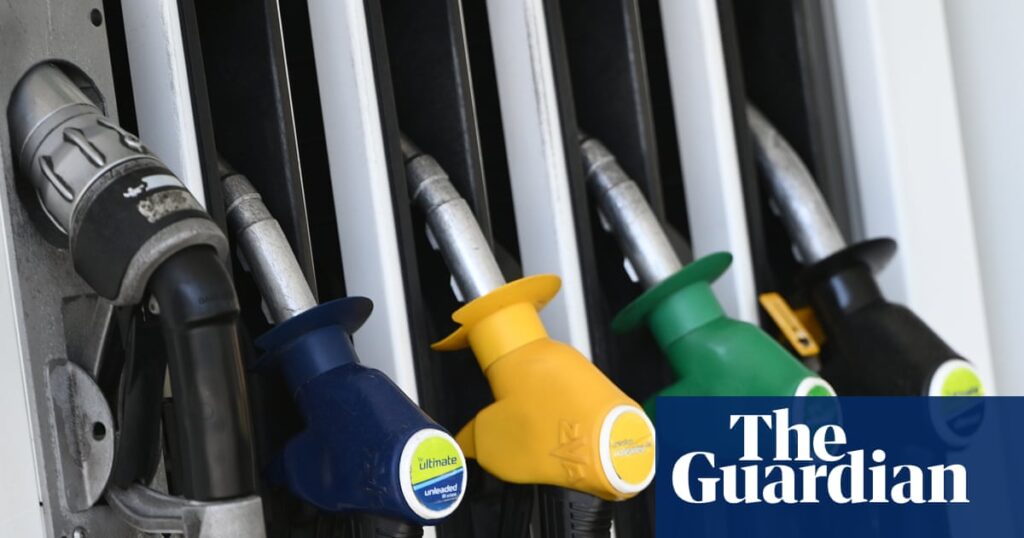
Motorists are already seeing fuel price increases of as much as 70c a litre for diesel since the start of the war on 28 February, as fears of climbing prices and even shortages triggered a rush on regional service stations that has left some empty.
Fuel spikes in regional centres
The dire warnings and emergency planning come as Brent crude, the international benchmark, jumped above $US100 after Oman evacuated all vessels from its key oil export terminal following the attack on two tankers in Iraqi waters.
Economists have warned that surging energy costs will unleash a wave of inflationary pressures that will hit consumers and force central banks to respond with higher interest rates.
Amid warnings inflation could push towards 5% by the middle of the year, ANZ became the last of the four major banks to predict the Reserve Bank would now deliver back-to-back rate hikes, starting at its next meeting on Tuesday.
The effective closure of the strait of Hormuz has choked off about 20% of the global oil trade, or about twice as much as the first gulf war at the start of the 1990s and nearly three times the disruption triggered by the 1970s Arab oil embargo.
As Iran escalated its attacks on infrastructure and transport networks, Vivek Dhar, CBA’s head of commodities, warned prices were likely to climb substantially further from here.
Dhar in a note to clients said the current shock was “unprecedented”, both in terms of the hit to oil supplies and the lack of spare capacity worldwide available as a buffer.
He warned that energy market players were underestimating the damage from a conflict that was more likely to last months, rather than weeks.
“If the conflict is not resolved and the strait remains closed, oil and refined product prices are at significant risk of rising to levels not seen in history,” he said.
“For context, the Arab oil embargo saw oil prices nearly quadruple – and that was when there was adequate spare capacity to cover the net shortfall.”
Daniel Hynes, a senior commodity analyst at ANZ, agreed that it was time to recognise that the damage from the Iran war was now “structural” rather than a short-term geopolitical event.
“Our previous analysis framed Middle East tensions largely as an event-driven risk, where oil prices responded to fear rather than realised supply losses. That distinction no longer holds,” Hynes wrote in a research note.
He predicted the Brent crude global benchmark price would be at $US100 a barrel by the middle of the year, as suppliers shuttered wells to protect reservoirs and workers.