
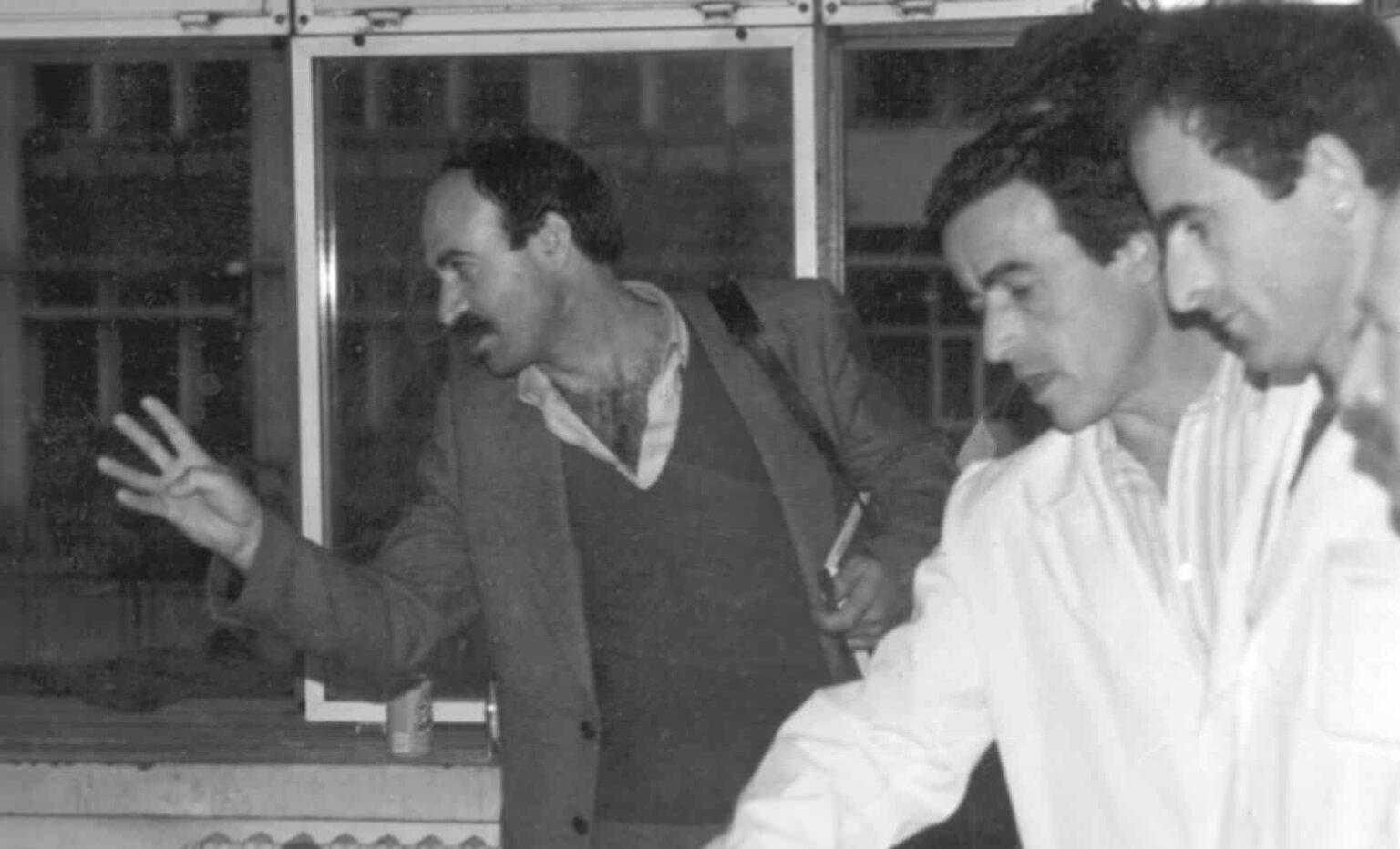
After the end of the war in 1999, he undertook a rare and courageous act: direct meetings with people who had participated in his arrest, torture, investigation, trial and sentencing during the 1980s.
“The purpose of these meetings was not revenge but the pursuit of truth,” he explains. He wanted to personally inform them that Kosovo is free and to tell them what he knew and they did not, while also listening to what they knew and he did not.
This was a genuine process of personal transitional justice, based not on punishment but on confrontation and illumination of the past, and on conveying the message that Kosovo’s society should not be built on hatred, but on truth and respect for suffering. “Reconciliation must first take place among Albanians, followed by discussions on Albanian-Serbian reconciliation,” he argues.
Cetta held no meeting without informing, beforehand and afterwards, members of the Association of Political Prisoners, as well as his friends and fellow sufferers.
He says such a process should have been led by state institutions. However, as he puts it, “in reality, individuals holding positions in Kosovo’s state institutions met with people from the former system not for justice, but to process them for their own needs and integrate them into their system”.
The end of the war did not bring an end to violence. In August 2000, nearly two decades after he was injured by Serbian police bullets at a student demonstration in Pristina, Cetta was seriously wounded in the town of Bajram Curri in Albania, while entering Kosovo.
According to Cetta, he was presenting a project aimed at ensuring that local power in Kosovo would be exercised by honest and professionally competent individuals, regardless of political orientation. He claims that the attempt on his life was the result of cooperation between Albanian state structures and parapolitical groups in Kosovo aiming to take power without popular legitimacy. “In 1981 I was wounded by Serbia; in 2000, I was wounded by the mafia,” he says.
Cetta’s story is not merely the story of a political prisoner but the story of an ethical stance that challenges both the violence of the oppressive system and the opportunism of Kosovo’s post-war society.
He did not seek revenge, did not become part of simplified victim narratives, nor did he exploit his suffering for political capital. Instead, he sought truth, confrontation, and moral responsibility, even when these demands were inconvenient for those in power and uncomfortable for society.
His path from student resistance, injury, long political imprisonment, early release, political activity in exile, contribution to Kosovo’s liberation, to confrontation with representatives of the repressive system, demonstrates that transitional justice is not only a matter of institutions but above all a matter of conscience. In the absence of state will to illuminate the past and clearly separate responsibility from victimhood, he chose to do so personally, openly and publicly.
For this reason, he remains a different kind of political prisoner – not because he suffered more or less than others, but because he refused to build his identity on hatred and silence.
His story still challenges us today with a fundamental question: do we want a society built on forgetting and compromise with injustice, or on truth, responsibility, and respect for human suffering?
Shkelzen Gashi has written several books on Kosovo’s recent history, including ‘Adem Demaci: Unauthorised Biography’ and ‘Massacres in Kosovo 1998-1999’.
The opinions expressed are those of the author and do not necessarily reflect the views of BIRN.