
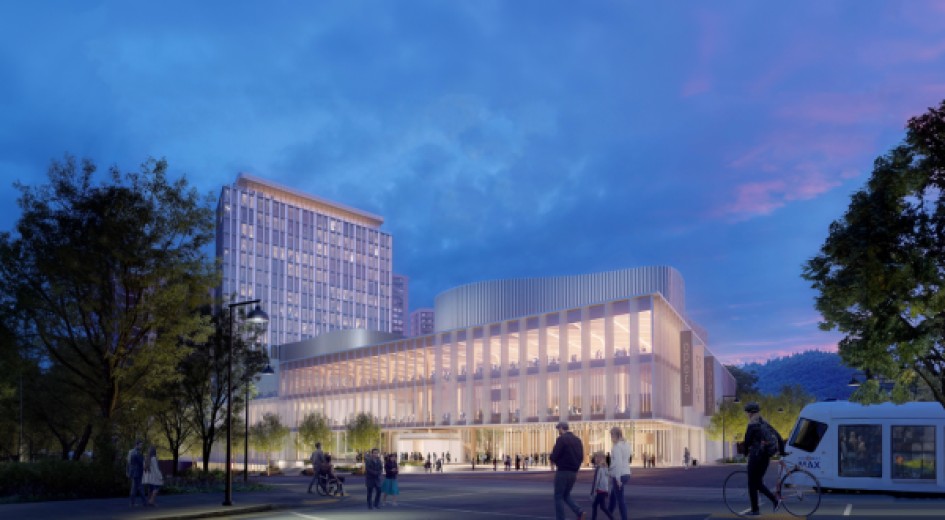
 Portland State University’s proposed Performing Arts and Culture Center, which would include a City-owned 3,200-seat hall. PSU photo
Should the Keller Auditorium, Portland’s premiere downtown large-scale performing arts center, be remodeled into a midsize venue that can no longer host the largest touring Broadway shows? That was the surprise compromise offered during a March 9 public hearing about whether a new City-owned 3,200-seat center should be built at Portland State University as part of a larger project that would include a smaller PSU-owned theater, new academic buildings, a new hotel, and parking.
The choice has divided the City Council and Portland residents, many of whom prefer renovating the Keller to building a new center at PSU. The compromise was offered by PSU Foundation President and CEO Sarah Schwarz during a meeting of the council’s Arts and Economy Committee. It was the first public hearing on a recent City-commissioned Market Feasibility Study that recommended building the new center at PSU and not renovating the Keller, which does not meet current earthquake standards and has other structural deficiencies.
During her testimony, Schwarz said PSU could reduce the size of its planned theater to between 800 and 1,200 seats, clearing the way for the Keller to be remodeled as a mid-size 1,500 to 1,800 seat venue.
“We can find a middle ground,” Schwarz said.
In response to a question from new Council President Jamie Dunphy (District 1), Chariti Montez, director of the city’s Office of Arts and Culture, said there is a need for such a facility in Portland. No one has yet researched converting the Keller to such a venue, however, she added.
 Keller Auditorium is home to the Broadway in Portland touring shows, which help pay for all of the city’s downtown performance halls. Above: Alysha Deslorieux (middle Allie) and Ken Wulf Clark (middle Noah) star at the Keller in the Broadway tour of The Notebook, playing through March 15. Photo by Roger Mastroianni.
The idea was rejected by Keller supporters after the meeting. They are so far firm that the City should renovate the Keller as a modern 3,000-seat performing art center instead of building a new one at PSU. Renovating the Keller, they say, would preserve an existing historic city asset, cost less, be more environmentally friendly, and would benefit the downtown economy more than a new one at PSU, which would be several blocks to the south.
“The City of Portland can’t afford to build a new 3,000-seat theater near PSU while also paying to renovate the Keller Auditorium into a smaller theater the city doesn’t need and the market can’t support,” said Elise Haas, spokesperson for the Save The Keller coalition. “This idea makes no financial or economic sense for a city already struggling to pay for basic maintenance of its existing infrastructure.”

The Arts and Economy Committee took no vote on the choice, which is still being studied by City-appointed advisory committees behind closed doors. Among the five committee members, Dunphy, a trained stage technician, spoke strongly in support of the PSU project and said the Keller will never be capable of hosting newer Broadway and other shows that are growing larger and more complex every year.
Councilors Olivia Clark (District 4) and Loretta Smith (District 1) were in favor of renovating the Keller. Co-Chair Dan Ryan (District 2) said the Keller should not be allowed to “go dark,” but did not endorse the PSU project. Only Co-Chair Mitch Green (District 4) did not take a stand.
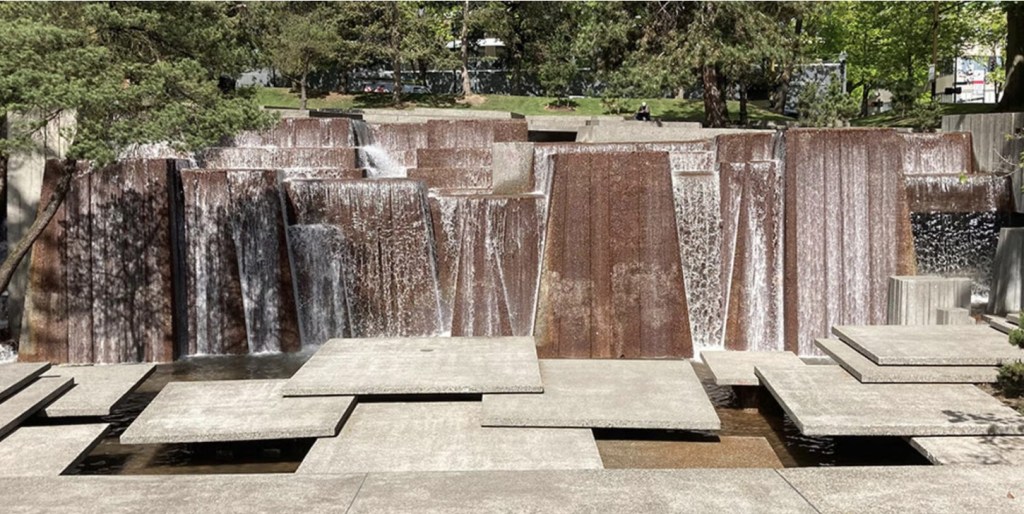 Keller Fountain Park sits directly across from Keller Auditorium, and many people think of the two as a package deal. The Halprin Landscape Conseratory, which supports the fountain, is propsing a complete remodel of Keller Auditorium rather than a new center at PSU. City of Portland photo.
Despite the lack of a vote, the exchanges hinted at the choices being discussed as the 12-member council that took office in January 2025 prepares to address more than $1 billion in arts, culture, and infrastructure needs about which they have yet to hold a full public hearing.
The cost of building a new center at PSU is estimated at up to $358 million, while a full renovation of the Keller is projected at $290 million. In addition to the City doing one or some version of both, the council recently learned that the three city-owned downtown buildings known as the Portland’5 Centers for the Arts need up to $336 million in deferred and scheduled maintenance.
All of the council members have been aware of these issues since they took office. But now Mayor Keith Wilson has also committed the City to at least $120 million in upgrades to the Moda Center that it also owns, as part of a $600 million package approved by the 2026 Oregon Legislature. NBA basketball’s Portland Trail Blazers are the Moda’s prime tenant. Yet-to-be-determined additional annual payments will also be required if the conditions set by state lawmakers are met.
During the meeting, Clark said she did not understand where the council would find the funds to do any of these things. She noted that the City is facing an estimated $66.9 million general fund shortfall in the budget that will take effect on July 1, 2026. That is in addition to other infrastructure needs, including an estimated $6 billion-plus deferred maintenance backlog at the Portland Bureau of Transportation. She is proposing that a new street fee be added to Portland water, sewer and stormwater bills to help close it.
“Where are we going to find the funds to do any of these things?” Clark said about the project discussed at the meeting. “I think we will have to live with the Keller as it is for a long time.”

Quick updates on the arts, culture and entertainment infrastructure choices:
Keller Auditorium and/or PSU Portland Arts and Culture Center
With about 3,000 seats, the Keller Auditorium at 222 S.W. Clay St. is the only venue in the region that is large enough and properly configured to host touring Broadway theater shows. It was built in 1917 and rebuilt and modernized in 1968. The Broadway shows generate enough revenue to support the other city-owned performing arts venues. But the Keller has structural shortcomings, and a 2016 city study determined that it does not meet current earthquake codes.
In response, the Halprin Landscape Conservancy that supports the Keller Fountain across Southwest Third Avenue proposed that the Keller be completely renovated and upgraded, with the street closed to traffic and converted into a public plaza. That, however, would require closing the building for up to two years, displacing the touring Broadway shows.
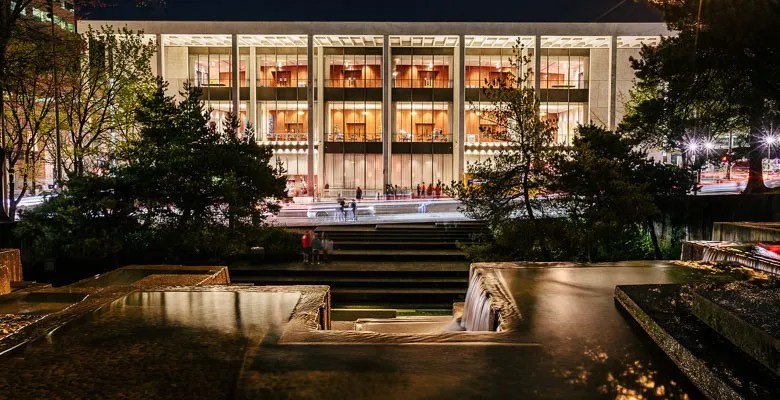 Keller Auditorium, home to touring Broadway shows, Portland Opera, and Oregon Ballet Theatre, seen from the Keller Fountain. Photo: Jason Quigley/courtesy Portland’5 Centers for the Arts.
Instead of simply agreeing, the previous five-member City Council solicited other proposals. Portland State University submitted what the city considered the only viable alternative. It would convert the current University Place Hotel and Conference Center at 310/330 S.W. Lincoln Street into a new Portland Arts and Culture Center that would include a 3,000-seat performing arts center owned by the city and related facilities owned by PSU, including a 1,200-seat community theater, an academic building, and a 150-room hotel. The total cost is estimated at $615 million to $650 million.
Rather than choosing between the two proposals, the previous council passed a resolution in October 2024 calling for both of them. The so-called “two-venue” solution would build the City-owned center at PSU first, allowing it to host touring Broadway shows while the Keller is then shut down for renovation. The resolution also called for a Market Feasibility Study to be conducted to assess whether there is enough public support in the region for the combined facilities.
The study was conducted by Chicago-based Hunden Partners and released on Jan. 24, 2026. It concluded there is not enough demand in the region to support two Broadway-capable venues, and recommended the City build a new one at PSU. It said the Keller should not be renovated to resume hosting Broadway shows, but did not propose any other use for it.
PSU has already raised $155 million toward its share of the Portland Arts and Culture Center. That includes $137.5 million in state bond funds, $7.6 million from Prosper Portland, and more than $10 million in philanthropy. The state funding includes $85 million for the theater/academic space and $52.5 million for integrated parking.
Keller supporters pushed back by forming the Save the Keller coalition that opposes building a new center at PSU, and instead renovating the Keller as proposed by the Halprin Landscape Conservancy. Members held a press conference on Feb. 25 in front of Keller Fountain before delivering a petition in support of the renovation project to Mayor Keith Wilson. Some also testified at the March 10 committee hearings.

Although no vote was taken at the March 10 meeting, staff of the Office of Arts and Culture indicated when more information might be available. An Economic Impact Study that is under way will be published in April. The 16-member Ex-Officio Committee appointed by Wilson is scheduled to present its recommendation to him that month. A study requested by City Council member Clark about whether the Keller can remain open and host Broadway shows while being renovated will be completed by April 30. And the 11-member Steering Committee is scheduled to present its recommendation to Deputy City Administrator for Community & Economic Development Donnie Oliveira in June.
Portland’5 Centers for the Arts maintenance needs
The Arts and Economy meeting also received an update on the transfer of management of the Portland’5 Centers for the Arts from Metro, the elected regional government, to the City. Metro has been managing them on behalf of Portland for years, but both governments agreed that the City will become responsible for them on July 1, 2027.
Deputy City Administrator for Community & Economic Development Donnie Oliveira described the transfer as a “sea change” that will require a lot of work before it is completed. He said the City has issued a Request for Information for entities interested in the day-to-day management of the venues.
“We are in the middle of a process where we are getting feedback and gathering data,” Oliveira said. “This is not happening in a vacuum. We have aging assets, and this will give us an opportunity to think strategically about them.”
The Portland’5 consists of three downtown Portland buildings: the Keller Auditorium at 222 SW Clay St.; the Arlene Schnitzer Concert Hall at 1037 SW Broadway; and just across from the Schnitzer on Southwest Main Street, the Antoinette Hatfield Hall, which houses the Brunish, Newmark, and Winningstad theaters.
As part of the transfer, Metro commissioned Facility Condition Assessments of the buildings by the Sazan Group. Released on March 2, the assessors found the three buildings need up to $336 million in deferred and scheduled maintenance.
“While each building has a slightly different story, they all have significant capital needs,” said Portland’5 Executive Director Rachael Lembo.
According to the Sazan Group:
- The Keller Auditorium needs $6 million to $11 million in immediate/high priority maintenance (2026-2030) and $4 million to $7.5 million in short-term maintenance (2031-2035), for a total of $10 million to $18.5 million. Mid-term and long-term maintenance needs for the Keller were not estimated, because it might be replaced.
- The Antoinette Hatfield Hall needs $9 million to $17 million in immediate/high priority maintenance (2026-2030), $46 million to $86 million in short-term maintenance (2031-2035), and $28 million to $53 million in mid-term maintenance (2036-2045), for a total of $83 million to $53 million.
- Arlene Schnitzer Concert Hall needs $14 million to $26.5 million in immediate/high priority maintenance (2026–2030), $36 million to $66 million in short-term maintenance (2031-2035), $13 million to $23 million in mid-term maintenance, and $24 million to $45 million in long-term maintenance (2046–2055), for a total of $87 million to $160 million.
Moda Center upgrades require Portland funds
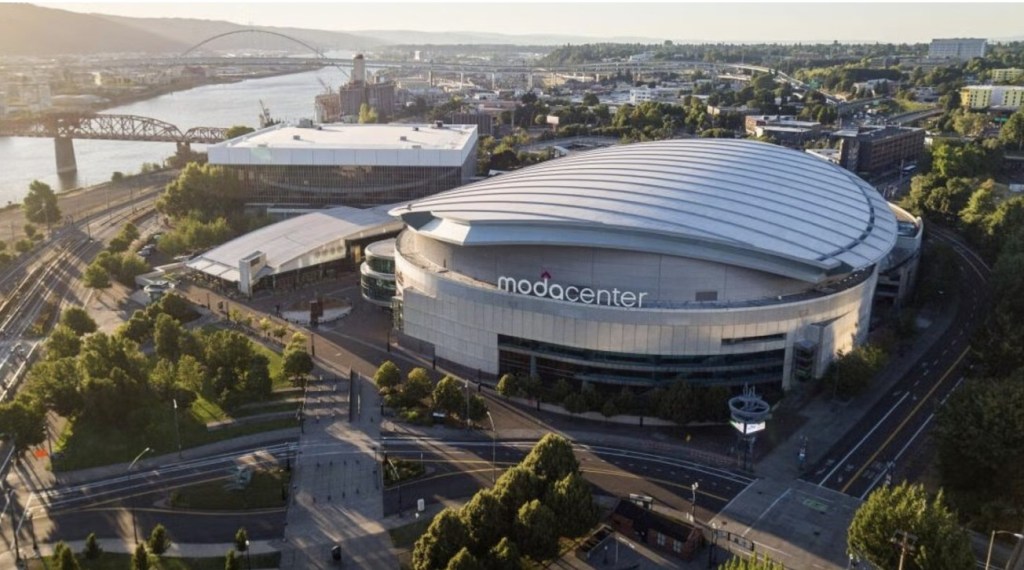 The Moda Center, home to the Portland Trail Blazers, large concerts, and other events, is up for an estimated $600 million in upgrades, throwing a financial curve to plans for new or renovated performing arts halls. City of Portland photo.
In a remarkable show of bipartisan unity, the Oregon Legislature created the Oregon Arena Fund to help finance $600 million in upgrades to the Moda Center in Northeast Portland, believed to be necessary to prevent NBA basketball’s Portland Trail Blazers from leaving town. Senate Bill 1501 passed the State Senate by a vote of 24 to 6, and the Oregon House of Representatives by 42 to 14.
The project is strongly supported by Portland Mayor Keith Wilson and new City Council President Jaime Dunphy, who told Oregon ArtsWatch that the improvement will also help attract large touring acts than now skip Portland, such as Taylor Swift.
“Modernizing the Moda Center is a generational opportunity — one that strengthens our economy, supports jobs, and ensures that Oregon’s largest arena continues to serve as a cultural and economic anchor for decades to come,” Wilson and Dunphy said in a joint statement after the vote. “We’re committed to continuing this work with our partners to ensure this renovation delivers lasting benefits for Portland and the entire state.”
The Moda Center is 30 years old, the oldest professional sports arena in the country that has not been renovated. The City of Portland acquired it two years ago from the family of the late Paul Allen, which owned the Blazers. National Basketball Association Commissioner Adam Silver has suggested the Moda Center needs an estimated $600 million in upgrades for the Trail Blazers to continue playing there.
Under SB 1501, the State of Oregon would sell $360 million in state bond funds to support the renovations. They would be financed by personal income taxes collected on performers and employees at the center. As required by the bill, the bond funds will not be spent unless these conditions are met:
- First, the Trail Blazers need to change hands to a new owner as planned. Texas billionaire Tom Dundon is expected to close a deal to purchase the team next month. The Blazers would then need to sign a 20-year lease to play in the Moda Center.
- Second, funding is also dependent on the State entering into an agreement with the City to establish shared authority over the Moda Center.
- Third, Portland and Multnomah County need to make their own financial commitments to support the renovations. In February, Portland Mayor Keith Wilson promised the city would pay $120 million up front, with additional yearly payments for maintenance and operations. Multnomah County Chair Jessica Vega Pederson said she would find $88 million.
- SB 1501 also requires assurances that the State will have legal recourse if the Blazers break their lease, and an agreement that the state is not on the hook for cost overruns to renovations that it is not directly responsible for.
Neither the Portland City Council nor the Multnomah County Commission has yet voted to approve those payments.

***