
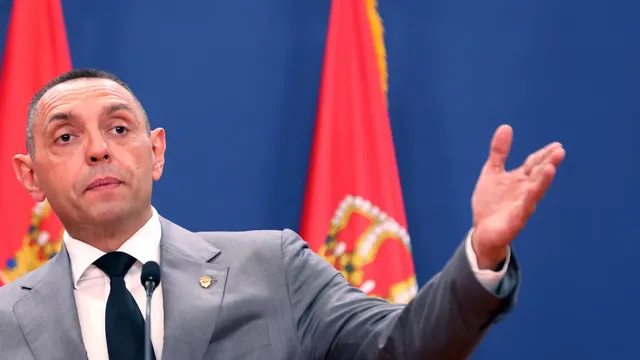
Vulin is known for supporting the concept of the so-called “Serbian World,” which envisions political and cultural unification of Serbs across the region.
A series of statements by Serbian politicians has sparked new tensions between Belgrade and Pristina after former head of Serbia’s Security Intelligence Agency (BIA) Aleksandar Vulin spoke about possible actions against individuals he described as promoting “anti-Serbian policy.”
Vulin is known for supporting the concept of the so-called “Serbian World,” which envisions political and cultural unification of Serbs across the region. He is under sanctions by the United States and the United Kingdom for corruption, ties to organized crime and cooperation with Russian intelligence actors. Vulin has also consistently advocated for closer relations between Belgrade, Moscow and Beijing.
During a television appearance earlier in March, the close ally of Serbian President Aleksandar Vučić compared potential actions by Serbian services to the methods of Israel’s intelligence agency Mossad.
“The Serbian state must act. I would ask our services to prepare a clear plan on how we will deal with individuals who are carriers of anti-Serbian policy. Let them think about what might happen to them. If Israel can do it, if Mossad can do it, why can’t the Serbian service? This is not something we have never done before. We know how it is done,” Vulin said.
He also referred directly to Kosovo Prime Minister Albin Kurti.
“Kurti has no problem breaking any agreement and is not afraid he will ever be punished. He is not afraid that anything will happen to him or to the people around him,” Vulin added, The Gunpowder Chronicles reported.
The remarks triggered a sharp reaction in Pristina. Kosovo Interior Minister Xhelal Sveçla described the statements as “an unacceptable and deeply troubling threat.”
“Drawing analogies with a conflict defined by open warfare and operations against declared enemies, and applying them to the Prime Minister of the Republic of Kosovo, means normalizing the logic of covert operations as a tool of threat and destabilization in the Balkans,” Sveçla said.
He stressed that Vulin’s comments are particularly concerning given his long-standing role within Serbia’s security structures and his ties with Moscow. Sveçla also recalled that the United States sanctioned Vulin over alleged cooperation with Russian intelligence actors.
The Kosovo minister pointed to historical cases of assassinations of Albanian political activists during the Yugoslav period.
“When Vulin says Serbian services ‘know how to do this,’ it evokes a dangerous precedent,” Sveçla said, referring to the killings of Jusuf and Bardhosh Gërvalla and Kadri Zeka.
Against this backdrop, Kosovo Prime Minister Albin Kurti said the liberation war against the Serbian regime was the culmination of sacrifices made by generations of Kosovars. His remarks came on the anniversary of the 1981 student protests, which later evolved into mass demonstrations.
Kurti said he had visited national activist Mehmet Hajrizi, one of the prominent figures of the Albanian political resistance in Kosovo during the 1970s and 1980s.
In a Facebook post, Kurti noted that Hajrizi worked as a teacher for 15 years and educated entire generations of students before being arrested in front of his class. Hajrizi was detained in December 1981 and later sentenced to 12 years in prison along with a group of activists.
After his arrest, the leadership of the organization was taken over by Kadri Zeka, who was later killed together with Jusuf and Bardhosh Gërvalla.
“Great historical events are the result of the daily and continuous work of political organizations and the people of Kosovo over the years,” Kurti wrote.
Meanwhile in Belgrade, Serbian Interior Minister and leader of the Socialist Party of Serbia Ivica Dačić defended the legacy of dictator Slobodan Milošević, the former Serbian and Yugoslav president who was indicted for war crimes by the International Criminal Tribunal for the former Yugoslavia in The Hague.
Marking the anniversary of Milošević’s death, Dačić said he was “the only Serbian nationalist and patriot in power after the liberation of Kosovo in 1912.”
The latest exchange of accusations between Belgrade and Pristina once again highlights the fragile balance in the Western Balkans more than two decades after the breakup of Yugoslavia.
Kosovo has been recognized by more than one hundred countries, but Serbia continues to reject its independence, while EU-mediated dialogue between the two sides has repeatedly stalled.
According to Kosovo officials, Vulin’s remarks go beyond political rhetoric and suggest that Kosovo is often viewed in Belgrade not as a negotiating partner but as a target of political confrontation. | BGNES