
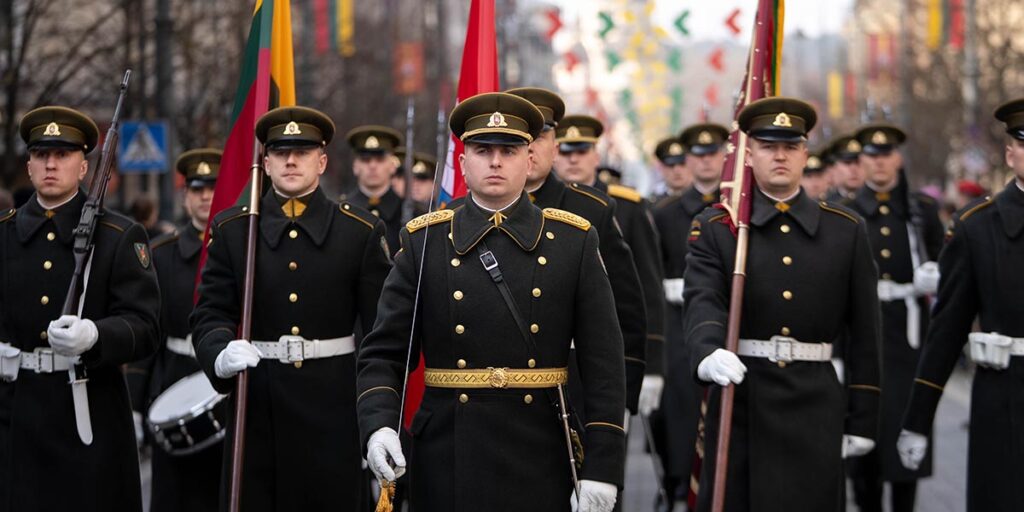
A military parade held on Gediminas Avenue in the city of Vilnius
On March 11, 1990, Lithuania proclaimed its independence from the USSR, 50 years after being invaded by the Soviets.
Spanish EF-18Ms intercept Russian fighter jets armed with missiles and cluster bombs
Spanish aviators from Wing 11 bid farewell to Lithuania by placing a cross in Šiauliai
This Baltic state celebrates its Independence Day every March 11th, and it does so with a military parade that usually draws large crowds. As in previous years, yesterday’s parade proceeded along Gediminas Avenue in Vilnius, from Independence Square (in front of the Seimas, the country’s unicameral Parliament) to Cathedral Square, located in front of the neoclassical Cathedral Basilica of Saints Stanislaus and Ladislaus, the Catholic heart of Lithuania.

The official ceremonies began at noon with the raising of the flags of the three Baltic states in Independence Square. Above, Lithuanian soldiers can be seen carrying the Estonian flag, and below, Lithuanian sailors carry the Latvian flag. Lithuania, Latvia, and Estonia are three closely linked countries. All three gained independence from Bolshevik Russia in 1918, and all three had to fight to maintain their newly declared independence in separate wars fought until 1920.

The three Baltic states were invaded and annexed by the USSR in 1940, an invasion previously agreed upon by the Soviets with Nazi Germany in the Molotov-Ribbentrop Pact of August 1939. The three countries declared their independence from the USSR in 1990 in the so-called “Singing Revolution,” a peaceful process that the USSR attempted to suppress through violence. The Soviets killed 14 civilians and wounded hundreds of unarmed people in Vilnius in an attempt to regain control of the country. Finally, Moscow recognized the independence of Lithuania, Latvia, and Estonia in September 1991. Below, we can see Lithuanian soldiers with the two official flags of Lithuania, which I already mentioned here.

Vladimir Putin’s dictatorship has targeted the three Baltic states. Last year, Russia demanded that NATO withdraw from these three countries as a condition for ending the Russian invasion of Ukraine, a new deception intended to leave the Baltic states defenseless against a Russian attack. Lithuania, Latvia, and Estonia joined the Atlantic Alliance on March 29, 2004, and since Russia’s annexation of Crimea, NATO has been deploying forces in the three Baltic states to deter any attack against them.

Many Ukrainian flags were visible at yesterday’s parade in Vilnius. Like the other two Baltic states, Lithuania is one of the NATO countries that dedicates the highest percentage of its GDP to sending military aid to Ukraine in the face of the large-scale Russian invasion that began on February 24, 2022. In fact, the three Baltic states are among the four largest contributors, with percentages several times higher than the aid provided by larger countries such as the United States, France, the United Kingdom, or Spain. Among Lithuanians, Latvians, and Estonians, support for Ukraine is resounding, as the four countries share a common enemy: Putin’s Russia.

Yesterday’s parade featured three aircraft. One of them was a Lithuanian UH-60M Black Hawk helicopter. The Lithuanian Air Force is the largest of the small air forces of the Baltic states, but it has a fleet of only 12 aircraft (5 planes and 7 helicopters) and is awaiting another 5. Lithuania signed a contract to purchase 4 UH-60Ms in November 2020. The first two were delivered in October 2025. Delivery of the other two is still pending.

In addition, two Spanish EF-18M Hornet fighter jets flew over Vilnius during the parade. Since November 2025, Spain has deployed ten EF-18M fighter jets and one A400M transport aircraft at Šiauliai Air Base in Lithuania, as part of a reinforced NATO Baltic Air Policing (BAP) mission. The fighter jets belong to Wing 15, based in Zaragoza, and the A400M is from Wing 31, also based in Zaragoza.

You can see here a video summary of these events for Lithuania’s Independence Day, published today by the Lithuanian Ministry of Defense. The Spanish fighter jets appear at 0:11 in the video:
Lithuania’s Independence Day was preceded by a new Russian provocation. According to a statement released today by NATO Air Command, on Monday, two Russian SU-24D “Fencer” attack aircraft were intercepted by Spanish fighter jets from Šiauliai while flying in international airspace near NATO borders.

Los aviones rusos tienen la costumbre de volar por esa zona con el traspondedor apagado y sin responder a las comunicaciones del control de vuelo, lo que obliga a la OTAN a desplegar cazas para identificarlos.
—
Photos: Lietuvos Respublikos Krašto apsaugos ministerija / NATO Air Command.