
The President of North Macedonia’s Constitutional Court excludes Albanian from “Safe City”: BDI and VLEN clash
The President of the Constitutional Court of North Macedonia, Darko Kostadinovski, has sparked a wave of reactions from Albanian parties.
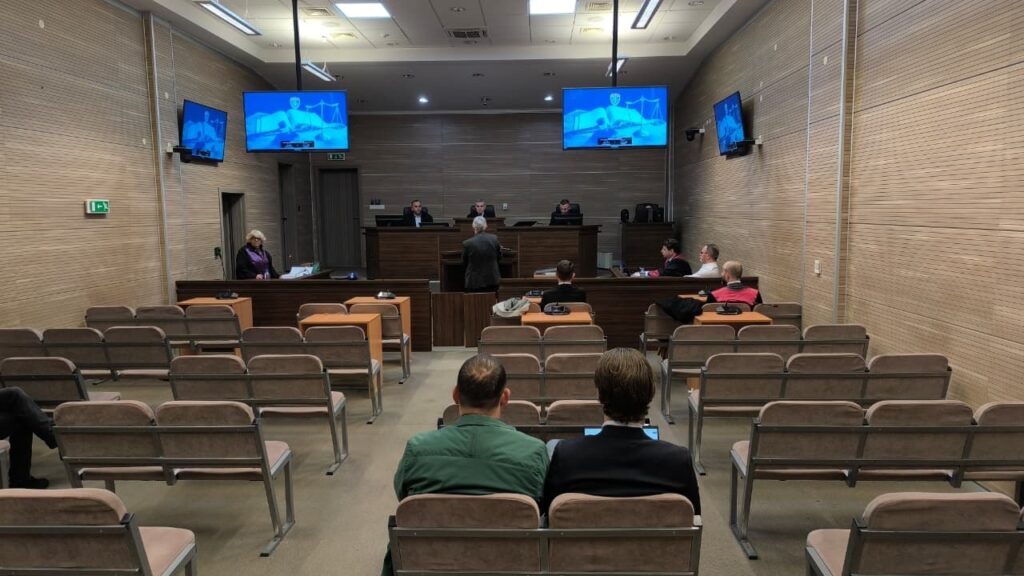
On Wednesday, during a session discussing the constitutionality of the “Safe City” system, he stated that SMS messages must be sent to citizens in Macedonian and English, but not in Albanian. He further claimed that the constitution obliges every citizen to know the Macedonian language.
The Secretary General of the Democratic Union for Integration (BDI), Arbër Ademi, told KosovaPress that this is another act of discrimination against Albanians in North Macedonia.
“Since February, in the context of communication security only in certain cities—and interestingly in cities where Albanians are the majority, such as Tetovo, Skopje, and Kumanovo, along Corridor 8—‘Safe City’ is applied, and the SMS messages sent to citizens are not delivered in Albanian. They come in Macedonian and English. Therefore, yesterday the Constitutional Court decided that the law enabling such a project is in accordance with the constitution, but the statements of the Court President were completely scandalous. You saw it yourself: he said Macedonian is okay, English is okay, but not Albanian. He even mocked the collective intelligence of all citizens by saying that those who have cars should also have smartphones and email; otherwise, they should ride horses,” he said.
He stated that the statements of the Court President reflect a “chauvinistic tendency,” for which he also accused VLEN—the bloc of Albanian parties currently in power.
“This is just a small display of Darko Kostadinovski’s chauvinistic tendencies, who for two consecutive years, since the formation of this government with Albanians as the losing side, has undertaken actions that undermine the Ohrid Agreement and damage good interethnic relations… The worst part is that throughout this process, they have had the support of VLEN. They have the support of these Albanians resembling Rrahman Morina during Milosevic’s time in Kosovo, because a year ago when we initiated a procedure in the parliament regarding Kostadinovski’s responsibility, it was VLEN with nationalist forces in parliament that voted to remove the point from the agenda, and to this day, Darko Kostadinovski remains untouchable. He does whatever he wants, violates the constitution and the law with impunity, and no one can stop him,” he added.
The Ohrid Agreement is a quarter-century-old accord that ended armed conflict in what was then Macedonia, triggered by discrimination against Albanians. It led to constitutional changes and regulated the use of other languages alongside Macedonian.
The Albanian parties forming the ruling coalition VLEN, accused by BDI of undermining the Ohrid Agreement, hold 12 seats in the North Macedonian Parliament, six ministries in the executive, and two deputy prime ministers.
However, VLEN spokesperson Driton Sulejmani said that the reason these issues are still open today is due to BDI’s irresponsibility and manipulations.
“Previously, the issue of language use was raised by the Constitutional Court itself. VLEN has assured that the Albanian language would not be affected and remains firm on that position. The problems BDI has left unresolved, we are attempting to address daily. Very soon we will conclude an issue directly related to the Ohrid Agreement, namely the law on fair and adequate representation. BDI failed for 23 years to pass a law on fair and adequate representation, and we are doing it in less than two years, closing one of the most important points of the Ohrid Agreement, even though it was supposed to be completed in 2004. Today we are in 2026, and we are still discussing matters related to the Ohrid Agreement,” Sulejmani responded.
The law on language use in North Macedonia requires state institutions to allow official use of languages spoken by at least 20 percent of citizens.
VLEN also criticized the statements of the Court President, saying that “the composition of this court often resembles the political elite of a state that no longer exists.”
“We cannot escape the impression that this Constitutional Court, through its comments, often resembles the Yugoslav political elite more than a highest judicial instance in the country. Regarding the use of the Albanian language, it is a fundamental human right and one of the basic values of the constitution. State institutions are obliged to guarantee every citizen’s right to be informed in their mother tongue, including obligations arising from their actions or behavior. This applies to the Safe City system as well. VLEN has been clear and remains steadfast that when the state informs, warns, or sanctions a citizen through this system, it must also do so in Albanian. This is not a matter of political will but a constitutional obligation and respect for a fundamental right,” he concluded.
On Wednesday, the Constitutional Court held a session to review the constitutionality of the law for the “Safe City” project. It rejected initiatives from the Alliance for Albanians led by Zijadin Sela and Arben Taravari, as well as from Ylli Paçuku of the Democratic Union for Integration. These parties had challenged Safe City over several issues, particularly its application to only three cities and the requirement that citizens possess a cellphone and email.