
Activists and artists working to reclaim the Drina know that reconciliation in postwar Bosnia is not only a matter of institutions or tribunals, but also of landscapes, and of how people choose to live with them.
The Drina River flows quietly through eastern Bosnia and western Serbia, a green-blue ribbon threading mountains, villages, and borders. In summer, its surface reflects forests and bridges, its banks dotted with fishermen and swimmers. To an untrained eye, it appears timeless, almost indifferent. But for those who live along it, the Drina is not just a river. It is memory, boundary, witness, and, increasingly, a site of contested healing.
During the Bosnian War of the 1990s, the Drina became one of the most heavily charged landscapes in the region. Flowing through towns like Visegrad and Foca, it marked a frontline of violence and displacement, a physical and symbolic border between communities. In 1992, the river became a primary site of ethnic cleansing; in Visegrad, hundreds of Bosniak civilians were executed on the Mehmed Pasha Sokolovic Bridge and cast into the current, a fact later detailed in ICTY war crimes convictions. In Foca, the conflict was marked by the establishment of systematic rape camps and detention centers.
Three decades later, the Drina is being renegotiated. Across the eastern municipalities of Republika Srpska, the Serb-led entity through which the river flows, environmental groups, artists, educators, and local residents are engaging the river in new ways. While these towns are now majority Serb following the wartime displacement of Bosniaks, small but persistent numbers of Bosniak returnees have moved back to Visegrad and Foca. Efforts like these to shift the river’s meaning from a line of division to a shared ecological and cultural space are neither uniform nor uncontested. They unfold alongside unresolved trauma, political fragmentation, and competing narratives of the past. Yet, taken together, they suggest that reconciliation in postwar Bosnia is not only a matter of institutions or tribunals, but also of landscapes, and of how people choose to live with them.
A River Marked by History
 The Drina cuts a precipitous canyon through eastern Bosnia. Photo via Wikimedia Commons.
The Drina’s role in Balkan history long predates the 1990s. For centuries, it has functioned as both connector and border, separating empires, administrative regions, and later nation-states. Ivo Andric’s The Bridge on the Drina famously captured this duality, portraying the river as a constant amid shifting powers and human suffering. That literary legacy still shapes how the Drina is imagined today, particularly in Visegrad, home to the Mehmed Pasa Sokolovic Bridge immortalized in Andric’s novel, now a UNESCO World Heritage Site.
During the Bosnian War, however, the river’s symbolism hardened. In eastern Bosnia, where Bosniak and Serb populations had long lived side by side, violence fractured social life. The Drina became associated with expulsions and killings, its waters carrying physical traces of war downstream, including the remains of victims that would, years later, be uncovered in the riverbed during periods of low water or dam maintenance. For many survivors, the river remains inseparable from loss.
Local historian and educator Amir Hadzic, who grew up near Foca, describes the Drina as “a place where memory feels unavoidable.” He notes that even mundane activities – crossing a bridge, fishing, or walking along the banks – can trigger recollections that are rarely addressed in public discourse. “The river remembers even when people try not to,” he says.
This weight of memory has shaped how communities interact with the Drina in the postwar period. For years, many residents avoided the Drina River entirely, treating its bridges and banks as places best left untouched. Others used it without speaking of the past, maintaining a fragile coexistence built on omission. The river flowed on, but its meanings remained frozen. These omissions are particularly visible in the landscape of monuments: while official markers often commemorate the fallen of the majority community in towns like Visegrad and Foca, the sites of mass atrocities against the minority Bosniak population frequently remain unmarked or contested by local authorities, leaving the physical river as the only witness.
Environmental Work as Neutral Ground
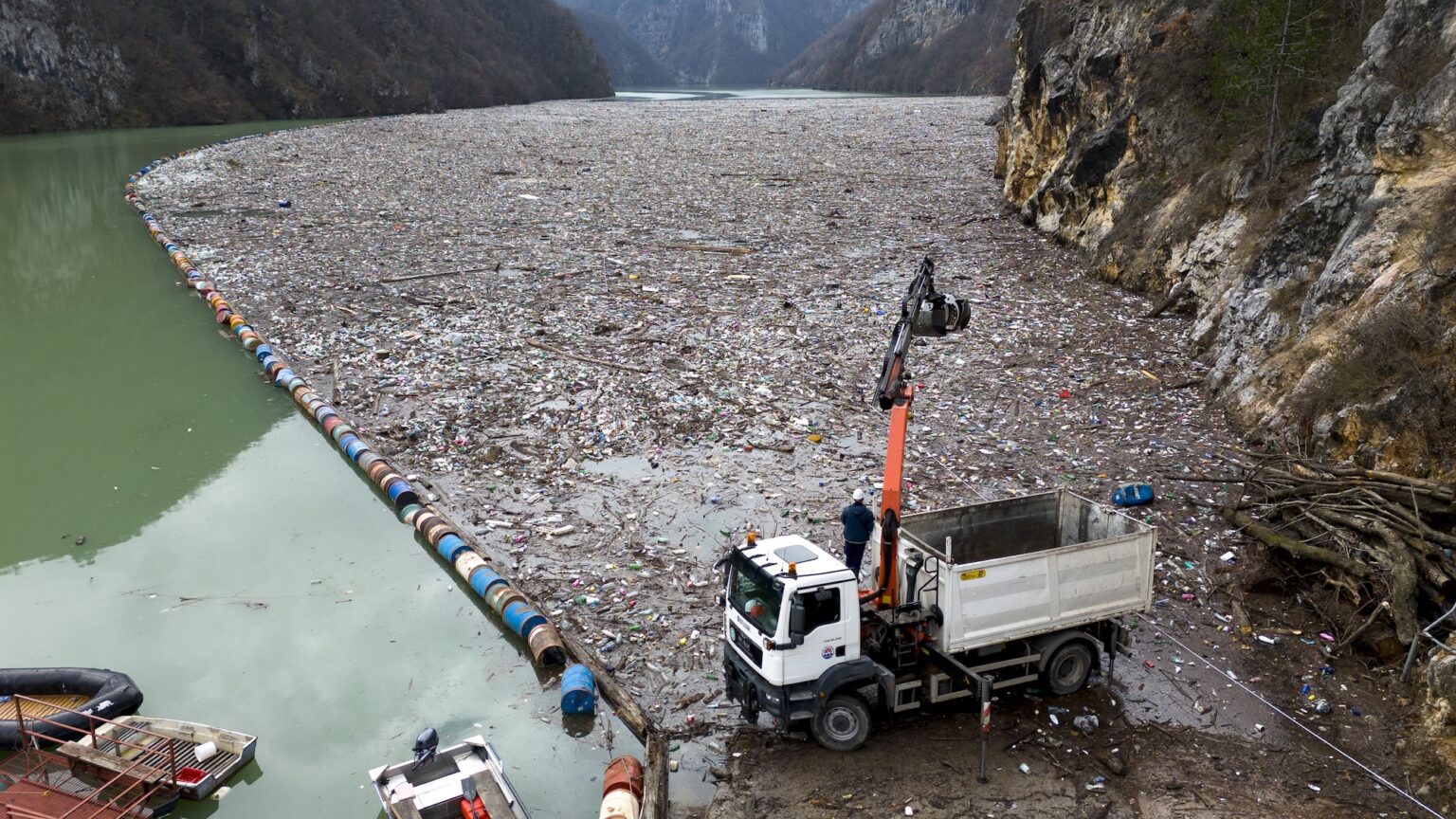
In recent years, environmental activism has emerged as one of the most visible ways people are reengaging with the Drina. Cleanup campaigns, anti-pollution initiatives, and opposition to unregulated hydropower projects have brought together residents across ethnic and political lines, often without explicitly framing their work as reconciliation. These efforts are often born of physical necessity: every winter, the river carries thousands of cubic meters of waste, plastic bottles, household appliances, and industrial debris, where it accumulates behind a hydroelectric plant’s river barrier, creating vast floating islands of debris that clog the reservoir behind the Visegrad hydroelectric dam. Addressing this “floating landfill” requires local volunteers to coordinate across internal entity lines and the international border with Serbia.
In Visegrad, a small collective of environmental volunteers organizes seasonal river cleanups, drawing participants from both sides of the Bosnia-Serbia border. Plastic waste and illegal dumping have increasingly threatened the river’s ecosystem, particularly after flooding events that wash debris downstream from Montenegro and Serbia. These environmental emergencies reveal a practical division: while Serbs on both sides of the border share a cultural and ethnic identity, they are often at odds over the river’s management.
Many years, it takes up to six months to skim garbage off the Visegrad dam reservoir, local environmentalist Dejan Furtula told the AP in 2023. The waste ends up at the municipal landfill in Visegrad, which Furtula said “does not even have sufficient capacity to handle [the city’s] municipal waste.”
For organizer Jelena Petrovic, environmental work offers a practical starting point. “The river doesn’t care who you are,” she says. “If it’s polluted, everyone suffers.” She emphasizes that shared ecological concerns can create space for interaction without forcing immediate confrontation with history. To different communities, “history” represents a fundamental divide: for Bosniak returnees, it is a record of 1990s victimization and a quest for recognition; for many local Serbs, it is framed through the lens of the earlier world wars or as a defensive struggle for autonomy. “People can stand side by side picking up trash without having to agree on everything else,” Petrovic adds, suggesting that focusing on the water allows for a “functional peace” that avoids the gridlock of competing national narratives.
Not everyone sees these efforts as neutral. Some critics argue that highlighting environmental issues risks depoliticizing the river’s violent past. Others counter that such projects build trust gradually, allowing relationships to form before more difficult conversations emerge. In practice, both dynamics coexist. Reports from local activists and observers of these cleanup days note that they often end with informal discussions where memories surface unexpectedly, sometimes cautiously, as when someone points out a former neighbor’s house, and sometimes with a surprising openness that the rigid political climate usually prevents.
Art, Memory, and the Limits of Metaphor
In Foca and other towns along the Drina, including Srebrenica, artists and cultural organizers have increasingly turned to the river as a subject for community projects and cultural events, inviting residents to reflect on what the river means in their daily lives. Installations, performances, and community workshops use the river as a metaphor for continuity and transformation, attempting to reframe its narrative without erasing its history.
Yet artistic interventions are not universally welcomed. In towns where memorialization remains politically sensitive, art projects risk being dismissed as abstract or inappropriate. In Visegrad, the politics of memory is physically contested; for example, in 2014, local authorities used a sandblaster to remove the word “genocide” from a memorial at the Straziste cemetery dedicated to Bosniak victims. Similarly, in Foca, monuments often exclusively celebrate Serb military history, while sites of wartime atrocities, such as the Partizan sports hall, remain without official markers for the victims. Some survivors feel that metaphors of healing come too easily, smoothing over wounds that remain unaddressed. Others find that art provides a language for experiences that formal political processes, often stalled by denial or ethnic tension, have failed to accommodate.
 The 450-year-old Mehmed Pasha Sokolovic Bridge over the Drina at Visegrad. Photo by Lazar Krstić via Pexels.
A Generation at a Distance
For younger residents along the Drina, the river is often encountered without direct memory of war. Born after the conflict, many grow up aware of its legacy but shaped more immediately by economic uncertainty, emigration, and environmental change. Their relationship to the river reflects this temporal distance.
At a secondary school in Visegrad, geography teacher Marko Stojanovic incorporates local environmental efforts into his curriculum, using the Drina as a case study. Students learn about hydrology, biodiversity, and regional development, alongside discussions of how borders shape ecosystems.
“When students talk about the river, they talk about pollution, about tourism, about jobs,” Stojanovic says. “The war comes up, but it’s not the only frame.” He views this as neither denial nor indifference, but as a different orientation toward place. These students, though primarily from the Serb community, are increasingly vocal about the lack of economic opportunity in the Drina valley and the ecological mismanagement that crosses political lines. “They inherit the past, but they’re also looking for a future.”
This generational shift does not erase historical responsibility, but it complicates it. Young people often express frustration at being asked to carry unresolved conflicts while lacking the power to change political structures. For some, environmental and cultural engagement with the Drina offers a way to assert agency where formal reconciliation feels distant.
As environmental pressures mount and political divisions persist, the river remains a shared necessity. It demands cooperation, whether for flood management, pollution control, or sustainable development. In this sense, the Drina continues to force encounters across boundaries, just as it has for centuries.
Between Healing and Forgetting
The idea of the Drina as a site of healing remains contested. For every initiative that seeks to reclaim the river as a shared space, there are voices warning against premature closure. Memorial practices along the Drina are uneven, with some sites marked and others left unacknowledged. Public commemorations can provoke tension, particularly when narratives clash. In Visegrad, the annual “Remembrance Day” in June sees Bosniak survivors drop roses into the river from the Mehmed Pasha Sokolovic Bridge to honor the victims of 1992, an event that takes place in a town where the local government promotes the bridge as a purely historical and tourist landmark, often downplaying its wartime history. These conflicting uses of the same physical space create a palpable friction between the act of mourning and the local politics of tourism.
Sociologist Edina Becirevic, author of Genocide on the Drina River, has written extensively about how the atrocities along the Drina shaped collective memory and identity in eastern Bosnia. Her research situates Visegrad, Foca, and other towns within the broader narrative of genocide and its aftermath, showing how landscapes carry the legacy of violence and influence everyday life. According to Becirevic, even when people do not openly speak about the past, the river, its bridges, and surrounding terrain continue to shape how communities relate to one another and negotiate daily coexistence. Understanding these geographies of violence, she argues, is essential to grasping how reconciliation and memory are practiced locally over time.
At the same time, Becirovic acknowledges the limitations of institutional justice. “For many communities, the river is part of daily life in a way that courts and reports are not,” she says. “That everyday relationship matters.”
Eniola Matilda is a freelance writer interested in stories about culture, environment, and the ways communities rebuild after conflict. Her work explores how memory, place, and everyday acts of care shape collective futures.