
Chinese belongs to a different language family from Korean. However, historically Korea borrowed many words from Chinese for high-level vocabulary and abstract concepts. But because many individual changes in pronunciation of Chinese characters and word formation have occurred over 1500 years, spoken communication is impossible.(This does not mean that it was disconnected for that amount of time. This is because some degree of interaction existed during that time as well. A significant number of Korean pronunciations of Chinese characters are estimated to have originated from the Tang Dynasty.) Mutual intelligibility between Chinese and Korean is close to 0 percent.
It is estimated that these Sino-Korean words reach 60 percent of Korean vocabulary. However, this is the amount of vocabulary seen in dictionaries, and most of the basic vocabulary is native Korean words. (This is the reason why English is not a Romance language. According to a research result, the ratio of native Korean words reaches 80 percent in spoken Korean.)
Also, the grammar of the two languages is completely different. In Chinese, sentences proceed in the order of subject, predicate, and object, and the position of the word determines the role of the word without changes in vocabulary. In Korean, sentences proceed in the order of subject, object, and predicate, and suffixes attached to each word determine the role and tense. This is another piece of evidence showing that the linguistic lineage of Korean is different, in addition to basic vocabulary.
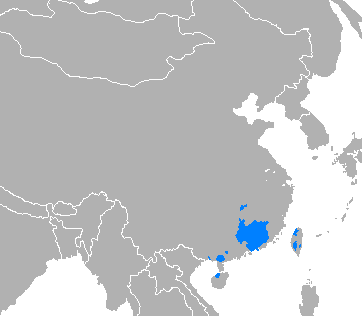
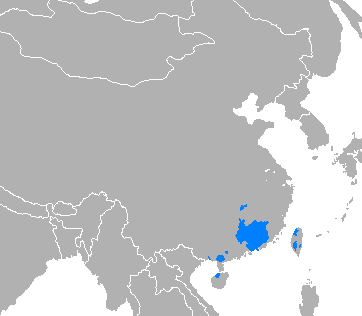
But still, the majority of high-level vocabulary and abstract concepts in Korean rely on Chinese characters. However, the question we might be curious about here is where the pronunciation of Chinese characters in Korea originated. According to the results of a study conducted in Korea, the language with the most similar pronunciation to Korean is Hakka, a Chinese dialect. This dialect is one of the most idiosyncratic among Chinese dialects, which are known to be mutually unintelligible.
(In the field of linguistics, the dialects of Chinese are considered separate languages. This is similar to French, Spanish, and Italian within the Romance family, but China treats them as dialects for political reasons. Do not misunderstand this as meaning that it is wrong. Usually, the boundary between language and dialect is political.)
This language is used by a group that culturally branched out after a specific ethnic group in the capital fled to the south due to the chaos of the times. As this language was disconnected for a long time, it relatively preserves the pronunciations of a thousand years ago. The pronunciation of Chinese characters in Korean also underwent variations but changed relatively less. These two situations resulted in a mysterious phenomenon where languages that are geographically far apart became relatively similar.
(Hakka-speaking regions are located in southern China, which is geographically very distant from Korea.)
This exactly coincides with two common linguistic theories.
- The larger the population, the faster the language changes. This applies exactly to Chinese. In particular, Chinese history was very dynamic, and it was a struggle over who would occupy the fertile Yellow River area.
- A language that has accepted loanwords has a tendency to preserve the corresponding words more intact than the language of origin. This applies exactly to Sino-Korean words. This is the case even though Koreans don't regard them as loanwords because there are so many Chinese loanwords in the vocabulary and they have their own unique Korean pronunciations.
https://youtu.be/88U664y-oCA?si=AuVV2q_WrErw7mNa
As a native Korean speaker, it is true that it is considerably more similar to Sino-Korean words than Standard Chinese.
https://i.redd.it/ddmup41c7qog1.png
Posted by Embarrassed_Clue1758
11 Comments
Ha. very interesting. If there was any glimpse of profitability, I would choose the linguistic major.
I don’t know about Hakka. I kinda know when I hear hakka (long story) and that dialect is closer sounding to Cantonese than it is to Korean. However the map is not entirely wrong. I think some of the hanja words sound closer to Hokkien/Taiwanese by the way the word of the same meaning is pronounced – also a southern chinese dialect.
One of the old theories I heard from older Koreans is that southern chinese dialects is closer to the original “chinese” before mongol invasion created what we know as Mandarin today and as you know that’s mainly in the north. Well I can’t verify the theory, but it does make sense.
This is not exclusively for China/Korea, by the way. You may have heard that Canadian French sounds more ‘archaic’ than French spoken in Europe.
This was an insightful post. I learned a lot, thank you for writing it.
Here we go again summoning “Mandarin is Chinese dialect spoken/butchered by barbaric Manchurian/Mongolian” theorist
The analogy comparing Korean to English as a non-Romance language is directionally correct but not precise. English is Germanic yet still belongs to the same Indo-European family as the Romance languages, so the borrowing happened between relatives. Korean belongs to the Koreanic family, entirely unrelated to Sino-Tibetan, making the lexical borrowing far more distant — more like importing from a completely different household rather than borrowing from a cousin.
I think it’s interesting to note that Hakka is one of the most conservative Sinitic languages when it comes to conserving the Middle Chinese (e.g., “T’ang-era Chinese) phonology of initials and codas – which is when the large Chinese lexicon was imported into Silla en masse – hence, why Hakka naturally sounds the closest to Korean hanja reading.
Cantonese (also known as Yue) is the major* Chinese dialect closest to Korean.
This is because Cantonese, being well preserved, is the closest to Middle Chinese (spoken from the 4th to 12th centuries).
The Cantonese pronunciation for directions (east, south, west, north), basic geography (mountain, river) and numbers (1-10) are very similar to Korean.
As a native Cantonese speaker who knows a little Hakka, I don’t think it’s Hakka.
Add: Put * because there may be some minor dialects that are also well preserved, like some Min dialects. Maybe that’s where you got Hakka from.
흥미롭네요
객가어랑 객가인이 해외에 꽤 퍼진 걸로는 알고는 있었는데요
난방공화국이라고 해서 객가어가 쓰이던 국가(?)가 보르네오에도 있었고
This map could also represent language/dialects which sound the closest to ancient Chinese, which is what/when many Japanese /Korean word originated from. The fact modern Mandarin has moved on and heavily blended from foreign language (Manchu , Mongol etc during their rules) is why Mandarin don’t sound as close to Korean/Japanese, but there are still similarities just the tone is not as close.
What I got out of this is…..in the end the whole “Korean is a Chinese dialect” brain rot narrative STILL doesn’t hold water, much to the dismay of online Han-supremacist keyboard warriors and wumaos.
Ahaha….haha….ha…..
HAHAHAHAHA!! 😂😂😂