

Anatol Lieven is Director of the Eurasia Program and Andrew Bacevich Chair of American Diplomatic History at the Quincy Institute for Responsible Statecraft in Washington, DC. He previously worked as a journalist in South Asia, Afghanistan, the former Soviet Union and Eastern Europe, and is author of several books on these regions including Ukraine and Russia: A Fraternal Rivalry (1999) that warned of the danger of war in Ukraine. He writes frequently for the media, and his articles have appeared in The Financial Times, The Guardian, The New York Times, Foreign Affairs, Foreign Policy, Time and Newsweek. Mr Lieven was a distinguished guest at the Mathias Corvinus Collegium (MCC) Summit on Reclaiming the West, where he sat down with Hungarian Conservative to discuss the war in Iran, its effects on America, Europe and the war in Ukraine.
***
You are a self-described geopolitical realist and an anti-interventionist. How do you feel about 2026 so far with the recent US interventions in Venezuela and Iran?
Well, I fear that what has happened is that because Venezuela went very well and was very easy, Trump basically thought he could do the same thing in Iran. Of course, they are totally different situations—different countries, different everything. In many ways, it is very disappointing. It is also quite surprising, because Trump ran on a platform that was categorically opposed to this kind of intervention. He gained a great deal of support precisely by condemning previous administrations—Republicans as well as Democrats—for what they had done in Iraq above all.
You know the origins of the term ‘blob’ for the American foreign policy and security establishment. It was coined by Ben Rhodes, referring to a science fiction film from the 1950s in which an alien blob swallows people. There is a famous poster showing a human arm trying to escape from it. The point is that people move to Washington not necessarily knowing everything about international affairs. And this American establishment swallows them. It is devoted to maintaining American primacy on the world stage and has very strong inclinations towards militarism and the use of military force, because that is one thing the United States is very good at. We saw this with Obama, a self-proclaimed realist who opposed the Iraq War. Although he did, thank God, prevent intervention in Syria, he went along with the attack on Libya, which has had disastrous consequences for Europe.
It is possible that Trump will now declare victory and end this war. He should be able to see by now that if it continues, energy prices will eventually affect prices inside the United States itself. And if that happens, the Republicans could lose the midterm elections in November.
‘It is possible that Trump will now declare victory and end this war’
The extraordinary thing is that he did not predict this before launching the war, because it was entirely foreseeable. Iran cannot hit back effectively against the United States in a conventional way, so of course it would target oil and gas production and transport through the Strait of Hormuz. And because it is difficult to hit Israel directly or American warships and aircraft, it would go after soft targets—oil tankers. That was obvious.
The depressing thing is that this is the third time the United States has intervened in a country it did not understand. First there was Vietnam. The United States had no real understanding of how the communists were supported by Vietnamese nationalism. That ended in disaster. Then Iraq, where American policymakers again understood very little about the society they were intervening in. It is often said that George W Bush himself did not know the difference between Shia and Sunni, which turned out to be fundamental to the conflict.
And now something similar has happened with Iran, seemingly on the basis of an analogy with Venezuela—two countries that could not possibly be more different.
One of your main arguments against American interventions is that Washington tends to get stuck in these conflicts. With the midterm elections approaching, do you see the United States becoming stuck in Iran? And what could Trump present as a victory before the midterms?
The one good thing about Trump from this point of view is that he has been extraordinarily good at issuing enormous threats—even beginning to implement radical policies, for example in tariffs or Greenland—and then backing off, making a compromise, and presenting it as a victory. So maybe he will do that in the case of Iran. He could say, not without reason, that the Iranian navy has been destroyed and that American objectives have been achieved.
There is another very important factor in this case: Israel and its impact on US policy. The Israeli government under Benjamin Netanyahu is not aiming at a rhetorical or limited victory. They are not even aiming simply at destroying Iran’s nuclear programme—which in fact Iran does not currently have as a nuclear weapon capability. Their aim is the destruction of the Iranian state itself: crippling it or breaking it up.
If that is the objective, there can be no compromise and no peace. The war would have to continue. So the question is whether Trump will be able to restrain Netanyahu and tell him to stop.
 According to Mr Lieven, Israel is not aiming for a rethorical victory, but the complete destruction of the Iranian state itself: crippling it or breaking it up. PHOTO: Tamás Gyurkovits/Hungarian Conservative
Do you see it as possible for Israel to continue the military operation without the United States?
To a degree, yes, but it would be much less effective. Israeli stocks of offensive weapons and air defence systems would run down quite quickly. At that point there is a real risk that Iranian attacks would begin inflicting serious damage on Israel. Without American support, Israel would also be unable to sustain the same level of damage against Iran.
If Israel continued the war alone, that would also create difficulties for Trump politically. Iran would likely continue blocking the Strait of Hormuz, because Israel would still be seen as operating with American backing. And since Iran has few other effective means of retaliation, it would keep using that lever.
At that point the global economic consequences would continue—or even worsen. Israel would certainly not be able to guarantee the security of oil and gas exports from the Gulf.
Trump is also obsessed with appearing strong. If the United States ends the war while Israel continues, he risks looking weak from two directions. The pro-Israel lobby and hawks in Washington would accuse him of weakness for stopping the war, while others would accuse him of weakness for failing to stop Israel. So from his own political point of view, he would need Israel to stop as well.
Let us talk about the conflict’s effect on Europe. Europe often feels the consequences of Middle Eastern wars first. We have already seen energy prices rise sharply and even terrorist attacks on European soil. What is the right strategy for Europe in this situation?
One thing this reinforces is the lesson of the unreliability of the United States. In launching this war, Trump and those supporting him did not give a moment’s thought to the effect on Europe—whether economic consequences, refugees, or anything else. It simply did not occur to them. That is a strange kind of alliance in which one member pays no attention at all to the interests of the others.
If the war ends soon, European policy will probably revert to its previous course. But if it continues, Europe could face very serious consequences.
If the Israeli objective of destroying Iran as a state and triggering civil war succeeds, Europe will face another massive refugee crisis. At the very least, Türkiye would gain enormous leverage over Europe by threatening to open the floodgates.
At the same time, Trump has already relaxed attempts to sanction third parties buying Russian energy. He has to. If Gulf energy supplies are disrupted while Russian energy is also cut off, the consequences for countries like India would be catastrophic.
‘So far Europe has not presented a single positive proposal for ending the war in Ukraine’
What Europe should do in the short term is offer Russia the suspension of sanctions and the resumption of Russian energy imports as part of a peace settlement. So far Europe has not presented a single positive proposal for ending the war in Ukraine.
Offering sanctions relief could give Russia an incentive to settle along the current front lines rather than insisting on control of the entire Donbas. It would also be greatly in Europe’s interest to restore cheaper Russian energy. High energy prices have already severely damaged the German economy.
In the longer term, Europe should aim for energy self-sufficiency. That will require huge investment in alternative energy, but also a return to nuclear power. Closing nuclear plants—especially in Germany—was a catastrophic decision.
Hungarian Prime Minister Viktor Orbán has recently called for exactly the same thing: the suspension of EU sanctions on Russian energy.
As I said, it should be done as part of a peace settlement—as a positive attempt to end this war. And to end this war, Europe has to start talking to Russia. The problem, of course, is that Europe would also have to get rid of its present foreign affairs chief and basically tell the Poles, the Balts, and the Swedes to shut up. That is very difficult.
But mind you, they have managed to tell everybody else to shut up. Certainly, it is absolutely ludicrous that the fate of the European continent should be placed in the hands of Estonia.
How do you think the war in Iran could affect relations or dynamics between Europe and Russia?
It depends entirely on how long the war lasts and on the internal balance of power within the United States—whether Trump’s domestic priorities or Israeli objectives dominate policy.
European domestic politics will also matter. If parties like Rassemblement National gain power in France or other countries, that could shift policy. These parties, often labelled as pro-Russian, are not pro-Russian—and the same can be said about Hungary as well; they simply believe their national interests should come first.
When it comes to Russia and Iran, it is important to remember that they are not formal allies. There is no alliance comparable to NATO. They cooperate in some areas, but neither is legally obliged to defend the other. That being said, if the war in Iran ends quickly, Russia will suffer a setback because of its inability to help Iran. But if the war continues, the opposite could happen.
Energy prices would rise dramatically, benefiting the Russian economy and war effort. And if the United States and Europe send increasing numbers of air defence systems to the Middle East, fewer will go to Ukraine. That would strengthen Russia’s position in the Ukraine war.
That is another reason why Europeans should aim for peace with Russia if the Iran war continues. Otherwise, hardliners in Moscow could conclude that this is their opportunity for a much larger victory.
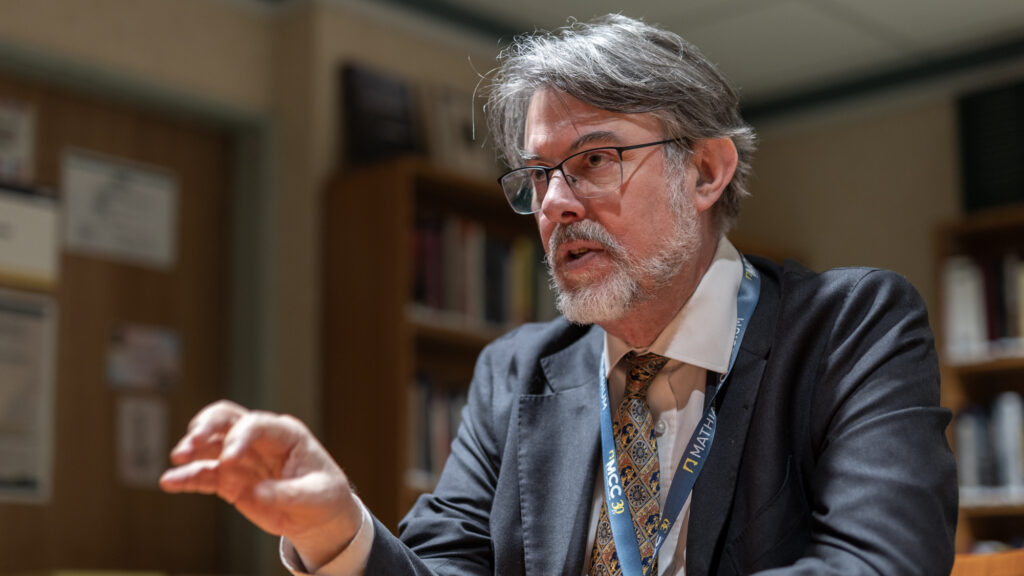 Europeans should aim for peace with Russia if the Iran war continues. PHOTO: Tamás Gyurkovits/Hungarian Conservative
As I understand from your words, Ukraine could be one of the biggest losers of the current situation. What might an acceptable peace deal look like for both parties?
Ukraine will certainly suffer if the war continues. This is a war of attrition. If Russia benefits from higher energy prices while Ukraine receives fewer air defence systems, eventually Russia will win. If the Iran war ends quickly, however, the situation will return roughly to where it was before.
An acceptable peace settlement would involve a ceasefire along the current front lines. Sanctions on Russia would be suspended with a snapback clause. Ukraine would not join NATO, but NATO would continue arming Ukraine and provide enhanced support if Russia resumed the war. The United States would restore normal economic relations with Russia.
This would be painful for Ukraine, but two facts remain. First, Ukraine cannot realistically recover its lost territory. The same military factors that have prevented Russia from breaking through completely have also prevented Ukraine from retaking territory. Second, NATO membership was never truly realistic. NATO membership requires unanimity, and Hungary alone could veto it. Zelenskyy himself admitted in 2022 that major NATO capitals had privately told him Ukraine would not be admitted within five years. NATO membership was effectively an illusion.
Unfortunately, Putin has tied his own prestige to capturing the entire Donbas. Objectively speaking, this is tragic and absurd. We are talking about a very small territory that has become an enormous matter of principle and prestige.
For Ukraine, surrendering more territory is deeply painful. For Putin, declaring victory without conquering the whole Donbas is also politically difficult. Despite constant rhetoric about Russia threatening Europe, Moscow has struggled even to capture relatively small towns like Pokrovsk. Putin will need to present the outcome as a victory, but many Russians may eventually see the war as a serious strategic failure unless circumstances allow Russia to achieve a much larger victory. That is another reason why the war in Iran should end quickly.
What should Europe do to save face, become relevant on the international stage, and ensure its presence at the negotiating table?
Get rid of Ursula von der Leyen. Get rid of Kaja Kallas. Get rid of a whole range of other senior officials. And start thinking realistically about Europe’s real interests and real power. Stop this endless repetition of empty mantras and phrases.
Recognize that vital European interests are involved in restoring Russian energy supplies, restoring a normal relationship with Russia, and bringing the Ukraine war to an end without a bigger Russian victory—but bringing the war to an end nonetheless.
Europe must also prepare for a multipolar world. But this should not be based on fantasies of a centralized European superpower. Instead, the European Union must function in a way that European populations are willing to support and tolerate. That means cooperation between member states in pursuit of their own interests, not dictates from Brussels. And it means prioritizing the issues that ordinary Europeans increasingly care about.
Read more of our interviews: