
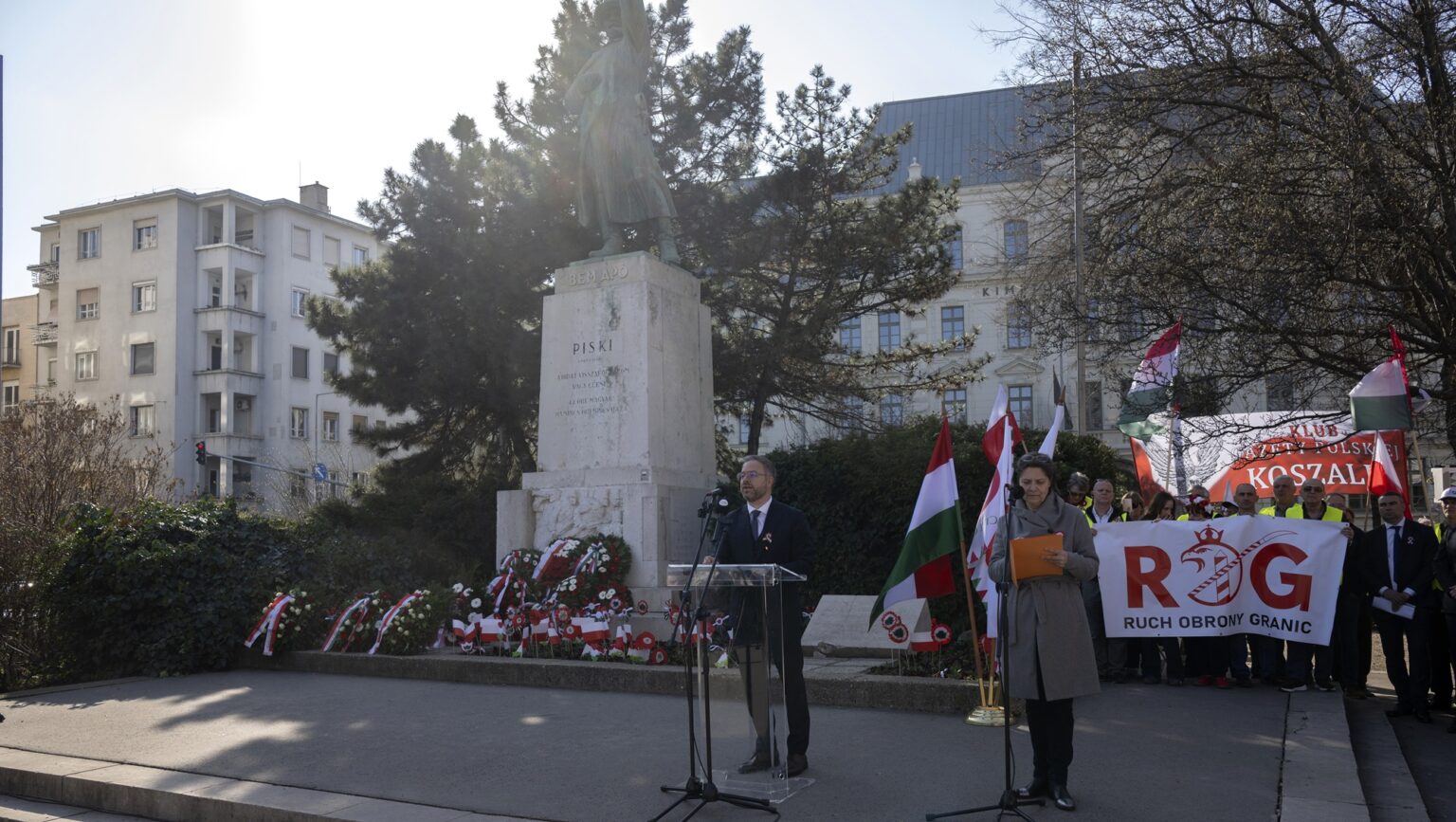
To commemorate the 1848–1849 Hungarian Revolution and War of Independence, the Civil Solidarity Forum – Civil Solidarity Non-Profit Foundation (CÖF–CÖKA) organized an event at Bem Square in front of the Józef Bem statue in Budapest, Hungary on Saturday, 14 March. Józef Bem was a Polish general who led Hungarian troops during the 1848–1849 revolution.
The event also paid homage to the historic Polish-Hungarian friendship with a number of people from the Polish Border Defence Movement in the audience, and with two Polish guests slated among the speakers.
Norberh Hiezler, Organizing Director for CÖF-CÖKA, spoke first. He reminded all that the 1848 Revolution was about winning independence and creating the constitutional order for Hungary. He shared that in the spring of 1848, a number of uprisings broke out across Europe, which gave the opportunity for a set of Hungarian leaders to push for their reforms within the Habsburg Empire. 15 March is a symbol of winning and taking back our freedoms, the speaker continued; and noted ‘our Polish brothers’ who stood with the Hungarian revolutionaries—known as ‘the March Youth’—even back then.
The day has been celebrated as a national holiday in Hungary since 1860, Mr Heizler pointed out, ‘whether the incumbent regime liked it or not,’ referring to the communist regime of the 20th century, which sought to suppress national feelings in Hungary.
László Csizmadia, attorney and President of the Civil Cooperation, got on the mic next. He thanked the ‘ideological soldiers’ who came out in support of the event, referring to the audience. He also reminded all that there will be a Peace March held on the next day, the 15 March holiday, where the crowd will have the chance to tell the EU leadership in Brussels that they stand by peace and national sovereignty.
Balázs Orbán, Political Director for the Prime Minister of Hungary, followed. Director Orbán noted the battle cry of General Bem’s troops, ‘For our and your freedom!’. This was another testament that ‘Hungarian freedom is Polish freedom,’ he explained, also citing Hungarian revolutionary leader Lajos (Louis) Kossuth’s statement in front of Hungary’s National Assembly, ‘the Polish matter is a Hungarian matter’.
Today, however, ‘what is going on in Warsaw is not an example, but a warning,’ Mr Orbán declared, referring to the administration of the ‘globalist’ Prime Minister Donald Tusk of Poland. He accused PM Tusk of lying to the Polish people during his campaign; and instead of delivering on his popular campaign promises, he is now more focused on gender propaganda in Poland.
However, he assured the audience that ‘our Polish friends can count on us, Hungarians;’ and that the right-wing populist cause does not only have support in Hungary and Poland in Europe, but among millions of patriots across the Old Continent.
Paweł Czubik, Polish law professor and jurist, delivered his remarks in Hungarian. He stated there is no other relationship between two nations like that of Poland in Hungary anywhere else in Europe, which withstood all the twists and turns of history, and the onslaught of any enemy. The European Union leadership does not like this fact, according to Mr Czubik, but neither Western or Estern forces can break the bond of Polish-Hungarian friendship, he declared.
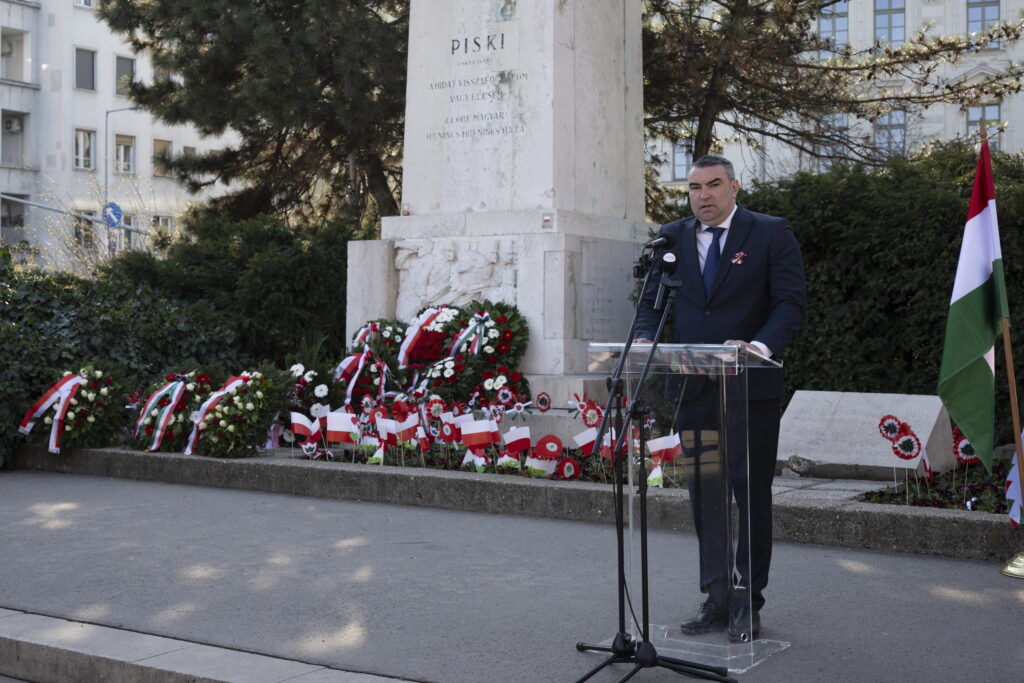 Constitutional lawyer and CÖF-CÖKA spokesperson Zoltán Lomnici. PHOTO: Péter Lakatos/MTI
Constitutional lawyer and CÖF-CÖKA spokesperson Zoltán Lomnici stressed that the heroes of 1848 did not just rebel, they sought to build the constitutional foundation of Hungary; thus they did not just break things down, but also built things up. They also wanted an independent Hungary.
As for Józef Bem, the statue of whom stood behind him, Mr Lomnici described him as ‘the symbol of Polish-Hungarian friendship’. The speaker also shared that General Bem served in Napoleon’s army, and led troops in the 1831 Polish uprising against the Russians, before he joined the revolutionary Hungarian army. He was deployed in Transylvania, where he performed ‘a miracle,’ and pushed the Habsurg forced out of the region in a short period of time.
However, 1848 is not just the past, the speaker declared: today, it symbolizes constitutionality, sovereignty, and freedom. Today, Prime Minister Viktor Orbán of Hungary is the one who is fighting for sovereignty in Europe, Mr Lomnici told the audience, for which PM Orbán had to endure threats against him and his family by a former SBU General from Ukraine, Mr Lomnici pointed out.
Related articles: