
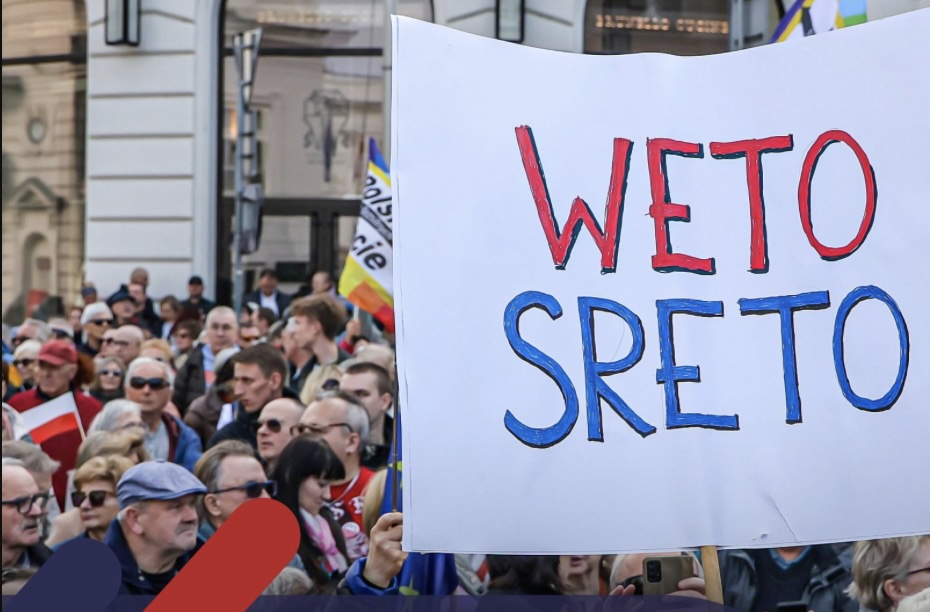
The demonstration was organised by the Committee for the Defence of Democracy under the slogan “We want to be SAFE”, and drew a crowd carrying placards condemning the veto and accusing the president of putting party politics ahead of national security.
The protest followed Mr Nawrocki’s move on 12 March to block the bill that would have enabled Poland to draw on around €43.7 billion in EU loans under the SAFE mechanism. The programme, formally known as Security Action for Europe, is a €150 billion EU-backed instrument designed to support defence investment, increase military readiness and encourage joint procurement among participating states. The European Commission describes it as the first pillar of its wider Readiness 2030 agenda.
EU Launches €150 Billion SAFE Instrument to Strengthen Defence Procurement and Industrial Capacity
For the government of Prime Minister Donald Tusk, the Polish share of SAFE funding is central to a broader rearmament strategy at a time of heightened concern over Russia and the security of NATO’s eastern flank. Warsaw is the largest prospective beneficiary of the scheme, with the funding intended to strengthen military capabilities and support defence-related spending. Mr Tusk’s government has argued that the loans offer relatively favourable long-term financing and would help accelerate procurement without forcing Warsaw to rely exclusively on domestic borrowing.
EU defence financing moves up the agenda as Poland advances SAFE loans
Mr Nawrocki, however, has presented the scheme in markedly different terms. In explaining his opposition, he argued that SAFE would saddle Poland with a long-term foreign debt obligation and expose the country to external political conditions. The president described the arrangement as a 45-year loan that could burden taxpayers and limit national sovereignty. The dispute has become one of the clearest early clashes between the president, who is backed by the Law and Justice camp, and Mr Tusk’s centrist, pro-EU governing coalition.
The president has instead advanced an alternative approach branded “SAFE 0%”, under which rearmament would be financed from Polish national resources rather than EU loans. Mr Nawrocki and allies around him had floated the idea of using unrealised gains linked to the National Bank of Poland’s gold and foreign exchange reserves. The government has so far shown little enthusiasm for that proposal, arguing that it lacks a sufficiently clear and immediate financing base.
Sunday’s protest therefore reflected more than disagreement over one financing mechanism. It also exposed a wider political divide over the direction of Polish defence policy and the country’s relationship with EU structures at a moment when security questions dominate European politics. Participants quoted by RMF24 said they viewed the veto as a direct threat to Poland’s security interests. Placards displayed at the rally carried messages including: “This veto smells of a Russian sock”, “Veto for Karol Nawrocki”, and “Enough of party games.”
The government has already signalled that it does not intend to abandon the SAFE route. Immediately after the veto, ministers approved a resolution allowing work to continue on defence funding arrangements. Mr Tusk said Poland would press ahead with efforts to secure EU support despite the president’s intervention, while the European Commission stated that it remained committed to finalising the loan agreement with Warsaw. Commission spokesman Thomas Regnier said Brussels was still working to conclude the agreement and disburse pre-financing, with an advance of 15 per cent potentially available.
That means the immediate constitutional and political argument in Warsaw is unlikely to settle the matter entirely. The veto has certainly complicated the process, but it has not removed the strategic question facing Poland: whether to fund its military build-up primarily through national means or through EU-backed long-term borrowing tied to a wider European defence effort. With Poland continuing to rank among the states most exposed to the consequences of Russia’s war against Ukraine, that question is unlikely to disappear from domestic politics soon.
Post Views: 1,043