
![[OC] Net domestic migration by state, 2021–2024](https://www.byteseu.com/wp-content/uploads/2026/03/wdcwdyjip9pg1-1536x1074.png "[OC] Net domestic migration by state, 2021–2024")
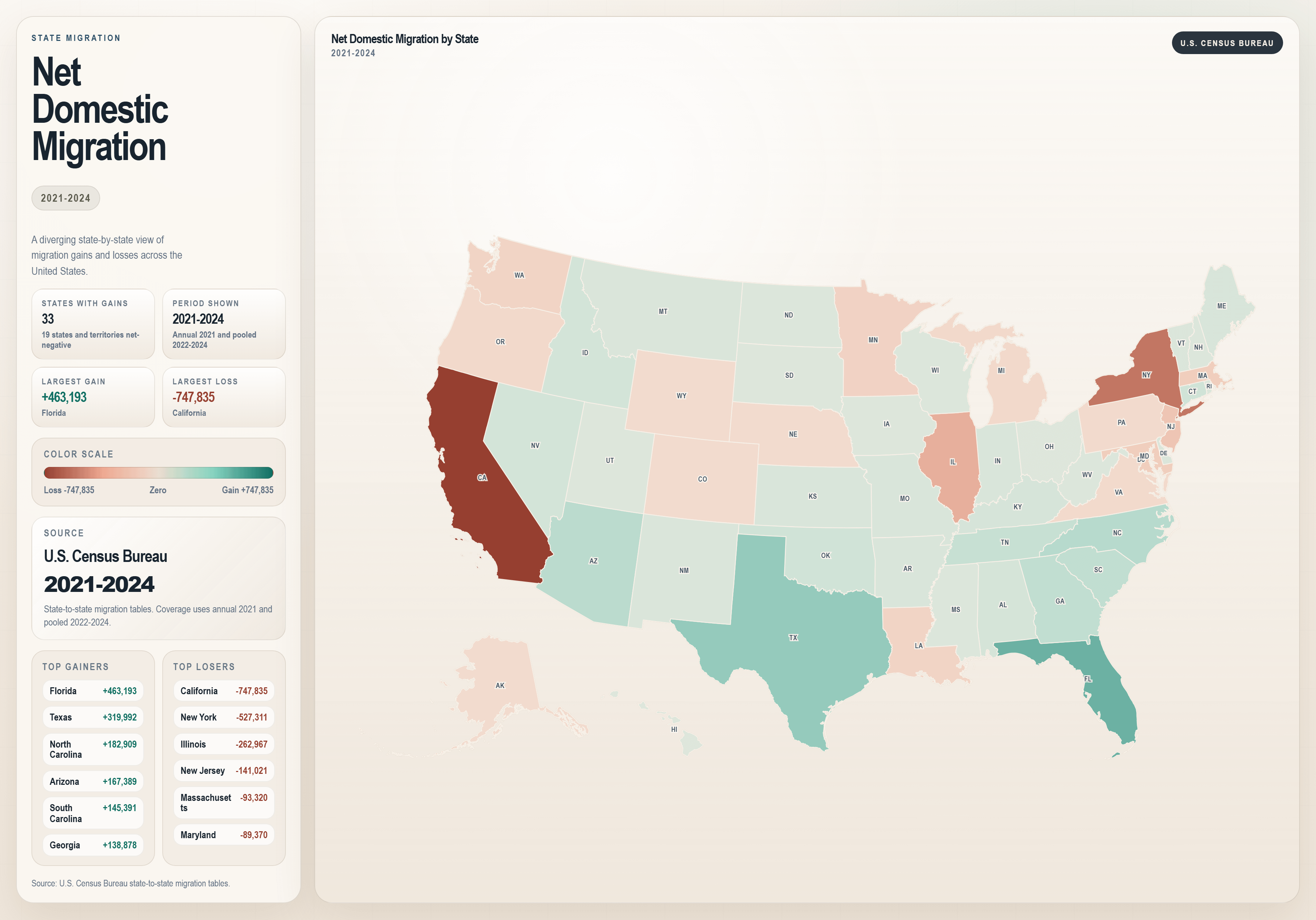
Source: U.S. Census Bureau state-to-state migration tables, using annual data from 2021-2024: https://www.census.gov/data/tables/time-series/demo/geographic-mobility/state-to-state-migration.html
Tools: Python for data prep, JavaScript/D3 with HTML/CSS for the choropleth design, and Playwright/Chromium for the high-resolution PNG export.
Method: I calculated net domestic migration for each state as inflows from other U.S. states minus outflows to other U.S. states, then mapped the result on a choropleth. Positive values indicate net gains and negative values indicate net losses. The side panel highlights the largest gains and losses over the period.
If helpful, the interactive version is here: https://willsigal.github.io/state-migration-analysis/migration_flow_3d.html
Posted by Live-Fan-7661
25 Comments
Y’all need to show this as a percentage since CA losing people when they have a lot of people doesn’t really mean squat in the big picture. Showing absolute numbers makes it look much larger than it is. Also it doesn’t show that the outmigration from CA recovered in the last two or three years and population is back to increasing. S
Interesting, it’s damn near 1:1 map for majority political party. Really gets the noggin’ joggin’.
It would make far more sense if you showed per capita data. Raw numbers don’t really paint a clear picture.
I wonder what the migration amounts would be relative to age? A lot of the top gainers are your typical retirement states such as Florida, Arizona, and South Carolina, for example.
Every day I thank god I don’t live in Florida
California has had a net negative domestic migration for decades but typically still has net positive total population change from migration due to international migration into California.
Further proof that a lot of Americans will put up with all kinds of political shit as long as they can buy a cheap, big-ass house.
As someone who’s lived in TX all my life – y’all should go back to CA.
Ah not done per capita,
Shocker all the largest movements happening in the largest 5 states.
Poorly analyzed. Why is California more important than several other states that add up to the same total population?
All you told us is which states have large populations and whether they’re growing or shrinking: CA, NY, IL vs. FL, TX. The migration could be insignificant or a huge concern and we’d never know from this mess.
Everytime post like this got posted, there would be tons of people defending California, but i havent seen anyone defending NY.
Do we have data for 2025? I am curious how many people who moved to TX and go for tax purposes started moving out in the last few years
Funny because according to Reddit Texas and Florida are shitholes but the data shows people from left-leaning states are moving there in droves.
Whatever Reddit says, assume the opposite is correct
Wonder when people are going to get tired of posting the “during covid people realized they could get away with WFH and moved from expensive successful cities and coastal areas to LCOL and warmer areas” map
The top gainers/losers is opposite of what you’d believe if you read r/SameGrassButGreener
Why do I suspect if this showed net migration from red states to blue states none of these commenters would care about per capita or not?
Everywhere I look, even in the states losing population, housing costs are rising. That doesn’t square with so many people supposedly leaving the state. With all the ICE raids etc. and people retiring and moving to FL and TX, you’d think that the states losing net population would have more affordable housing.
I left NY in 2025. I know few other young families who also moved south. It’s gotten extremely expensive.
This is sus as I know WV has been losing population.
This is a really odd way to view the data. And I would argue, pretty deceptive. The **standard way analysts compare population change across U.S. states is percentage growth**, not raw net numbers. Notably, that list is quite different:
1. Florida — **~7.0%**
2. Idaho — ~6.8%
3. South Carolina — ~6.5%
4. Texas — ~6.3%
5. Utah — ~6.0%
6. Arizona — ~5.8%
7. North Carolina — ~5.6%
8. Montana — ~5.5%
9. Tennessee — ~5.2%
10. Delaware — ~5.0%
11. Nevada — ~4.9%
12. Georgia — ~4.4%
13. Washington — ~3.3%
14. Colorado — ~3.2%
15. South Dakota — ~3.1%
16. Wyoming — ~3.0%
17. Oregon — ~2.9%
18. New Hampshire — ~2.9%
19. Arkansas — ~2.8%
20. Alaska — ~2.7%
21. Maine — ~2.6%
22. Vermont — ~2.5%
23. Alabama — ~2.4%
24. Indiana — ~2.3%
25. Kentucky — ~2.3%
26. Oklahoma — ~2.2%
27. Wisconsin — ~2.1%
28. Minnesota — ~2.0%
29. Iowa — ~2.0%
30. Kansas — ~1.9%
31. Nebraska — ~1.8%
32. Virginia — ~1.7%
33. Missouri — ~1.6%
34. Maryland — ~1.5%
35. Massachusetts — ~1.4%
36. Michigan — ~1.3%
37. Ohio — ~1.2%
38. Pennsylvania — ~1.1%
39. Connecticut — ~1.1%
40. Rhode Island — ~1.0%
41. California — ~0.4%
42. Illinois — ~0.3%
43. New York — ~0.2%
44. North Dakota — ~0.2%
45. New Mexico — ~0.1%
46. Louisiana — **−0.3%**
47. Mississippi — −0.3%
48. West Virginia — −0.4%
49. Hawaii — −0.6%
50. Alaska — ~0% to slightly negative depending on estimate year
#
Maybe over time the population will be more spread out across the county as remote work and the loss of manufacturing no longer requires people to live in certain areas.
And, somehow, upstate NY has the hottest housing markets in the country 😐
I’m guessing it has less to do with age and more to do with financial stability. People with higher earning potential typically migrate away from higher tax rate States. Although people typically become more financially viable the older they are, that viability plateaus or even decreases once they hit retirement age.
Really interesting visual, thanks for sharing.
democrats are losing congressional seats after 2030. democrats may need more than the blue wall to win the presidency in 2032. Biden won by 4 points in 2020 and barely squeaked out an electoral win that included 2 red states. democrats will likely need at least a 4 point victory to win the white house in 2032. maybe more.
this also may permanently give the house to republicans. since 1994, the democrats have only held the house for 8 years.
Is the move to tx/fl because they don’t have any state taxes?