

China is back on investors’ radar again. Beijing continues to signal possible policy support, and each comment from policymakers quickly triggers speculation about whether a stronger recovery is finally taking shape. At the same time, the United States continues to show steadier macroeconomic performance than many analysts expected after several years of higher interest rates.
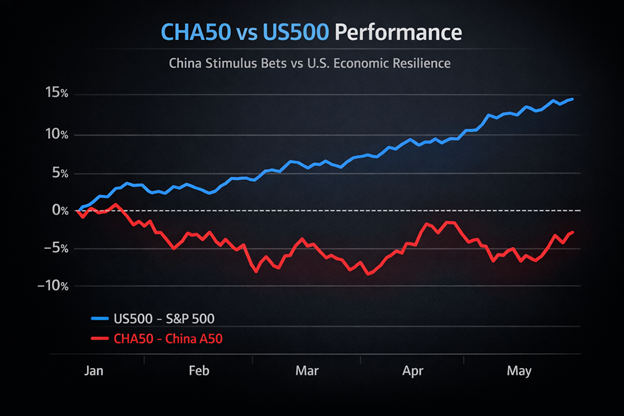
This tension sits at the center of the vs. discussion. One side offers the possibility of a policy-driven rebound. The other still benefits from stronger earnings visibility, deeper capital markets, and a macro environment that remains relatively stable. For traders watching the versus trade of the CH50/US500 pair, the core dilemma is straightforward. Should investors position themselves for a China rebound or continue relying on the durability of U.S. equities?
A Widening Macro Contrast
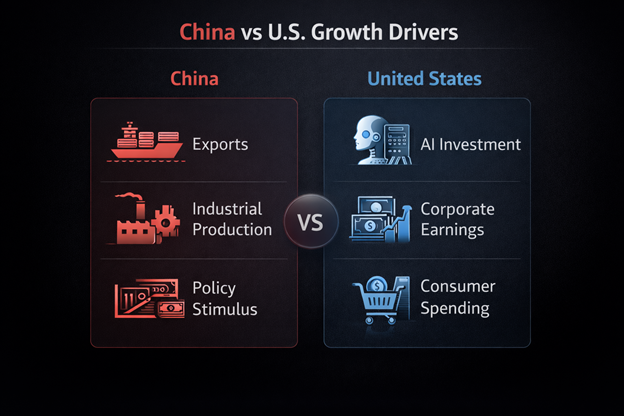
Any serious China vs. US economy comparison in 2026 begins with growth expectations. The International Monetary Fund estimated global economic growth at roughly 3.3% for 2026, with the United States projected to expand around 2.4% and China approximately 4.5%. On paper, China still grows faster. In practice, investors increasingly focus on the structure of that growth rather than the headline number.
The United States has been supported by a resilient labor market, steady consumer demand, and strong corporate investment. Growth has slowed compared with the immediate post-pandemic recovery period, yet it continues to exceed many forecasts. That is why US economic resilience remains one of the dominant narratives in global markets.
China’s outlook reflects a different set of drivers. Economic momentum has leaned more heavily on industrial output and exports while policymakers continue working to stabilize domestic demand. This contrast shapes the current macro outlook, China vs. the US, and explains why investors increasingly examine relative positioning between the two markets.
China’s Recovery Still Depends on Policy Signals
For many investors, the China story remains closely tied to China’s stimulus expectations. Policy support has repeatedly stabilized sentiment over the past several years. Each new hint from Beijing raises expectations that fiscal spending or credit easing could strengthen economic momentum and lift market confidence.
Recent trade data shows that China’s external sector remains strong. Exports rose 21.8% in January and February, while imports increased 19.8%. These figures suggest the economy has held up better than some analysts feared despite ongoing global trade tensions. They also support a more balanced Chinese economic recovery outlook than the most pessimistic scenarios implied.
The same numbers illustrate China’s economic resilience to US tariffs in 2024 and 2025. Chinese exporters have adjusted by expanding trade relationships and shifting supply chains, allowing exports to remain strong even amid geopolitical pressure.
At the same time, strong trade performance may reduce the urgency for aggressive policy intervention. If exports continue supporting growth, Beijing may prefer gradual policy adjustments rather than a large stimulus package. This tension sits at the center of China’s stimulus vs. US market strength.
What the CHA50 vs US500 Pair Actually Reflects
Viewed through China A50 vs. the S&P 500, the comparison represents far more than two equity indices. Each market reflects a different economic structure and a different set of growth drivers.
CHA50 contains many companies connected to China’s domestic financial system, industrial production, and state-linked sectors. Their performance often depends on policy direction, credit conditions, and investor expectations about government support.
The U.S. market reflects another dynamic. Corporate earnings remain supported by strong balance sheets and an ongoing investment cycle tied to artificial intelligence infrastructure. Large companies continue expanding spending on data centers, computing capacity, and digital services. This investment wave has become one of the defining forces in regional equity performance comparison and helps explain why China vs. US equities often respond to different catalysts.
This difference also shapes the broader discussion about emerging markets vs. US stocks. When the U.S. economy remains relatively strong and corporate profits continue expanding, investors rarely rotate capital into emerging markets purely because valuations appear cheaper. Capital flows tend to follow clearer shifts in global growth expectations.
That dynamic continues to influence the emerging markets’ outlook for 2026.
Global Capital Flows Are Shifting Cautiously
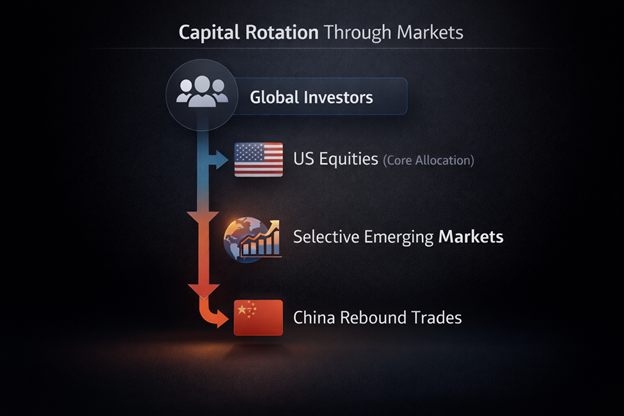
Signs of global equity rotation are beginning to appear across global markets, but the process remains gradual. Investors are testing new exposures rather than abandoning existing ones. Some portfolios have begun adding China allocations as a potential recovery hedge, while most global funds still maintain large positions in U.S. assets.
This cautious approach reflects broader global capital rotation patterns. Large reallocations typically occur only when several conditions align: slower U.S. earnings growth, a weaker U.S. dollar, and stronger growth prospects outside the United States. Those conditions have not fully materialized yet.
As a result, investor allocation in global markets remains balanced rather than decisively shifting. Some investors prefer to trade China vs. US stocks through relative strategies instead of making a large directional bet on China. The divergence between the two economies creates opportunities linked to global growth divergence and encourages more selective regional investment strategies.
The Bottom Line for the CHA50 vs US500 Trade
The CH50/US500 comparison ultimately comes down to timing. China’s economy continues to show resilience, particularly in trade and manufacturing. The United States still benefits from stronger corporate earnings and a powerful technology investment cycle.
That balance explains why the emerging markets outlook 2026 forecast is improving but has not yet displaced the United States at the center of global portfolios.
In practical terms, the relative trade will likely hinge on one factor. If Beijing moves beyond signals and delivers meaningful stimulus, China’s equities could reprice quickly. If policy remains cautious, the steady strength of the U.S. market may continue to dominate.
For now, China’s stimulus expectations continue attracting investor attention. Yet the consistency of the American market remains the benchmark that competing regions still need to surpass.