
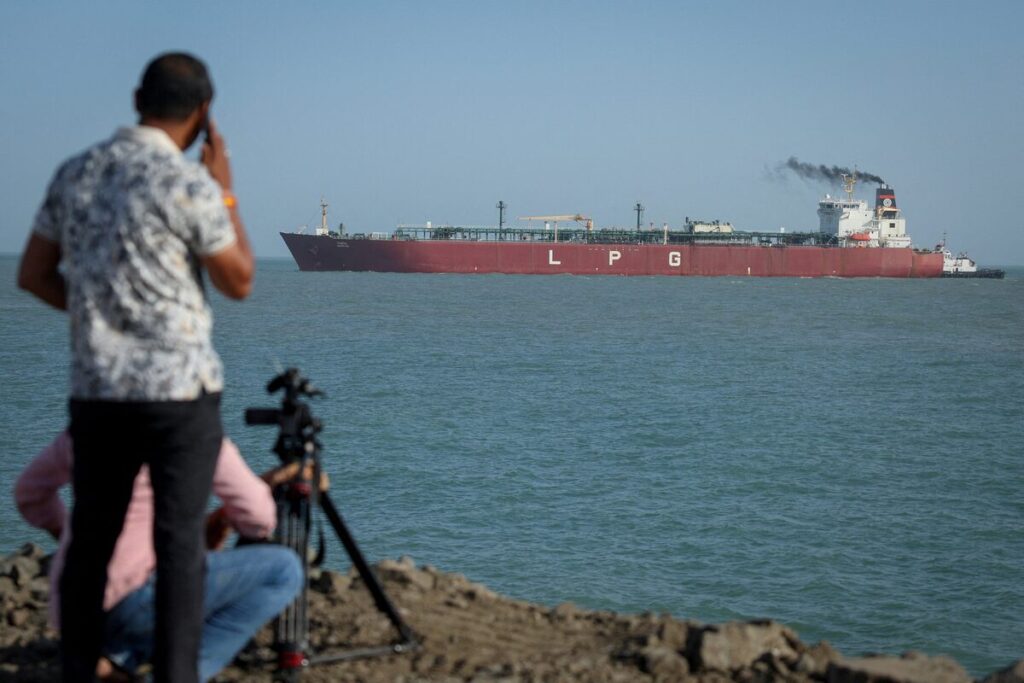
An Indian liquefied petroleum gas carrier, Shivalik, arrives at Mundra Port in Gujarat, India, via the Strait of Hormuz, amid the U.S.-Israel conflict with Iran, on Monday.Amit Dave/Reuters
Iran has allowed two Indian-flagged liquefied petroleum gas tankers to pass safely through the Strait of Hormuz, a rare exception to the blockade it has imposed on the waterway in its war with the United States and Israel.
At the same time, Indian Prime Minister Narendra Modi has yet to condemn the assassination of Ayatollah Ali Khamenei, Iran’s supreme leader, on the first day of the war, even though he has criticized Iran’s subsequent attacks on its Persian Gulf neighbours.
The diplomatic tightrope India is walking shows that a worsening energy crisis in the country is prompting Mr. Modi to recalibrate his response to the war, as India balances its defence partnership with Israel and its energy interests in the Persian Gulf region.
European leaders rebuff Trump’s calls for military help in Strait of Hormuz
India buys about 90 per cent of its imports of liquefied petroleum gas (LPG), used mostly for cooking, from the Middle East. Since the start of the war, the government has invoked emergency powers and directed refiners to maximize production of LPG to ease the pressure on Indian consumers and businesses.
Mr. Modi’s decision to say little about the attacks on Iran appears to be linked to his cordial relationship with Israeli Prime Minister Benjamin Netanyahu and India’s evolving relationship with Iran.
Israel’s Prime Minister Benjamin Netanyahu and his Indian counterpart Narendra Modi arrive for a press conference in Jerusalem on Feb. 26.GIL COHEN-MAGEN/AFP/Getty Images
Two days before Israel and the U.S. launched air strikes on Iran, Mr. Netanyahu invited Mr. Modi to Jerusalem, where he described him as a “brother” and a “great champion of the Israel-India alliance.” Mr. Modi referred to him as a “dear friend.”
Some in India believe Mr. Modi was briefed by Mr. Netanyahu about the plan to attack Iran.
The visit drew criticism from the opposition Indian National Congress party and caused unease among Mr. Modi’s loyalists in diplomatic circles. Tensions escalated further after the strikes on Iran killed Ayatollah Khamenei and scores of civilians, including schoolchildren.
War in Iran causes energy crisis in South Asia, disrupting life for millions
Despite mounting pressure, Mr. Modi avoided making a public statement condemning the attacks. Even after a U.S. submarine torpedoed an Iranian vessel that had recently taken part in a naval exercise in India, killing 84 sailors, New Delhi steered clear of criticizing the U.S. or Israel.
India’s relationship with Israel really took off with defence co-operation during the the former’s 1999 Kargil War with Pakistan. Israel provided India with artillery shells on short notice, and in his book The Evolution of India’s Israel Policy, Nicolas Blarel says Israel even provided India with laser-guided missiles for its fighter jets and surveillance drones.
Mr. Modi’s 2017 visit to Tel Aviv, the first by an Indian prime minister, gave the relationship a decisive boost. It has since evolved into a special strategic partnership.
Indian Prime Minister Narendra Modi is accompanied by Israeli Prime Minister Benjamin Netanyahu and Yad Vashem Chairman Avner Shalev (L) during a visit to Yad Vashem Holocaust memorial in Jerusalem on July 4, 2017.POOL/Reuters
“Modi framed the co-operation within a civilizational framework, emphasizing a shared approach to combating terrorism as its victims, which indicates an ideological convergence of the ruling party with Israel,” Praveen Donthi, a senior analyst for India at the International Crisis Group, told The Globe and Mail.
“The trajectory, given the ruling party’s affinity for Israel and India’s role as the largest importer of Israeli arms, is not surprising,” Mr. Donthi said. “However, Modi’s visit to Tel Aviv amidst a looming conflict between the U.S., Israel and Iran was unusual, and New Delhi’s failure to condemn the assassination of Khamenei while criticizing attacks on Gulf countries was perplexing, especially considering its claims of strategic autonomy.”
As the Iran conflict deepened and energy supplies began to tighten, long queues formed outside cooking gas distribution centres across India amid fears that supplies might run out.
U.S. military may have bombed Iranian girls’ school using outdated targeting data, sources say
The government raised the price of LPG cylinders by 60 rupees to 912 rupees and began rationing supplies. Videos circulating on social media show public anger over cooking gas shortages and rising fuel prices in a country where energy costs remain politically sensitive.
Mr. Modi eventually spoke by phone with Iranian President Masoud Pezeshkian, underscoring the importance of keeping energy routes and transit through the Strait of Hormuz uninterrupted.
Before the call, India’s External Affairs Ministry made several diplomatic overtures aimed at easing tensions with Tehran and ensuring the safe passage of Indian oil and gas shipments through the narrow waterway linking the Persian Gulf to the Indian Ocean.
President Donald Trump said on Sunday his administration is talking to seven countries about helping to secure the Strait of Hormuz amid the U.S.-Israeli war on Iran, calling on them to help protect ships in the vital waterway that Tehran has mostly blocked to oil tanker traffic.
Reuters
Ministry spokesperson Randhir Jaiswal expressed regret over the civilian casualties in Iran, saying: “We regret the precious lives lost, and express our grief in that regard,” suggesting New Delhi may be attempting to soften the tone of its earlier stand.
“New Delhi, after tying itself up in knots over its stance, has attempted to modify it through subsequent statements and phone calls to Iran,” Mr. Donthi said, adding the shift appeared to be “damage control in response to oil and gas supply shocks amid mounting domestic pressures.”
India’s vulnerability reflects its dependence on Gulf countries, which supply more than 80 per cent of its crude oil. Roughly half of that, about 2.5 to 2.7 million barrels a day, typically travels through the Strait of Hormuz from suppliers such as Qatar, Iraq, Saudi Arabia and the United Arab Emirates.
Iranian Foreign Affairs Minister Abbas Araghchi told CBS on Sunday that Iran was “open” to talks with countries that want to discuss “safe passage of their vessels.”
“I am at the moment engaged in talking to them and my talking has yielded some results,” S. Jaishankar, India’s External Affairs Minister, told the Financial Times, adding that diplomacy offered a better solution. “This is ongoing. If it is yielding results for me, I would naturally continue to look at it.”
Opinion: India has an oil problem. The Iran war makes it worse. Canada is the solution
Mr. Jaishankar’s comments come after U.S. President Donald Trump called on countries to send warships to help the U.S. force open the Strait of Hormuz for energy markets.
Oil prices rose above US$100 a barrel last week for the first time since August, 2022, with analysts warning that the conflict could drive them higher if tensions persist.
“India maintains close ties with all power centres in the Middle East. It’s the only region where non-alignment in the 21st century delivers dividends,” Kabir Taneja, executive director for the Middle East at New-Delhi based think tank Observer Research Foundation, told The Globe and Mail.
“Iran is more important to India as an extended neighbouring state for its ‘other’ borders with Afghanistan, Pakistan and Central Asian states,” he said.
India now finds it increasingly difficult to maintain that equilibrium.
“There are far too many balls up in the air for a textbook juggling act,” Mr. Taneja said, warning that the historical balance of India’s Middle East diplomacy is now facing some of its strongest headwinds to date.
Mr. Donthi said there seems to be an overwhelming domestic consensus that New Delhi should remain neutral. “This will be a litmus test for India’s strategic autonomy and its status as a rising global power.”