
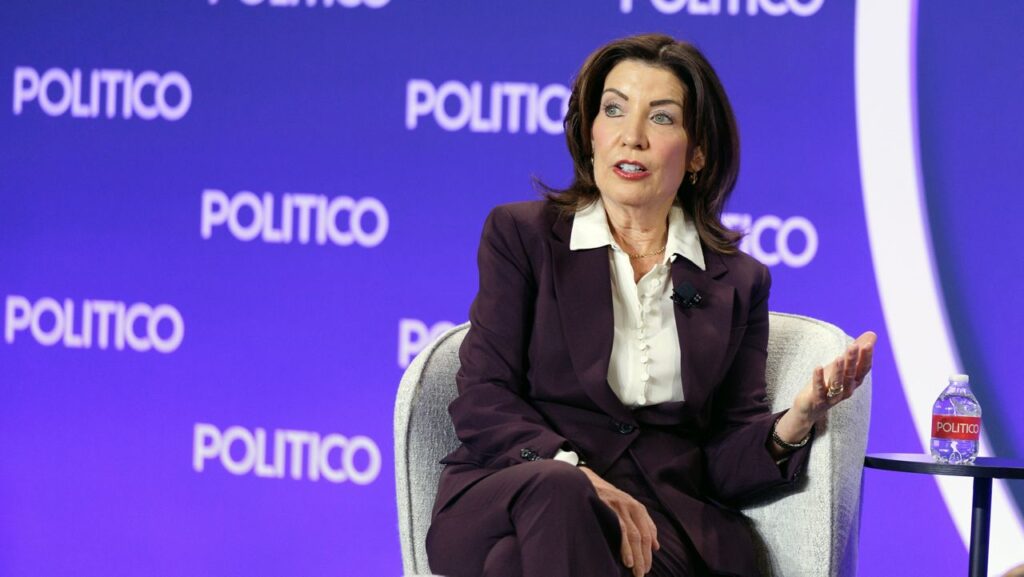
State budget negotiations took flight Monday with the kickoff meeting known in Albany circles as “the mothership” and an announcement from Gov. Kathy Hochul that she is preparing to introduce a formal proposal to change the state’s 2019 climate law this week.
Potential changes to the Climate Leadership and Community Protection Act, or CLCPA, are widely seen as the most likely cause of budget friction between Hochul, Senate Majority Leader Andrea Stewart-Cousins and Assembly Speaker Carl Heastie as they negotiate the budget ahead of the April 1 deadline.
Echoing comments she made last week, Hochul indicated she plans to propose changing the dates by which the state must meet certain emissions-reduction goals under the law by week’s end
“We’ll be announcing them this week. I think we need a longer runway,” Hochul told reporters in Buffalo on Monday. “All the goals we’re supposed to meet would have to be met by 2030, 2031. That’s not possible without prices going up.”
While Hochul and her team have slowly rolled out their intentions and thought process over the course of months, Monday’s comments were the first clear statement that a formal proposal for legislative leaders to consider is forthcoming.
Hochul has continued to blame the impending impacts of a lawsuit brought by environmental advocates intended to force the state to develop regulations for its troubled cap-and-invest program for her urgency in amending the law. But advocates have insisted Hochul is mischaracterizing the lawsuit and using it to push what they describe as an unrealistic doomsday scenario. Stewart-Cousins and Heastie will be left to sort it out and telegraph their members’ thoughts and concerns in the coming days.
The developments came as legislative leaders from the Senate and Assembly met Monday afternoon for the “mothership,” formally known as the General Budget Conference Committee, intended to be an exercise in transparency as the two houses work to consolidate their budget proposals.
Despite that goal, the meeting typically consists of about 30 minutes of prepared speeches from legislative leaders in both houses and both parties, followed by a series of individual meetings geared toward prioritizing spending needs. It’s no secret in Albany that the remainder of the conversation takes place behind closed doors, save for the small tidbits reporters can extract during brief hallway interactions with leaders or the occasional press availability.
While attending the mothership, Heastie told reporters he isn’t prepared to comment on the governor’s climate announcement without seeing a concrete proposal.
“I don’t know how to respond to that until I see a plan. I know the governor has spoken about this, but until there is an actual plan, I think I’ll reserve comment,” he said.
Stewart-Cousins agreed.
“We have not seen a plan. We have heard her say she would like to modify,” she said.
It comes as state Senate Republicans are urging Hochul to reconvene the Climate Action Council to review the CLCPA.
Changes to the climate law and how the state intends to respond to the Trump administration’s immigration crackdown have emerged as two oddballs this budget season. The climate law proposal hasn’t taken the form of a traditional State of the State proposal or a 30-day amendment add-on, nor does it appear it will be sprung on legislative leaders in an overtime sneak attack close to or after the deadline, as some of the governor’s pitches have been in recent years.
The development of an immigrant protection package has also followed a nontraditional blueprint existing largely outside of other budget talks despite Hochul introducing multiple proposals as part of her executive budget. Those include banning formal agreements between local governments and Immigration and Customs Enforcement, and protecting certain sensitive locations from ICE intrusion without a warrant. Progressives in the state Legislature, meanwhile, have pushed for a package anchored by the New York for All Act, which further restricts cooperation.
Despite repeated use of the phrase “sooner rather than later” since the legislative session began in January — and indicating they would like to see a package developed before the rest of the state budget is finalized — April 1 is closing in with limited movement.
Stewart-Cousins was ambiguous when asked Monday whether a solution would come before, during or after the budget.
“There are a lot of things that are priorities. Certainly the budget is what is in front of us, but the immigration issue has been a perpetual issue that we have to answer in the moment, and we want to do that as soon as possible,” she said. “If we can get a three-way agreement, it would certainly be outside of the budget. We left an opportunity to do it within the budget, but I think they are on parallel tracks.”
Stewart-Cousins has consistently said she would like to see a three-way agreement that comes as close to the New York for All Act as possible. Heastie acknowledged Monday that the final package will have to address how to handle people who commit serious crimes, which has long been a concern of the governor.
“No one wants the issue of what the federal government says was their mission of deporting the worst of the worst in terms of crime,” he said. “I think we’re trying to figure out language that would agree with that, but also not allow for the runaway stuff that ICE has been doing.”
In recent years, budget negotiations have run past the deadline, culminating in a May 9 deal last year that marked the latest budget in 15 years. Heastie didn’t rule out meeting the April 1 deadline this year, but offered little comfort for anyone hoping to flee Albany on the night of March 31.
“We always like to have an on-time budget, but a better budget is more important than an on-time budget,” he said. “We’ve got two weeks to figure it out. I want it to be on time. I’m sure the leader wants it to be on time. I’m sure our members want it to be on time.”
Deputy Senate Majority Leader Mike Gianaris’ hopes remained elevated Monday afternoon.
“Hopefully March 31 or very soon thereafter,” he said.