
![I mapped where people appear on screen — are modern movies being composed for vertical video? [OC]](https://www.byteseu.com/wp-content/uploads/2026/03/fw5lq58xhnpg1-1024x960.png "I mapped where people appear on screen — are modern movies being composed for vertical video? [OC]")
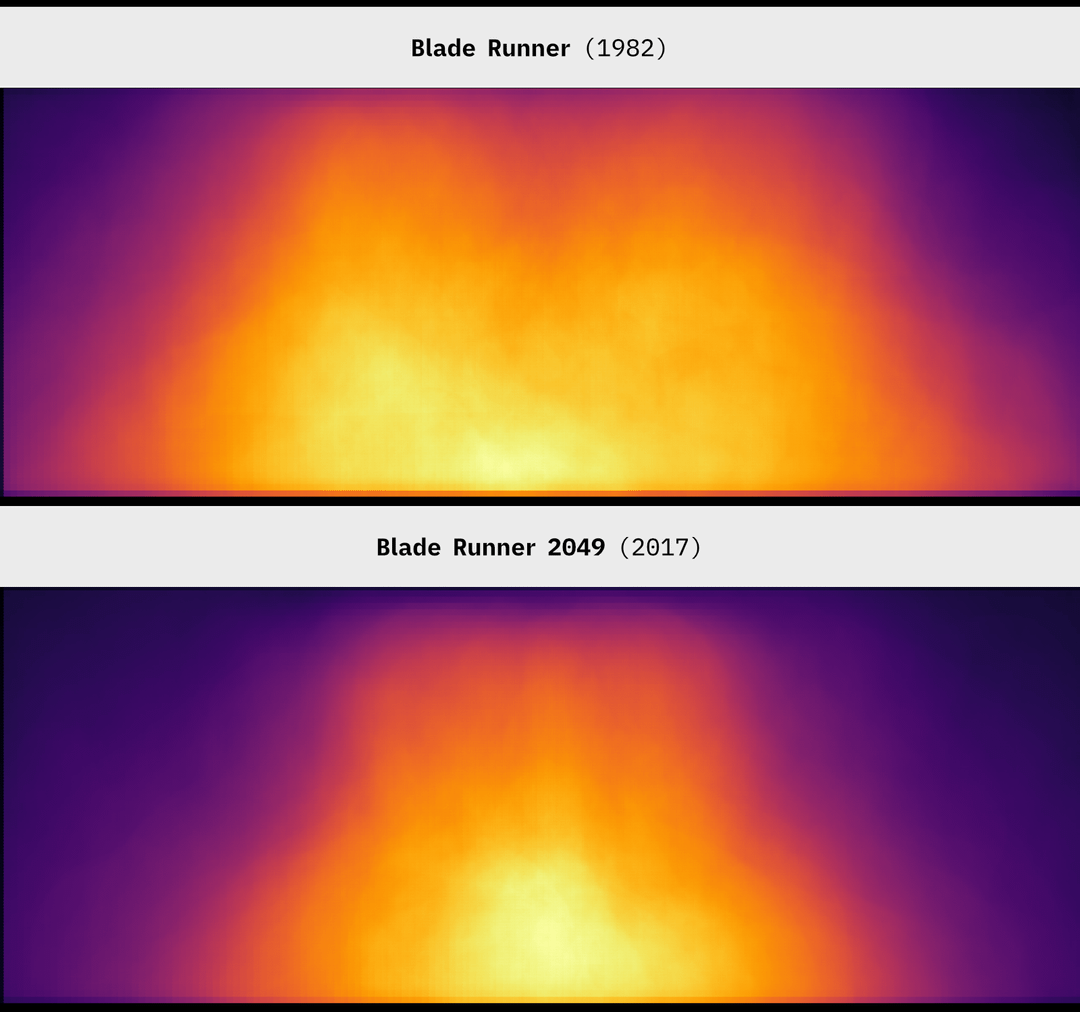

Built a little experiment after suspecting that modern movies are being composed with Instagram Reels in mind. Extracted one frame per second from a handful of films, ran YOLO segmentation to find where people appear in each frame, and stacked it all into interactive heatmaps.
Posted by PuciekTM
34 Comments
2017 seems a bit early to be influenced heavily by reels/tik toks.
that’s a SERIOUSLY cool visualization with the frame sliders.
Cool data but no way was Dennis Villeneuve optimizing Bladerunner 2047 for TikTok in 2017
Source of data: Own BluRay rips
Tool: Python, React, ffmpeg
Hard to say when you only look at 6 movies.
> are modern movies being composed for vertical video?
Cool visualisation, but obviously no. And your data barely even supports that claim
If anything, it’s probably the decline of cinematography in the digital green screen age
Really cool plots.
Should be interesting to see if the trend extends over a larger sample size.
Isn’t it a screen ratio thing
Your sample is 6 movies.
You should really control for things like genres or release aspect ratios and get a larger sample size before drawing any conclusions. It wouldn’t hurt to get a professional opinion either.
Interesting considering the older films would have been clipped to fit the 4:3 screen of TVs
Great visualization. Love the idea. To put it bluntly…now do all the movies
I remember watching the original Blade Runner years ago in a film class and being amazed at how it used the entire frame.
For Fury Road George Miller deliberately put the action at the center of the screen as a response to CGI action and superhero movies that had become a mess with too much fast action all over the screen.
An interesting one to study would be the 70mm cut of The Hateful Eight which has a lot of interesting peripheral action. (Maybe Tarantino was inspired by Leone?)
Too small a sample size. Wonderful idea to investigate however
I’m certain it has nothing do to with Instagram reels, though it is a trend do have more central shot on actors.
Before the “ensemble shot” was much more popular, with each actor filling it’s part of the screen talkin in turn, doing their own thing.
But as cinema progressed, this became less and less common due to several factors.
One, those kinds of wide shots require more from the actors performing, as you have multiple failure points vs piecing together the movie from 4-5-10 reshoots, using different takes from different actors.
The latter being much much faster to shoot.
Also a factor was how cheap cameras got, they have a lot more cameras on the sets, giving multiple angles. While before it was one main camera, and maybe a secondary angle shot, due to cost.
And also lately the “netflix” trend. People are too “stupid” to pay attention to 4 actors in one scene at the same time doing different stuff, so you have to piecemeal it, giving it with a teaspoon to the viewer or else they will miss something.
I can believe it honestly, but I think it’s ridiculous to use Blade Runner 2049 as an example!
Do the same experiment with some of the slop films that Netflix pushes out each year!
Very interesting, but obviously we need a waaaay bigger sample size.
I think this is a horrible example because I don’t believe that’s true for 2049.
We’d need you to map a lot more movies to be sure, but I would think that, if anything, this might be just to accomodate multi-platform viewing. TVs, laptops, phones.. idk, airplane screens..
(From a cinematography perspective, I think centering helps with continuity, eye tracking for viewers, and it makes it easier to cut between shots.)
I don’t think there’s enough here for a firm conclusion, but for reference – THIS is what I’m always hoping to see on this sub, not another ugly bar chart about current events.
Does anyone actually watch movies vertically? Most people I see put their phone in landscape and set it on a table.
Even watching short clipped content vertically just feels bad.
There were also many years where symmetrical shots were seen as kind of uncool. When Wes Anderson started doing it, it was so striking because he was one of the few people in the mainstream doing it. In the maps that are farther out, I have a suspicion that it’s not that the action of any individual scene is spread farther out, but rather that it’s more off-center.
How are you using the Big Lebowski to prove this theory when it came out almost a decade before the first iPhone?
I’d like to see the output for Parasite
Movies recorded today aren’t recorded on expensive film. Older movies would shoot scenes with both actors in frame if they were talking and scenes were done in as few takes as possible.
Today, storage is cheap, but the time of an actor is expensive. You do as many shots as you can of each scene and grab the best ones.
Dialogue between characters will often feature the speaking character only and shift to the person their speaking with when they respond. This makes the life of the editor easier.
I would do Mad Max fury road. It is known to have everything in the center of the screen.
Blade Runner was probably being optimized for the squarer IMAX format.
The glass onion heat map doesn’t really look dramatically different from the older movies; however, the film makes use of action in the foreground to distract from clues happening in the background, so that might explain why more happens in the middle of the screen.
Cool idea but youd need to analyze thousands of randomly picket movies for this data to be even remotely indicative on anything
Why did you go back 40 – 60 years? Just go back ~10, right around when short form content started picking up speed.
The subject of a scene is most likely to appear in the center of the screen.
Fork found in kitchen.
Not necessarily “vertical” but definitely to fit reasonably full frame on 16×9 and 4×3 aspect ratios without letterbox or pan-and-scan.
I don’t know what conclusions can be drawn from this, if any, but it sure is pretty and interesting.
Do Mr robot. They loved an off center character.
This is interesting. I work in film, and I’d attribute this trend not specifically to vertical video (maybe a bit), but more broadly to streaming. The standardization of looks by companies like Netflix across their products has people trained to shoot certain ways, and thus our visual lexicon changes over time much like language evolves. Specifically I’m betting this is the result of shooting tighter over-the-shoulder and 2-shots, “stacking” the actors visually creates better sense of depth and immersion