


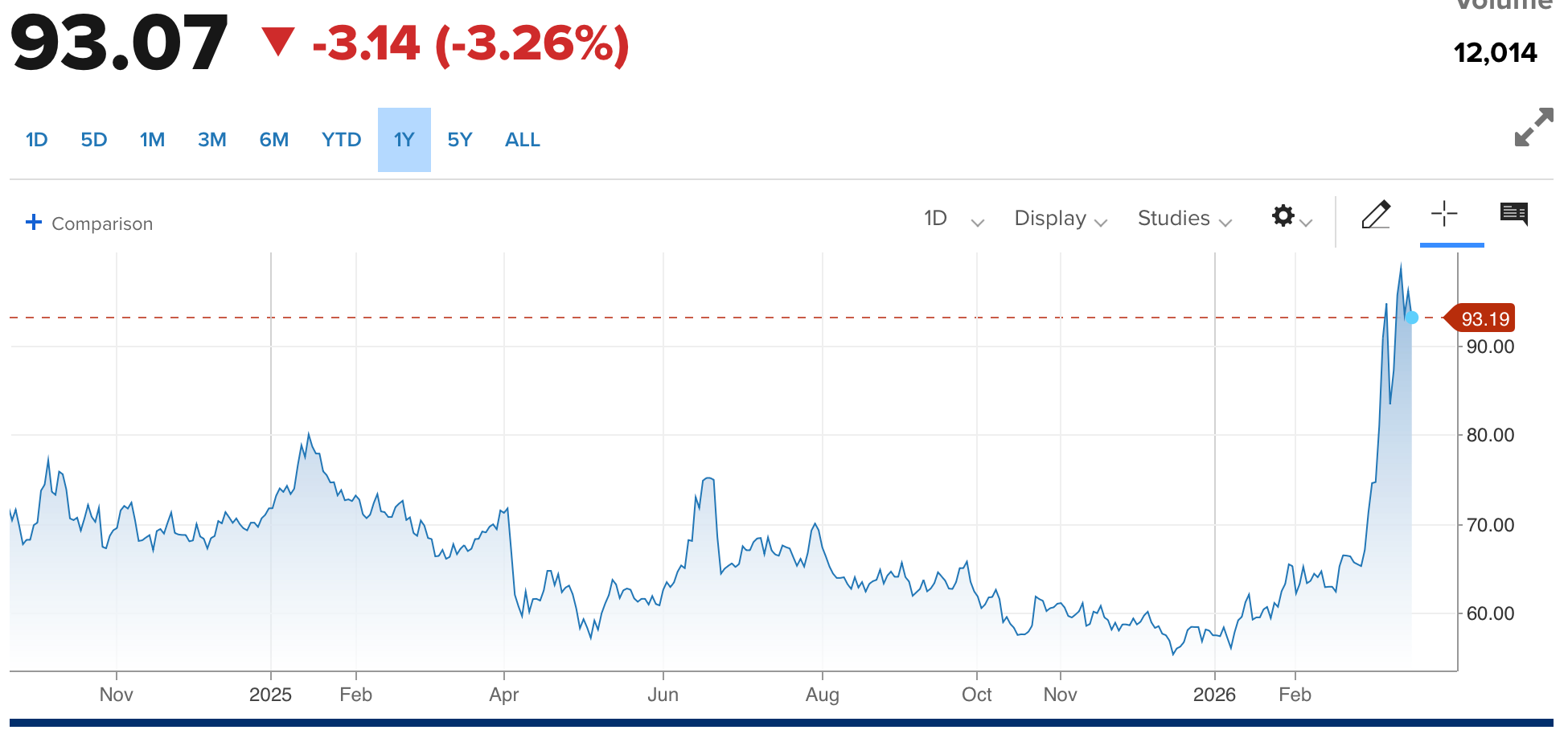
The question of what price West Texas Intermediate (WTI) crude oil must reach to trigger a U.S. recession may initially seem to have a simple numerical answer. Many economic analysts have pointed to thresholds of $100, $120, $130, or even $150 per barrel as key levels where economic harm might become unavoidable. However, focusing only on a fixed price level risks oversimplifying a much more complex process. Oil doesn’t act as a straightforward trigger for recession; instead, it serves as a probabilistic shock whose impact depends not just on price but also on expectations, the length of the shock, and the overall macroeconomic climate.
Source: CNBC
Currently, with spot prices increasing due to geopolitical tensions but future expectations easing, the gap between current conditions and forecasted future prices offers an important perspective for assessing recession risk. Consensus across Wall Street research offers a useful starting point. Bank of America has suggested that sustained oil prices above $100 can begin to dampen equity markets and curb discretionary spending. At $120 per barrel, some analysts see oil as having reached a “recession trigger,” where GDP growth could come to a halt. By the time prices near $130, firms like Wells Fargo Securities argue that the cumulative effects—eroding consumer confidence, reduced spending, and tightening labor markets—become strong enough to cause outright contraction. More extreme estimates from
Vanguard and Oxford Economics place the definitive recessionary threshold closer to $140–$150 per barrel, particularly if those levels persist for several months and coincide with restrictive monetary policy. These thresholds, however, should not be seen as exact tipping points. Academic research by Irfan A. Qureshi and Ghufran Ahmad reveals that the economic impact of oil shocks depends heavily on both the size and the duration of price increases. A quick jump from $80 to $110 in just a few weeks might be more disruptive than a slow rise to $120 over a year. This is because sudden shocks leave households and businesses little time to adapt, leading to immediate cuts in consumption and investment. The transmission channels are well understood: higher gasoline and energy costs reduce real disposable income, raise production costs for companies, and add to broader inflationary pressures, which can cause central banks to keep or tighten monetary policy. Goldman Sachs estimates that every sustained $10 increase in oil prices cuts U.S. GDP growth by about 0.1 percentage point, a modest figure that becomes more significant when increases are large and persistent.
Research by the St. Louis Federal Reserve also finds that almost every U.S. recession since World War II—except the pandemic-related downturn in 2020—was preceded by a sharp rise in oil prices. The oil shocks of the 1970s, the spike before the early 1990s recession, and the rise to over $140 per barrel in 2008 all show how energy costs can act as both a trigger and an intensifier of broader economic weaknesses. However, history also indicates that oil prices alone rarely cause a recession. Instead, they interact with existing imbalances, such as issues in housing markets, credit conditions, or monetary policy, to drive the economy into contraction.
This interaction is especially relevant in the current environment. The recent surge in oil prices, driven partly by geopolitical tensions involving Iran and disruptions in the Strait of Hormuz, has renewed concerns among economists. Moody’s Analytics Chief Economist Mark Zandi warned that a recession becomes “hard to avoid” if elevated prices last for even a few weeks, noting that leading indicators already suggest a 50 percent or higher chance. Goldman Sachs also pointed out that the economic impact of oil shocks is worse when they happen alongside geopolitical uncertainty, effectively doubling the negative effect on GDP. EY-Parthenon describes the current situation as a classic supply shock, characterized by rising inflation and limited output—a combination that increases the risk of stagflation. And yet, despite these warnings, market-based measures of recession risk have shown signs of easing.
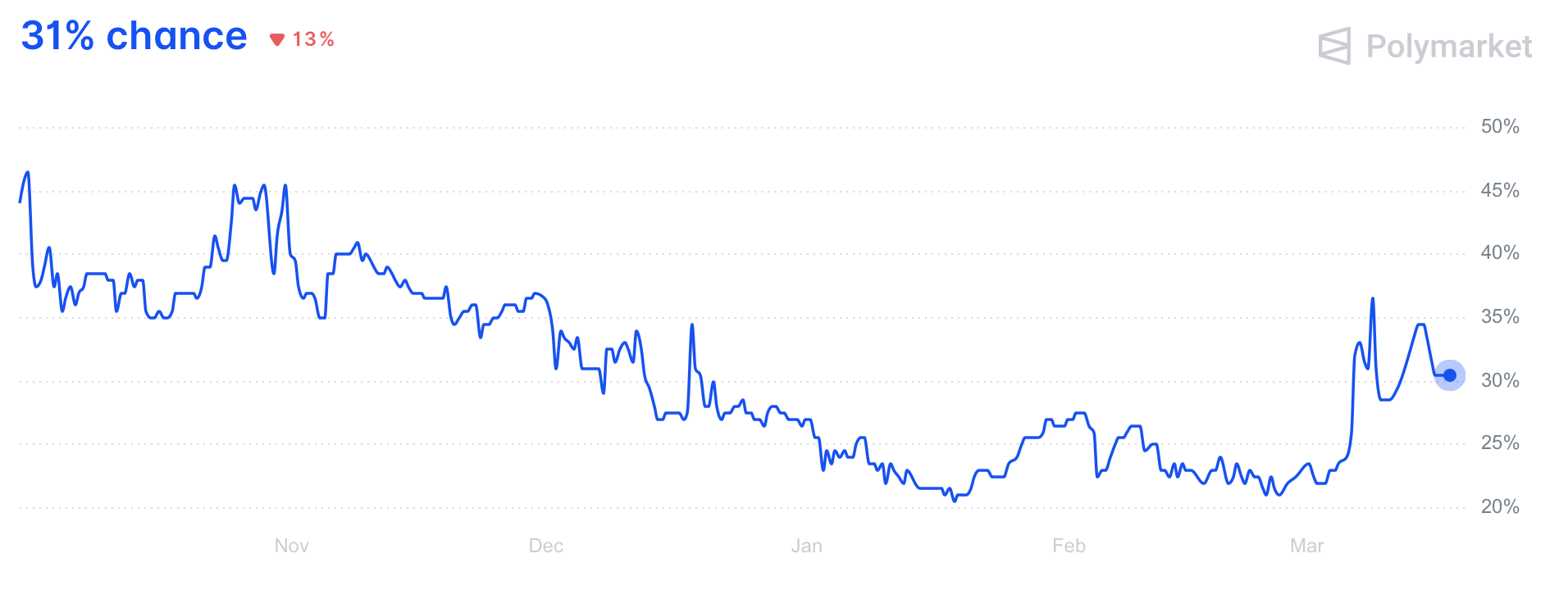
Odds that the U.S. Will Enter a Recession in 2026
Source: Polymarket
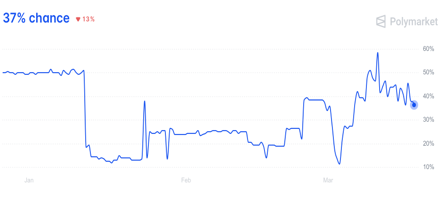
One of the more interesting developments has been the decline in betting odds on platforms like Polymarket that WTI oil will hit $90 by June 2026, with probabilities dropping from a high of 59 percent on March 10 to around 37 percent more recently. Meanwhile, the forward curve in oil futures markets has not fully confirmed the elevated levels seen in spot prices. This gap between current prices and future expectations is not just a technical detail; it is key to understanding why recession odds may be stabilizing even as headline oil prices stay high.

Source: Polymarket
When the futures curve indicates that prices will fall over time, it suggests that market participants view the current shock as temporary rather than structural. This expectation can lessen the economic impact in several ways. Businesses may be less inclined to cut investment or hiring if they expect lower input costs soon. Consumers, although still affected by higher gasoline prices, may adjust their spending less aggressively if they believe the increase will be short-lived. Financial markets, too, tend to respond more to expected future conditions than to current spot levels, which helps explain why equity markets and recession probabilities may not move in sync with oil prices.
In this context, the key question is not just “What price of oil causes a recession?” but rather “What path of oil prices—over what period and with what expectations—creates enough economic slowdown to trigger a recession?” A temporary spike to $110, or even $120, may not be sufficient if markets anticipate prices will fall soon. On the other hand, a prolonged period of prices in the $90–$100 range might be more damaging if it is accompanied by expectations of further increases or by consistently tight supply conditions.
The structure of the U.S. economy also complicates the connection between oil prices and recession risk. The United States is now one of the world’s largest oil producers and a net energy exporter, a shift that has altered the traditional dynamics of energy shocks. Higher oil prices can benefit domestic producers, supporting investment and jobs in the energy sector. This partly offsets the negative effects on consumers and energy-intensive industries. However, the overall impact remains negative for the broader economy, as the United States is still a large net consumer of oil and petroleum products. The pass-through to gasoline prices has a direct and noticeable effect on household budgets, especially affecting lower- and middle-income consumers who spend a larger share of their income on energy.
Additionally, the inflationary impact of rising oil prices extends beyond just gasoline. Energy costs affect transportation, manufacturing, and food prices, exacerbating overall inflation pressures that can influence monetary policy decisions. If the Federal Reserve responds to increased inflation by maintaining higher interest rates for an extended period, the combined effect of tighter financial conditions and elevated energy expenses could significantly increase the likelihood of a recession. This interaction explains why some analysts consider oil prices in the $140–$150 range to be particularly risky in the current environment, where interest rates are already elevated. At these levels, the economy faces a double challenge: increased costs and more restrictive financial conditions.
Another key factor is how quickly oil prices rise. Sudden increases tend to have a stronger psychological impact on consumers, leading to quick changes in behavior. Rapid jumps in gasoline prices can damage consumer confidence, which then affects spending decisions. This behavioral response can amplify the economic effects of higher energy costs, creating a cycle that accelerates the slowdown. Conversely, gradual increases give time for adjustment, whether through changes in consumption, efficiency upgrades, or switching to alternative energy sources.
Summary and Concluding Thoughts
When evaluating oil prices, our analysis shows that the difference between spot and forward prices is crucial. Although some may argue that the recent peak in oil prices increases the likelihood of a recession, one should not overlook the lower oil price expectations for the future, which suggest that markets do not yet see the shock as lasting long enough to trigger a recession. This explains why recession chances, as indicated by market-based indicators like Polymarket, have decreased even though spot prices are high and near record levels.
Ultimately, it appears as though there is no single price point at which a U.S. recession becomes unavoidable. The often-cited thresholds of $100, $120, or $130 per barrel should be seen as ranges in which risks increase, not as definitive triggers. The true turning point depends on a mix of factors: how long prices stay high, the trend suggested by futures markets, how monetary policy responds, and the economy’s underlying strength. Currently, the gap between high spot prices and more modest forward expectations indicates that, while recession risks are higher, they are not yet definitive.
If oil prices rise sharply and stay high—especially in the $130–$150 range—for a long time, the chances of a recession will undoubtedly rise significantly. Such a situation would probably put steady pressure on consumers, keep inflation persistent, and tighten financial conditions, creating a combination of factors that have historically led to economic contraction. However, if the current increase proves temporary and future oil price expectations remain moderate, the economy might be able to handle the shock without entering a recession.
Oil prices matter not only for where they stand now but also for where they are expected to go. In a market-driven economy, it’s those expectations—reflected in futures curves, financial markets, and consumer sentiment—that ultimately decide whether an oil price shock will trigger a U.S. recession.