
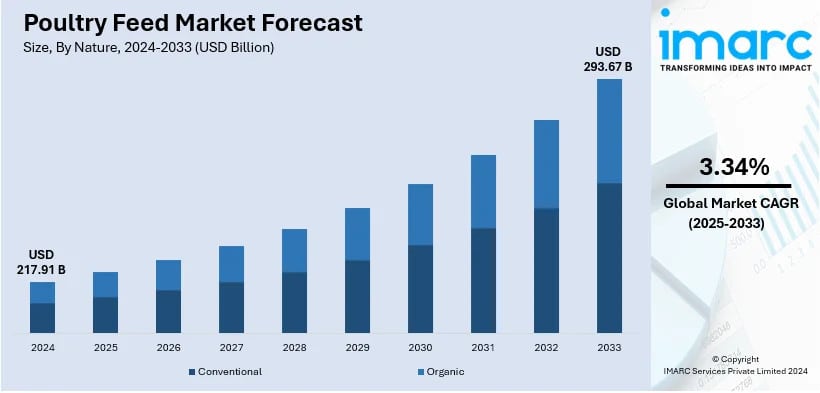
Rising demand for animal protein, expansion of intensive farming systems, and a shift toward nutritionally balanced diets are driving poultry feed consumption. This growth is further supported by innovations in feed additives, government incentives for livestock infrastructure, and the scaling of organized retail and distribution networks. According to IMARC Group’s latest data, the global poultry feed market size was valued at USD 217.91 Billion in 2024. Looking forward, IMARC Group estimates the market to reach USD 293.67 Billion by 2033, exhibiting a CAGR of 3.34% from 2025-2033. Asia Pacific currently dominates the market, holding a significant market share fueled by massive livestock populations in China and India.
The poultry feed sector has evolved into a high-tech industry focused on precision nutrition and metabolic optimization. Global demand is underpinned by the fact that poultry remains the most affordable and versatile source of meat and eggs for a growing population. Producers are increasingly prioritizing feed conversion ratios (FCR) through pelleted formats, which now account for over 52% of the market. Key segments include broiler feed, which leads in volume, and layer feed, alongside specialized additives like amino acids and enzymes that enhance gut health and bird performance in antibiotic-free environments.
Download Now: Free “Poultry Feed Market” Industry Analysis Sample
Poultry Feed Market Growth Drivers:
- Surge in Global Demand for Lean Protein
The global shift toward white meat over red meat is a primary driver, as consumers view chicken as a healthier, lower-fat alternative. With global poultry meat production reaching approximately 139 million metric tons recently, the pressure on feed supply chains has intensified. This demand is particularly visible in emerging economies where rising disposable incomes allow for higher per-capita protein intake. Because poultry has a shorter production cycle and better feed-to-meat conversion than cattle, it remains the bedrock of food security strategies in densely populated regions across Asia and Africa.
- Expansion of Organized and Intensive Farming
The transition from backyard farming to large-scale, vertically integrated operations is significantly boosting compound feed adoption. In major markets like China and India, integrated farms with over 100,000 birds now represent a majority of the broiler output. These commercial setups require standardized, high-quality nutrition to ensure uniform growth and biosecurity. Industrial-scale production allows for the use of advanced feeding systems that minimize waste, driving the market toward professional feed formulations that provide a precise balance of proteins, fats, and minerals essential for maximizing yield in shorter timeframes.
- Supportive Government Initiatives and Infrastructure Funds
Governments worldwide are incentivizing the poultry sector to ensure stable food supplies and reduce import dependency. In India, the Animal Husbandry Infrastructure Development Fund is actively supporting the establishment of new feed mills, with companies like Suguna Foods expanding capacity to 600,000 tonnes. Similarly, the USDA’s Meat and Poultry Processing Expansion Program (MPPEP) provides grants of up to $1 million to help processors upgrade facilities. These financial cushions allow producers to invest in better feed technology, enhancing the overall resilience and efficiency of the domestic poultry supply chain against global market volatility.
Poultry Feed Market Trends:
- Shift Toward Antibiotic-Free (ABF) and Precision Nutrition
Regulatory bans on antibiotic growth promoters (AGPs) in regions like the EU and China have forced a move toward functional additives. Producers are now incorporating enzymes, phytogenics, and probiotics to maintain gut health and prevent disease naturally. This trend toward “performance-based” nutrition means formulators are no longer just buying grains but are investing in metabolic optimization. In the United States, major retail commitments to “No Antibiotics Ever” (NAE) have already transitioned more than half of the country’s broiler production to these advanced, additive-rich diets to meet strict consumer and regulatory standards.
- Dominance of Pelleted Feed for Efficiency
There is a marked preference for pelleted feed over traditional mash due to its superior digestibility and reduced wastage. Current data suggests that pelleted formats improve feed conversion efficiency by 5% to 8%, a critical margin for large-scale integrators facing fluctuating grain prices. Modern manufacturing facilities are now achieving pellet durability ratings exceeding 92%, which reduces dust and respiratory issues in poultry houses. This trend is supported by heavy investments in high-throughput machinery from players like the GEA Group, enabling mills to produce consistent, nutrient-dense pellets that survive transport and automated feeding systems.
- Adoption of Sustainable and Alternative Ingredients
Sustainability is becoming a core component of feed formulation as brands look to lower their environmental footprint. This includes the use of amino acid supplements like MetAMINO, which allow for lower crude protein diets, reducing nitrogen emissions without sacrificing bird growth. Additionally, there is a growing interest in sourcing non-GMO and identity-preserved grains to satisfy premium retail segments. In Europe and North America, sustainability-linked sourcing is influencing purchase decisions for nearly a third of the market, prompting feed manufacturers to secure “green” supply chains and explore alternative protein sources like insect meal or algae-based nutrients.
Recent News and Developments in Poultry Feed Market
- March 2026: Zoetis completed the acquisition of Neogen’s genomics business for $160 million, a move aimed at integrating genetic testing with precision poultry nutrition to optimize flock health and feed efficiency.
- February 2026: Merck Animal Health received industry recognition for its INNOVAX range, highlighting new advancements in poultry disease prevention that allow for healthier flocks with reduced reliance on traditional therapeutic interventions.
- October 2025: De Heus India inaugurated a high-tech feed manufacturing facility in Rajpura with an investment of approximately USD 17 million, featuring a production capacity of 180,000 metric tons to serve the growing North Indian market.
Note: If you require specific details, data, or insights that are not currently included in the scope of this report, we are happy to accommodate your request. As part of our customization service, we will gather and provide the additional information you need, tailored to your specific requirements. Please let us know your exact needs, and we will ensure the report is updated accordingly to meet your expectations.