
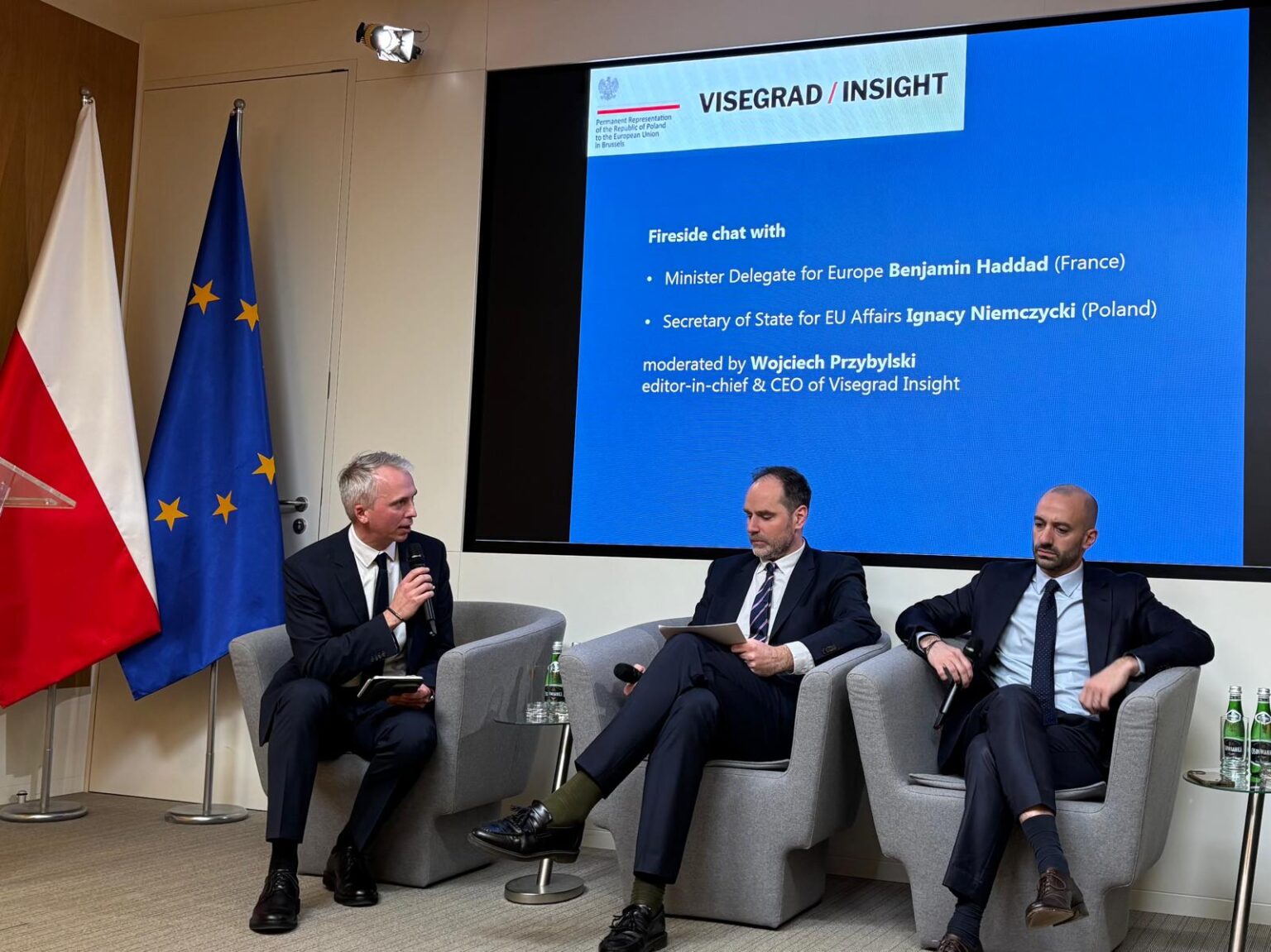
Benjamin Haddad, Ignacy Niemczycki and a panel of experts joined a fireside chat co-organised by Visegrad Insight to discuss the European Democracy Shield and the Centre for Democratic Resilience.
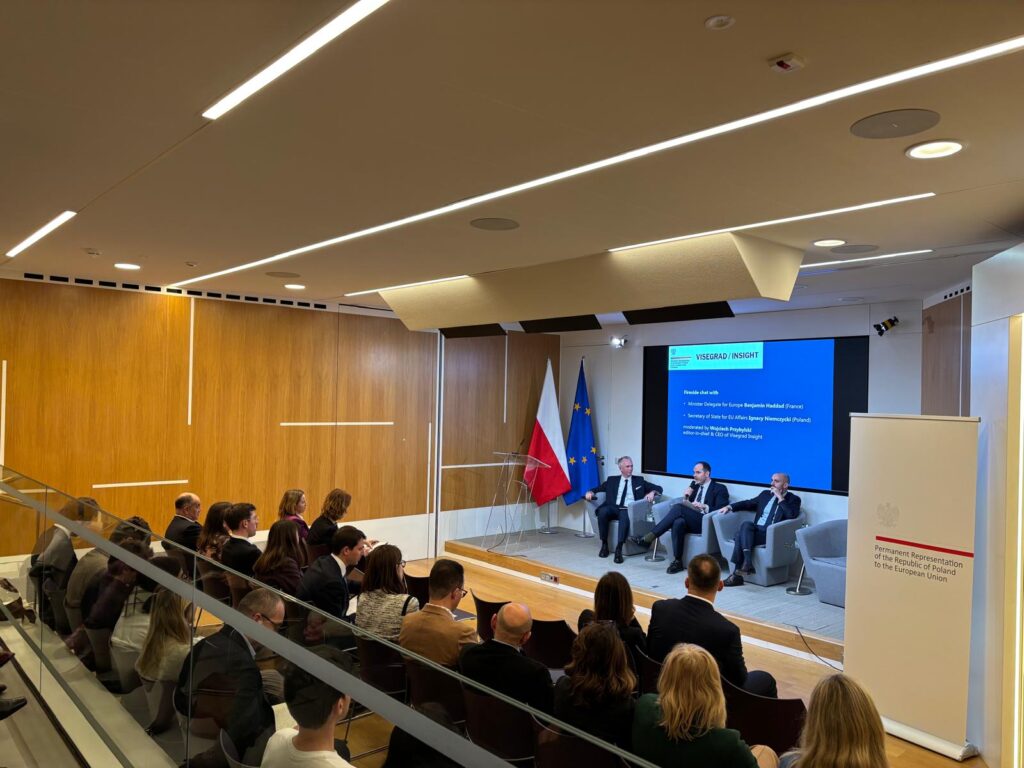
Democratic governance in Europe faces a systemic threat that no single government, institution or expert network can address on its own. That was the starting premise of a high-level policy discussion chaired by Wojciech Przybylski from Visegrad Insight on 17 March 2026 at the Permanent Representation of the Republic of Poland to the EU in Brussels. Benjamin Haddad, France’s Minister Delegate for Europe, and Ignacy Niemczycki, Poland’s Secretary of State for EU Affairs, spoke at a full-house event addressing hopes and challenges related to the European Democracy Shield. This new EU policy instrument centres on democratic security priorities and Visegrad Insight conducts policy research and public advocacy regarding its shape through the EU Values Foresight.
Setting the stage
The political debate underlined how democratic systems across Europe are under mounting pressure from cognitive warfare and electoral interference, amplified by eroding trust in democratic institutions. Pointing in particular to the 2027 elections in France and Poland as critical tests, the panel agreed that the EU’s European Democracy Shield, with the European Centre for Democratic Resilience at its core, is the most comprehensive effort so far to coordinate a response. The real question, however, is whether this framework is adequate, fast enough and inclusive enough for the current threat environment.
Admittedly, to use tools the EU and the Member States already have at hand requires courage in responding to local challenges and delivering on the security needs of each voter, participants agreed.
Expectations, concerns and developments that guided the discussion
Several other national elections and those for the European Parliament in 2029 loom on the horizon. Fringe parties hostile to the European project and with strong ties to foreign adversaries have been gaining ground in polling across the continent. Both ministers framed the timing as decisive. Measures that cannot show tangible results within one to two years risk arriving too late to matter. Overall, the fireside chat revolved around the question how Democracy Shield can constitute an appropriate and effective response including the European Resilience Centre.
The Resilience Centre is created as not yet another institution but as a coordinating hub where best practices will be shared and connected to level up resilience and empower people’s networks, including experts, academia and business communities of all sectors. Such an approach gives agility and fast reaction to mounting hybrid challenges.
said one of the participants.
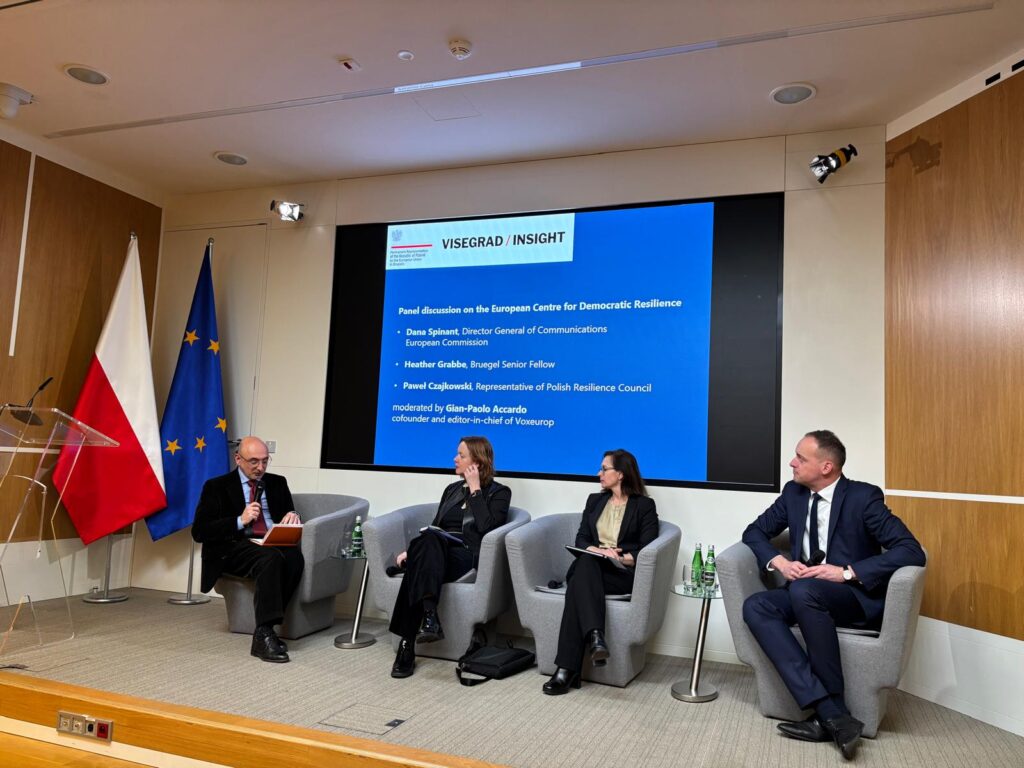
Political panel was later followed by expert discussion with Dana Spinant, Director General of Communications at the European Commission, Heather Grabbe, Bruegel Senior Fellow and Paweł Czajkowski, Representative of the Polish Resilience Council, moderated by Gian-Paolo Accardo, co-founder and editor-in-chief of Voxeurop.
State of play
While the Democracy Shield power rests on non-legislative, or ‘soft’, instruments, speakers debated whether such tools can generate real impact without binding commitments or dedicated emergency funding mechanisms. Participants noted that:
The Centre is designed as project-driven and funded according to the current needs of member states. It aims to build resilience via capacity and community-building measures.
The Brussels discussion surfaced two concrete areas where stronger action is needed, namely the speed of funding activation and the structure of the Centre’s partnership model.
On funding, participants pointed to humanitarian emergency financing as a model worth adapting. The Centre, it was argued, should be able to launch and fund activities at short notice, with a pre-developed operational playbook rather than waiting for standard institutional procurement cycles.
On partnership, speakers have highlighted that roles within the Centre’s network should be driven by identifying who is best placed to perform a given task, not by institutional rivalry or national quota.
The instruments are in place, they were democratically adopted, and now they require political will to use them and to protect the rule of law.
The new EU Resilience Centre will connect Europe’s fragmented pockets of expertise into a joined-up, whole-of-society hub. Through practical, member-state-led projects and close collaboration with civil society, business, academia and candidate countries, it will deliver concrete tools for long-term democratic resilience — not another talking shop.
Concrete action points
There were also other practical ideas floated in the room that the new Centre could benefit from.
For instance, would it be feasible to create more civil society working groups and study trips with special focus on the 2027 elections in France and Poland – and potentially other electoral battles – to feed into the European Cooperation Network on Elections’ foresight and risk management work?
Also, it has been argued that dedicated funds for local journalism should be released in the 12 months before elections, specifically to build awareness of electoral risks and how they can be mitigated under the Democracy Shield framework.
Ultimately, the Centre’s value depends on how effectively it channels the proximity, operational reach and early-warning capacities of civil society organisations that ‘sit’ closest to citizens. Speakers have agreed that:
Civil society organisations must be finally recognised as a line of defence and part of the comprehensive security system, since security concerns will dominate our priorities for decades to come, one of the participants affirmed.
The bottom line
The Brussels event made the case for treating democratic resilience as a policy emergency but also as a long-term effort to develop agility and innovate to meet the public demand for democratic institutions that match the present age realities. The European Centre for Democratic Resilience, as envisioned by its advocates, would need to operate with the speed of a crisis-response mechanism and the breadth of a cross-sectoral network. Whether the institutional design, funding arrangements and political will exist to deliver that combination remains to be seen.
Democratic security comes at a price. What is yours?
Subscribe now for full access to expert analysis and policy debate on Central Europe.