
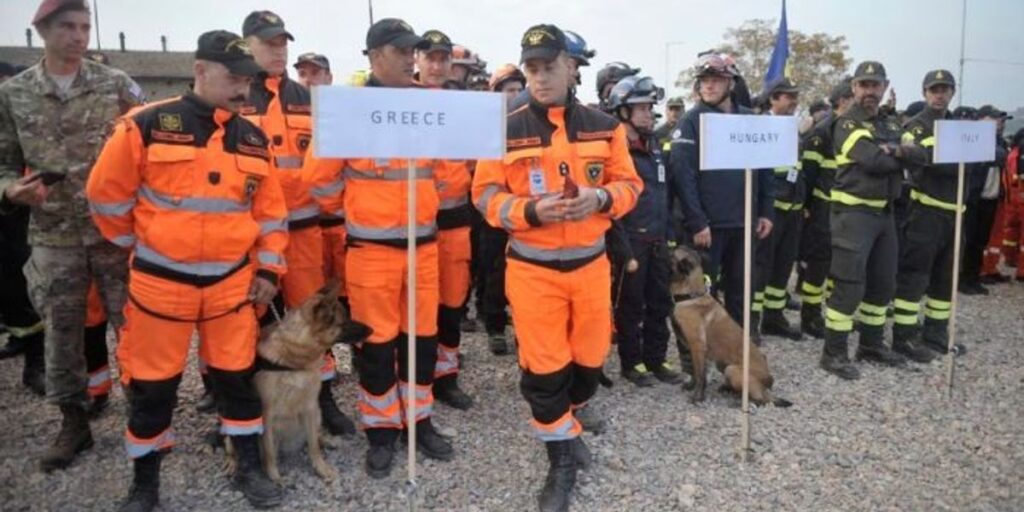
Exercise “Serbia 2018” jointly organized by NATO’s Euro-Atlantic Emergency Response Coordination Center (EADRCC) and the Serbian Ministry of Internal Affairs, Mladenovac, 7 October 2018.
Amid the announcement of the purchase of Chinese supersonic ballistic missiles, Serbia has invited NATO to a joint exercise.
The military exercise announced for May in southern Serbia will be their first joint training since 2018, when a field exercise on disaster management was held.
And the first exercise with NATO since the moratorium on military exercises with all partners, which Belgrade introduced at the beginning of the Russian aggression against Ukraine.
NATO tells Radio Free Europe that the exercise announced in May with Serbia is an important one.
“This will contribute to strengthening stability in the Western Balkans, which remains a region of strategic importance for NATO,” an Alliance official told Radio Free Europe.
As he said, the exercise will be conducted with full respect for Serbia’s officially declared policy of military neutrality.
“Planning is underway and the details of the exercise are being finalized in coordination with Serbian authorities,” the response added.
Kurt Bassuener from the Berlin-based Council for Democratization Policy estimates for Radio Free Europe that the NATO exercise is not a strategic change in Serbian politics.
“Nor is Serbia’s full alignment with the West,” he added.
Serbian authorities insist on military neutrality, as the country is on its path towards membership in the European Union (EU).
But they also cooperate with NATO through the Partnership for Peace, which includes joint training and exercises.
Serbia joined the Partnership for Peace, which represents bilateral cooperation between member states and individual partner countries, in 2006.
At the same time, Serbia has strengthened military cooperation with China in recent years, becoming the first European country to purchase Chinese weapons.
Geopolitical analyst and retired Montenegrin general Blagoje Grahovac does not see Belgrade’s invitation to NATO as a move towards the West.
“Serbia is doing wonders to arm itself and NATO countries are offering Serbia a different, peaceful policy, so possible joint exercises should be seen in this context.”
Grahovac told Radio Free Europe that he sees NATO’s decision for joint exercises as an offer to “finally justify Serbia’s policy.”
The Serbian Ministry of Defense did not respond to Radio Free Europe’s question regarding the details of the planned military exercise at the Borovac training range near Bujanovac, in southern Serbia.
The training area, near the border with Kosovo, is used to prepare units for international missions, including United Nations peacekeeping operations.
The announcement of the exercise was made by NATO’s Joint Force Command in Naples on March 7, stating that it would take place at the invitation of Serbia.
“The joint exercise improves interoperability, strengthens practical cooperation and supports stability in the Western Balkans,” the Command stated on the X network.
Belgrade between cooperation and criticism of NATO
NATO Command in Naples stated that the Western Balkans is a region of strategic importance for the Alliance.
“The joint exercise improves interoperability, strengthens practical cooperation and supports stability in the Western Balkans,” the March 7 statement said.
Serbia is almost completely surrounded by NATO members, but authorities say they will not join the alliance.
“We will maintain our neutrality, but we have correct and good relations and we will continue to build them,” Vučić told RTS on March 12.
In Serbia, there is a negative narrative towards NATO, which is also supported by the authorities, as a result of the NATO bombing of the Federal Republic of Yugoslavia in 1999 due to crimes committed by Serbian forces against Albanians in Kosovo.
Although relations with the Alliance have been restored in recent decades, this negative feeling has not disappeared.
Kurt Bassener says he has the impression that NATO accepted Serbia’s offer for a military exercise with the aim of maintaining and further developing its command and operational contacts with the Serbian armed forces.
He further states that he suspects that the call for the exercise was made with the aim of improving Belgrade’s ties with NATO command centers and American officers.
“With the aim of creating ties that would limit any multilateral regional relations outside the alliance structures,” Bassener added.
Months before the call to NATO, Vučić accused Croatia, Albania and Kosovo of “forming a military alliance with the aim of attacking Serbia at a certain moment.”
The authorities of Croatia and Albania, two NATO members, as well as Kosovo, have repeatedly rejected Vučić’s accusations, recalling that a military alliance was not formed, but rather a declaration was signed in the field of defense and security.
Bassener notes that he cannot separate Belgrade’s call for NATO from Vučić’s “heated rhetoric” about “preparing for an attack” and protecting Serbia’s territorial integrity.
“I find it absurd to project expansionist plans directed at Serbia from that defense agreement, which appears to be based on Serbia’s aggressive weapons program,” he added.
Maintaining KFOR presence in Kosovo as a possible motive
The announcement of the joint exercise came a day after the Serbian President’s meeting in Belgrade with the Commander of NATO’s Joint Forces Command in Naples, Admiral George Wyckoff.
Vučić announced that at that meeting he emphasized the importance of KFOR for peace and the protection of Serbs in Kosovo.
“It probably has a lot to do with Vučić’s interest in maintaining the KFOR presence,” says Bassener, commenting on Belgrade’s invitation to NATO for a military exercise.
KFOR is, among other things, responsible for security on the border between Kosovo and Serbia, while the two neighboring countries still have tense relations.
And in recent days, reports have emerged that the US is reviewing its military presence in Europe, including Kosovo, while the Pentagon is neither confirming nor denying any potential plans.
Continuing the ‘balancing’
Bassener also sees Belgrade’s invitation to NATO as an attempt by Vučić to “also demonstrate his ability to conduct geopolitical arbitration between the US, China and Russia, as well as other actors – Turkey, Israel, the Gulf countries.”
“While this exercise is being undertaken with NATO, I think Vucic also has Washington in mind,” says Kurt Bassener.
Bassener adds that Vučić also continues to “play with the EU” through enlargement and dialogue between Belgrade and Pristina.
Serbia is a candidate for membership in the European Union, under whose auspices it is negotiating the normalization of relations with Kosovo, which declared independence from Belgrade in 2008.
As a candidate for EU membership, Serbia has intensified cooperation with China in recent years by purchasing weapons from that country.
It also does not give up close ties with Russia and does not follow the EU’s policy of imposing sanctions on that country for its four-year occupation of Ukraine.
Blagoje Grahovac assesses that Belgrade is “prone to manipulation” and thus sees the invitation to NATO as manipulation.
What was excluded from the moratorium?
Serbia has not officially lifted the moratorium on holding military exercises with foreign partners, introduced in February 2022 after the start of the Russian invasion of Ukraine.
But there were exceptions, such as the Platinum Wolf military exercises in 2023 and 2025, which were held with the armed forces of the United States and several other NATO members.
“This speaks to the importance of cooperation with the US for the Serbian Armed Forces,” said Serbian Defense Minister Bratislav Gašić in July 2025.
He then met with US Deputy Assistant Secretary of Defense David Baker.
Also, in April 2025, a joint engineering training was held between members of the Serbian Army and the Ohio National Guard.
In November 2023, the President of Serbia announced that he would ask the Government of Serbia to reconsider the decision to resume joint exercises with NATO.
However, it is not known whether such a request, which Vučić announced at the time during his speech to then-NATO Secretary General Jens Stoltenberg, was followed.
In addition to exercises with the US armed forces, in which several other NATO members participated, the Serbian Army also conducted military exercises with the Chinese army.
In July 2025, a ten-day training session of special forces of the armies of Serbia and China was held in the Chinese province of Hebei in the north of that country, despite Brussels’ warning to Belgrade.
It was the first joint military exercise between China and Serbia.
Unlike previous years, since 2022 there have been no joint exercises between Serbia and Russia and Belarus.
Serbia has been criticized by the European Union for joint exercises with these countries.
This is why Belgrade canceled its participation in the Russian-Belarusian-Serbian exercises in 2020, because they were taking place in Belarus at a time when this country was rocked by a political crisis following the presidential elections.