
Among the countries classified as free, the sharpest decline was recorded in Bulgaria, Italy, and the United States. In Bulgaria, this is attributed to the 2024 parliamentary elections, which were marred by vote-buying and electoral fraud.
“Global freedom has declined for the 20th consecutive year,” according to a report by the international organization Freedom House.
A total of 54 countries have seen a deterioration in political rights and civil liberties, while only 35 have made progress.
Among the countries classified as free, the sharpest decline was recorded in Bulgaria, Italy, and the United States. In Bulgaria, the decline is attributed to the 2024 parliamentary elections, marked by vote-buying and electoral fraud, while in Italy it is linked to the weakening of anti-corruption mechanisms.
The reasons for the decline are mainly linked to military coups and efforts by those in power to suppress peaceful dissent or to change constitutional rules to their advantage.
All countries in the Western Balkans are marked in yellow, which means “partially free.”
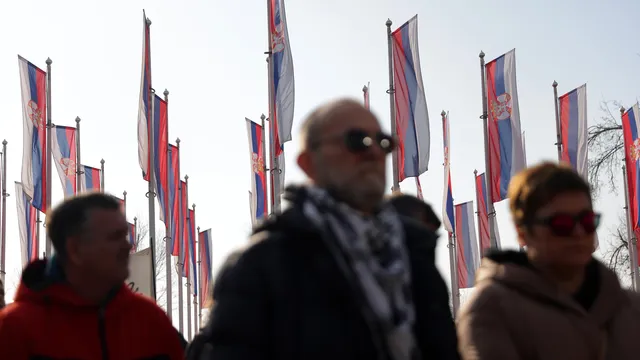
Serbia is among the countries with the most significant deterioration in freedoms over the past year and ranks fifth on this indicator, alongside countries such as Bulgaria and the United States.
The largest decline in 2025 was recorded in Guinea-Bissau, Tanzania, Burkina Faso, El Salvador, Madagascar, and Georgia.
The report emphasizes that over the past two decades, democratic regression has affected a wide range of rights, with media freedom, freedom of expression, and the right to a fair trial being the hardest hit.
Serbia lost three points this year after authorities responded to large-scale student anti-corruption protests by withholding salaries and terminating the employment contracts of teachers and professors who participated in them.
It is also noted that the police used excessive force against protesters and failed to protect them from armed groups. The country is facing democratic regression under the leadership of President Aleksandar Vučić and the Serbian Progressive Party, with the police and intelligence services using spyware to monitor journalists, activists, and protest organizers.
Investigations by Serbian journalists reveal that dozens, and likely hundreds, of personal devices have been targeted by a specialized surveillance tool known as NoviSpy. The exact number remains unknown, as the software was secretly installed during arrests and police interrogations. Awareness of such unchecked state surveillance has led to self-censorship among citizens.
As in previous years, Serbia, Kosovo, Bosnia and Herzegovina, Montenegro, and North Macedonia remain in the “partly free” category.
Montenegro lost one point due to the adoption of a number of bills under an emergency procedure and without parliamentary debate.
Political deadlocks have hampered the work of institutions in the region. In Kosovo, newly elected lawmakers were unable to form a government for most of the year, and there are allegations that the caretaker government overstepped its authority, leading to snap elections. This crisis has undermined progress on judicial independence and physical security.
Despite intense political pressure, courts in Kosovo and Bosnia and Herzegovina have issued rulings that demonstrate independence.
Globally, Russia continues to suppress dissenting voices. As the war in Ukraine persists, Russian authorities are increasingly persecuting people for anti-war statements and activism; in January 2025, for the first time, two media outlets were designated as terrorist organizations.
A similar trend is observed in China, where the ruling party is tightening control over political rights and civil liberties by persecuting journalists and restricting protests and international travel.
In Europe, the level of political rights remains generally stable, and the continent continues to be the freest in the world.
The report also notes a deterioration of civil liberties in the United States. Particular attention is drawn to a January 2025 executive order that shut down the U.S. Agency for International Development (USAID), which had funded numerous projects by civil society organizations and independent media, as well as a decision to close the Bureau of Global Media, which oversees “Voice of America,” Radio Free Europe, and Radio Free Asia. These changes were implemented rapidly and outside the legislative process, affecting thousands of organizations in at least 129 countries.
In Belarus, the authorities used disproportionate violence against protesters, with police arresting, beating, and firing on journalists, and tens of thousands were detained, forcing many pro-democracy leaders and activists to flee the country.
Georgia is also cited as an example of a serious decline, where opponents of the government have been subjected to physical attacks, harassment, and legislative restrictions targeting the opposition and civil society.
“Authoritarian regimes continue to advance around the world, and only the combined efforts of human rights defenders, civil society, and democratic governments can hasten the day when all people will live in freedom,” the report concludes.
For more than 50 years, Freedom House has monitored threats to democracy and freedoms around the world, annually assessing the state of freedom in 195 countries and 15 territories based on various indicators. | BGNES