
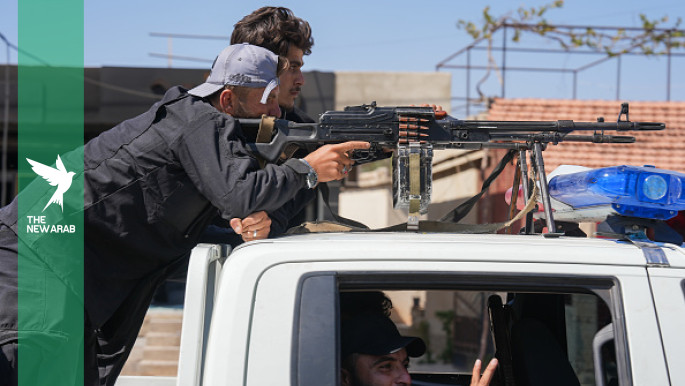
Describing violations as “individual and unsystematic” effectively exempts leadership from accountability, say critics. [Getty]
Nearly eight months after the “Suweida events” in Syria in July 2025, a special investigative committee released its report on the incidents and the parties involved in violations and extrajudicial killings.
The committee submitted the report to Syrian Justice Minister Mazhar Al-Wais on Tuesday, 17 March, noting that the total number of victims across all parties reached 1,760, in addition to 2,188 injured.
The committee head, Judge Hatem Al-Naasan, told a press conference on Tuesday that the violations were individual rather than systematic, citing survivor testimonies.
He explained that judicial referral is not within the committee’s mandate, but due to the sensitivity of the events, an agreement with the justice minister allowed immediate accountability before the final report.
Twenty-three security and military personnel involved in violations have been detained and are currently facing public trials.
Violations
The committee reported that 1,760 people were killed and 2,188 were injured. It documented 90 missing persons despite limited access to the city.
Investigators also confirmed retaliatory attacks targeting Suweida’s civilian communities, resulting in the destruction and burning of 36 villages and the displacement of thousands of Druze families.
The committee attributed the tensions to policies and actions of the previous regime, which it said had fuelled unrest over the years, including facilitating the entry of Islamic State (ISIS) members into Suweida, who committed crimes against civilians.
The report acknowledged serious human rights violations, including killings, armed looting, destruction and burning of homes and businesses, torture, abduction, sectarian insults, and incitement of sectarianism.
The committee compiled a list of suspects from the ministries of defence and interior, Druze armed groups, and civilians, including Bedouin and tribal members, citing reasonable grounds to suspect their involvement in serious crimes.
The results, along with complete investigation files and evidence, were referred to the public prosecutor.
Recommendations aimed at preventing recurrence included collecting weapons outside state authority, dismantling criminal networks involved in abduction and drug trafficking, supporting the Syrian government’s efforts to enhance professionalism and neutrality of security forces, ensuring effective legal and institutional oversight, establishing clear accountability mechanisms, and reducing hate speech and incitement to violence.
In July, southern Suweida witnessed deadly clashes between government forces supported by local Bedouin and tribal groups and local armed factions.
Violations against civilians were reported, and residents of roughly 36 villages were displaced.
Israeli intervention forced Syrian government forces out of Suweida city into western rural areas, where they retain control over about 30 villages.
Local armed factions reportedly committed violations against Bedouin residents, displacing them from the governorate.
Critical observations
Observers noted the report’s positive aspects, including its acknowledgement of violations, documentation of 1,760 victims, and admission of the involvement of multiple parties, including government forces.
However, it did not assign clear leadership responsibility; instead, it referred to “individuals” and “suspicions” without naming leaders or decision-making chains, thereby weakening perceptions of true justice.
Describing violations as “individual and unsystematic” effectively exempts leadership from accountability.
The committee’s independence from the executive was also called into question because it did not clearly identify the responsible officials.
The report serves primarily to contain the crisis and reinforce state legitimacy, presenting a seemingly balanced narrative while minimising direct accusations against specific parties, particularly official entities.
Human rights activist Samer Al-Tawil told The New Arab that the report lacks direct, tangible outcomes, such as victim compensation, the naming of suspects, or a clear timeline for accountability.
He described it as more of an administrative and political step than a precise legal response to victims’ suffering.
Al-Tawil highlighted theoretical measures, including judicial reform, weapon control, combating hate speech, and victim compensation, but noted the absence of “implementation mechanisms”, independent oversight, or political guarantees.
Al-Tawil also noted the paradox that the state appointed the committee while being one of the accused parties, citing the report’s acknowledgement of the justice ministry’s support as a conflict of interest.
Limited access to Suweida may have also deprived the committee of crucial evidence.
The report’s function, he argued, appears to be to seek mitigated solutions to avoid political escalation, acknowledging state-affiliated violations but not clarifying whether they resulted from leadership negligence, collusion, or loss of control.
Syrian political activist Adham Massoud Al-Qaq told The New Arab that the report includes detailed figures and descriptions of violations and foreign actor involvement, such as ISIS, without presenting clear evidence.
He said the recommendations reflect the committee’s desire to sustain civil peace and coexistence, emphasising judicial and institutional reforms for fair trials, uncovering mass grave sites, state monopoly on weapons, criminalising sectarianism, and promoting dialogue.
He noted that limited access to Syria’s southern areas, including Suweida, due to uncontrolled weapons, led to incomplete information and described violations, as individuals may shield senior security officials from legal accountability or expected punishment.
Article translated from Arabic by Afrah Almatwari. To read the original, click here.