
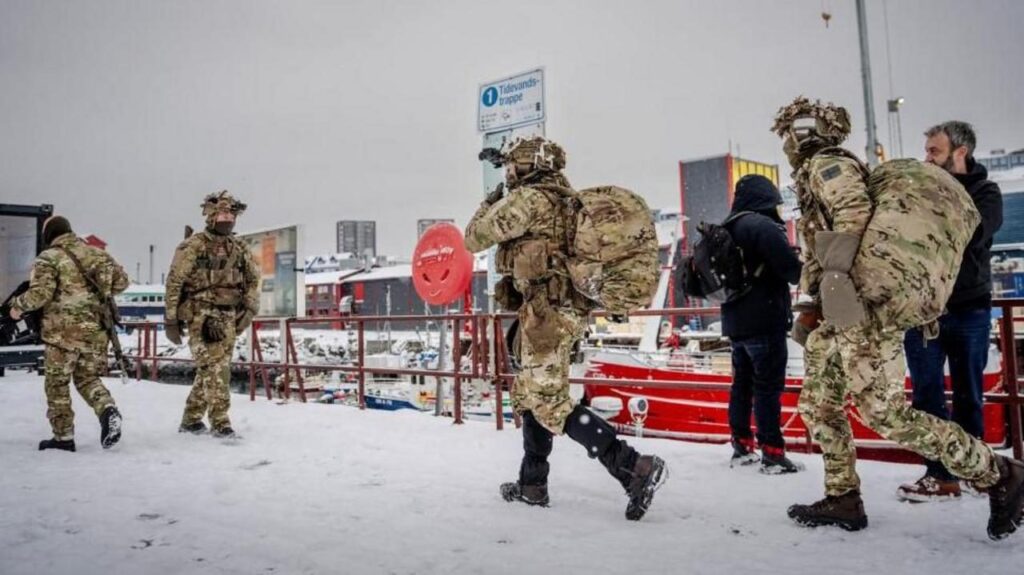
Danish soldiers deployed to Greenland in January were secretly prepared to destroy key airport runways if United States forces moved to seize the Arctic island — a stunning contingency plan that reveals just how seriously European allies took Donald Trump’s threats to annex the territory.
That is the explosive claim from Denmark’s public broadcaster DR, which says it based its reporting on 12 sources at the top of the Danish government and military, as well as sources among European allies. The Financial Times later reported that two European officials confirmed the account. The implications are hard to overstate: two NATO allies were quietly preparing for the possibility of direct military confrontation with each other.
The Danish defence ministry told the BBC it “has no comment.” A senior Danish military official, speaking anonymously, told the BBC that “only a limited number of people would have been aware of the operation for security reasons.”
What Denmark Was Actually Planning — and Why
According to DR’s reporting, Danish soldiers flown to Greenland in January were not just there for routine exercises. They were prepared to blow up critical airport runways to prevent any potential US military landing or rapid seizure of infrastructure on the island.
The mission went further than demolition planning. DR says blood supplies were also brought in — prepared to treat soldiers wounded in the event of actual fighting. That detail alone signals this was not a symbolic gesture. Danish military planners appear to have genuinely war-gamed a scenario in which US forces arrived and Danish troops had to respond.
The deployment was publicly described at the time as Danish-led joint military exercises called Operation Arctic Endurance, and Danish military aircraft were sent to the region as part of that framing. What was not disclosed was the contingency planning reportedly running alongside it.
The Greenland Dispute That Brought NATO to the Brink
Greenland is a semi-autonomous territory that is part of the Kingdom of Denmark. It has its own government and significant self-governance, but defence and foreign affairs remain under Danish authority. The island’s strategic position in the Arctic — sitting between North America and Europe, with enormous natural resources and military significance — has made it a focal point of geopolitical competition.
Trump has repeatedly stated during his second presidential term that he wants to annex Greenland. Both Greenland’s own leader and the Danish government have firmly and repeatedly rejected those demands. The standoff has created a serious and unusual rift between Washington and its European partners — all of whom are bound together inside NATO.
The situation presents a fundamental contradiction: NATO is a mutual defence alliance built on the principle that members do not threaten each other. The idea of one NATO member preparing to militarily resist another is the kind of scenario the alliance was never designed to handle.
Key Facts at a Glance
What the Reporting Says
- Both the US and Denmark are full NATO members
- Greenland is a semi-autonomous part of Denmark
- Trump has publicly and repeatedly demanded acquisition of Greenland
- Greenland’s leadership and Denmark have consistently rejected those demands
- A senior Danish military official confirmed awareness of the operation was deliberately kept to a very small circle
Why This Story Matters Beyond the Headlines
It would be easy to read this as a dramatic but distant geopolitical story. It is not. What the DR report describes — if accurate — is a European NATO member actively preparing to use military force against the United States, its most powerful ally and the country that underwrites the entire Western security architecture.
That says something profound about how seriously European governments took Trump’s Greenland rhetoric. Public statements of rejection are one thing. Quietly flying in soldiers with orders to destroy runways and stocking blood supplies for casualties is another level entirely.
It also raises urgent questions about the current state of the NATO alliance. The alliance’s credibility rests on unity. If member states are secretly war-planning against each other — even defensively — that unity is under a kind of strain that goes well beyond ordinary political disagreement.
For Europeans watching the situation, the episode reinforces a growing anxiety: that US commitments to the alliance can no longer be taken as fixed, and that contingency planning for scenarios once considered unthinkable is now a practical necessity.
What Happens Next in the Greenland Standoff
The Danish defence ministry’s refusal to comment leaves the core claims unconfirmed or denied by official sources. The Financial Times reporting, citing two European officials, adds weight to DR’s account — but the full picture of what was authorised, by whom, and at what level of the Danish government remains unclear from the available reporting.
Trump has shown no signs of abandoning his stated ambitions regarding Greenland. Greenland’s government and Denmark have shown no signs of yielding. That means the underlying tension driving this episode has not gone away — and the question of how far each side is prepared to go remains very much open.
What is clear is that the story of Greenland has moved well beyond diplomatic posturing. According to sources speaking to two separate major news organisations, it has entered the territory of real military contingency planning — and that changes the conversation significantly.
Frequently Asked Questions
Did Denmark actually blow up any runways in Greenland?
No. According to the reporting, this was a contingency plan — soldiers were prepared to destroy runways if a US invasion occurred, but no such action was carried out.
Who reported this story and how many sources were involved?
Denmark’s public broadcaster DR broke the story, citing 12 sources from the top of the Danish government, military, and European allies. The Financial Times subsequently said two European officials confirmed the report.
What was Operation Arctic Endurance?
It was the publicly stated name for Danish-led joint military exercises in Greenland in January, during which Danish military aircraft were deployed to the region.
Has the Danish government confirmed or denied the runway demolition plan?
The Danish defence ministry told the BBC it “has no comment.” A senior Danish military official, speaking anonymously, confirmed that knowledge of the operation was deliberately limited to a small number of people.
Are the US and Denmark still both in NATO?
Yes. Both the United States and Denmark are full NATO members, which makes the reported contingency planning between the two allies particularly significant and unusual.
Has Trump responded to this report?