
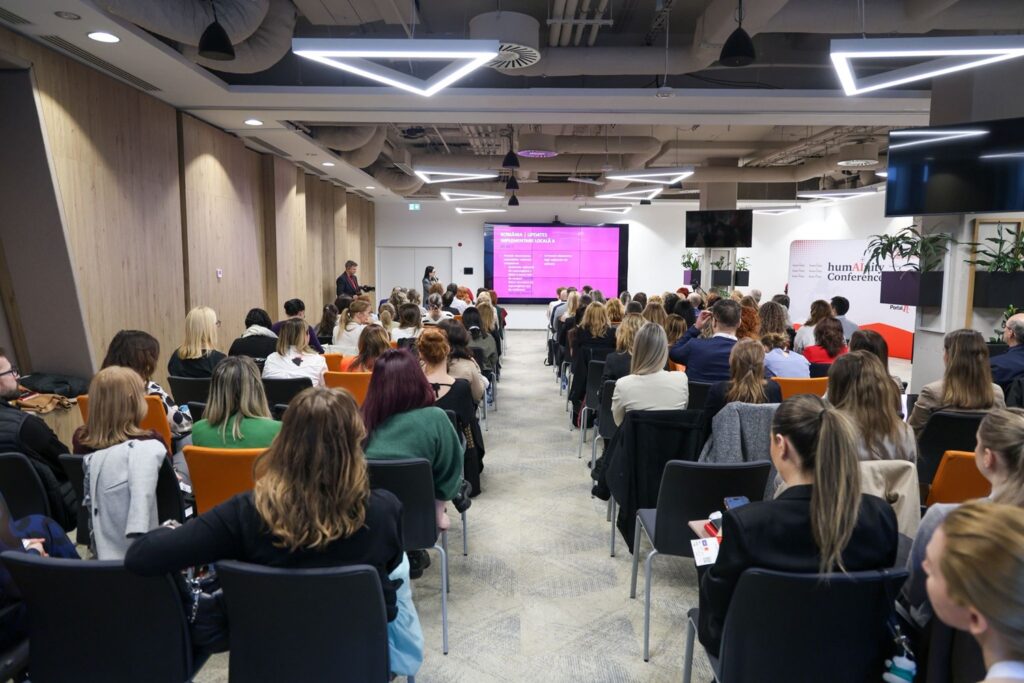
The HumAInity Conference 2026 brought to the forefront one of the most pressing issues of our time: the balance between the rapid evolution of artificial intelligence and the need for people, organizations, and the state to adapt. In Romania, approximately 12% of workers are at high risk of automation, meaning that more than a quarter of their skills and abilities can be largely automated, according to an OECD report.
Artificial Intelligence: Between opportunity and risk
Artificial intelligence is redefining how organizations operate, changing the dynamics of the labor market and business processes.
AI is useful, but it can also pose a risk, says Ana Maria Baciu, Founder of Baciu & Partners. “We all view AI as a tool that will help us, but we must also recognize that it is a tool from which we will need to be protected: as individuals, as a democracy, as a system of justice—all these elements are part of what needs to be protected. It may be a paradox, but it is the truth at this moment. It is something extremely useful for humanity and yet something that can cause a great deal of trouble,” emphasized Ana Maria Baciu, in the context of European regulations.
Digital Romania: Under 30% usage

Less than 30% of Romanians use digital services, 32% of the population has basic digital skills, and 9% of the population has no basic digital skills at all.
One of the most concerning signs comes from the education sector: 70% of young people up to age 18 have low levels of numeracy. Numeracy refers to the ability to reason, process information, and make informed decisions.

“AI won’t take over all jobs; we need people. Less than 10% of children have zero numeracy skills in grades 1–4, and 20% by the end of 12th grade. They lose their numeracy skills as they progress through school. (…) We absolutely need AI. But first and foremost, starting at the base of the pyramid, we need digital education in elementary and high schools so that these teenagers can naturally integrate into a technology-dominated job market in 5, 10, 30, or 50 years. And digital education is also necessary outside this age group,” says Mircea Stoian, Advisor to the Minister of Digitalization, Economy, and Tourism.
The job market is changing

The World Economic Forum also reports that 40% of employers plan to reduce their workforce due to automation, while 70% intend to hire people with AI skills. “I believe that in the HR field, there will be some fundamental changes in the coming period in how I evaluate people and how I use these tools. (…). We will continue to see a focus on bringing in people who can integrate AI into day-to-day business,” says Cristian Herghelegiu, CEO of Dendrio.
The event was organized by CareerAdvisor & Portal HR and brought together 100 leaders and senior professionals. Speakers included Diana Stafie (Foresight Strategist), Domnica Petrovai (Expert in Emotional Health in Organizations), Andrei Stupu (PhD, Researcher in Ethical-Moral Intelligence), Madalina Vilau (Founder of Market Insiders Group), Ana-Maria Baciu (Founder of Baciu & Partners), Luiza Muller (HR Director), Andreea Voinea (CHRO of BCR & President of HR Club Romania), Marius Ionita (CEO of Alumil Romania), Mihaela Gînju (Partner at Erudio), Alin Gherman (EXEC-EDU Expert), Mircea Stoian (Advisor to the Minister of Digitalization, Economy, and Tourism), Cristian Herghelegiu (CEO of Dendrio).