
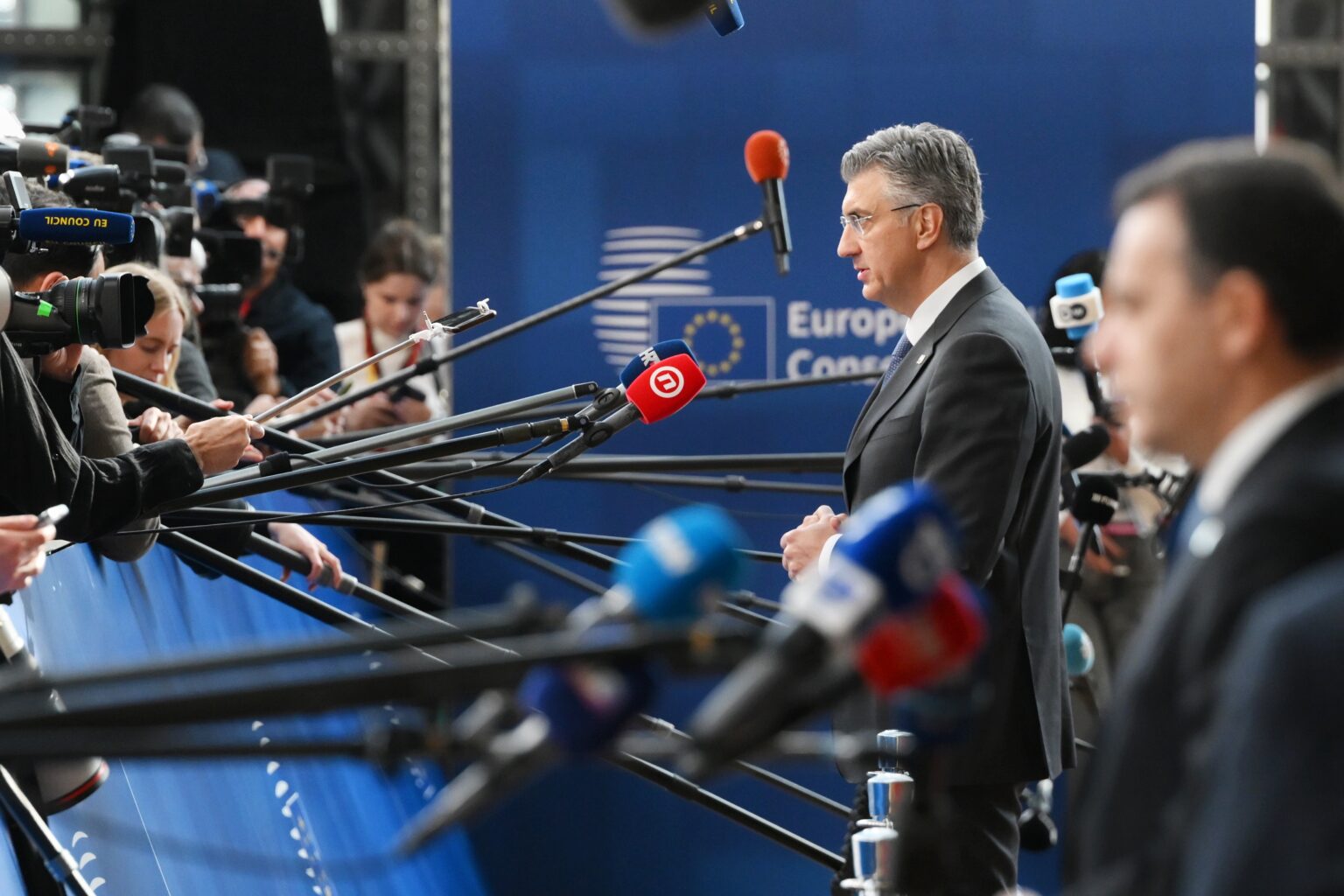
Following the conclusion of the European Council meeting, Prime Minister Andrej Plenković, in a statement to the press, referred to the most important topics discussed by European leaders.
Regarding the European Union’s continued support for Ukraine in its defense against Russian aggression, he reported that Hungary reiterated that, since Druzhba is not supplying oil, they are not prepared to give their consent to the amendment of the Multiannual financial framework and thus enable a guarantee for the €90 billion loan, which was agreed at the Council meeting in December.
This has been very poorly received by all member states, Prime Minister Plenković stressed, adding that at the moment there is still room because Ukraine still has sufficient funds to operate and finance its defense capabilities, and the Council will return to this topic in due course.
Croatia can ensure oil supplies to Hungary and Slovakia
When asked what to do next with Hungary, especially given Prime Minister Orban’s statements accusing European institutions of financing the Hungarian opposition so that he would lose the elections in April, the Prime Minister dismissed such accusations.
European institutions certainly do not finance any opposition in any country, including Hungary, he asserted, adding that the campaign in Hungary is entering its final stages and that tensions are high.
The whole concept of Orban’s party, he added, is that they are protecting Hungary from some kind of evil European leadership in Brussels.
He considers the fact that Orban agreed to a loan to Ukraine in December, and now, after the Druzhba oil pipeline was damaged, he has decided not to give his consent, to be a bigger problem.
The Prime Minister added that he reiterated to Orban and Fico at this European Council meeting that Croatia is a partner and a friend of both Hungary and Slovakia, and that JANAF can be a primary route, which is both reliable and safe and can supply them with all the necessary quantities of oil.
Commission to prepare additional measures to reduce energy pressure on member states
EU leaders discussed the global situation and multilateralism, in particular the situation in the Middle East, with UN Secretary-General Guterres.
In this context, the situation in Cyprus, namely the British bases that were hit there, was also discussed, as well as the overall consequences for the global energy situation and its economic consequences for member states.
Given that numerous energy facilities in both Iran and the Gulf countries have been hit, this no longer only affects the transport of oil through the Strait of Hormuz, but also calls into question the dynamics of production.
In this context, the President of the European Commission presented a framework, which was supported by the Council, which tasked the Commission to prepare additional measures and tools that would help member states horizontally reduce energy pressure on oil, gas and electricity prices.
Government will continue with measures aimed at protecting citizens and the economy
The Croatian government, he reminded, was among the first to react immediately and reduce the price shock, and it will come out with similar measures on Monday, he announced.
He expects this energy crisis to be more serious than the one at the beginning of the Russian aggression against Ukraine, and the Government will always deal with this issue with the aim of protecting Croatian citizens, the economy and institutions.
Asked whether the Government, given the energy crisis, would reconsider the takeover of INA, the Prime Minister said that it had done everything that someone who is serious and responsible and who works according to the rules could and should have done.
We expressed our desire, we made an adequate assessment from all possible aspects and offered a price that was realistic, and they did not accept it, said Prime Minister Plenković, adding that the Government cannot pay an affective price.
Congratulations to Boris Vujčić on his appointment
The Euro Summit was also held, Prime Minister Plenković said, and the impact of all these events on the European economy was discussed at that meeting too.
Although the topic of competitiveness, which should have been central, remained somewhat in the shadows due to all the circumstances, the Prime Minister said that everyone would strive to make the European economy a highly competitive and social market economy, emphasizing the need to strengthen competitiveness and the price of energy.
The European Council also made a formal decision to appoint Boris Vujčić as the new Vice-President of the European Central Bank.