
There is little doubt on this sub that AI, robotics and other technology will have a profound impact on labor markets. When confronted with the implications, most AI leaders suggest that AI will also create a lot of new jobs. They usually draw a parallel with some historical technological disruption, handwavingly mention the Jevons paradox or the lump of labor fallacy, and suggest that workers who adopt AI tools will be able to stay economically relevant for a long time.
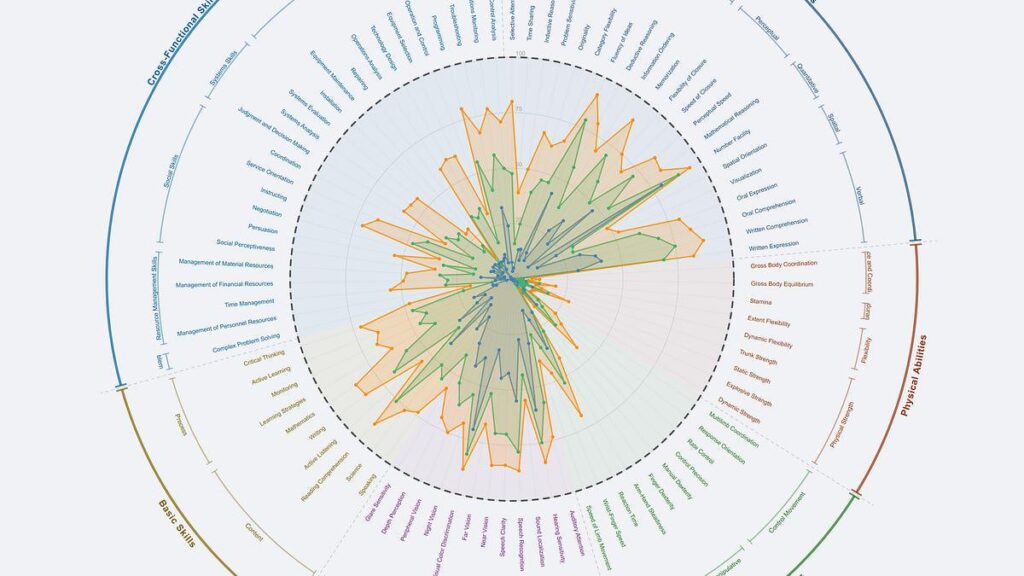
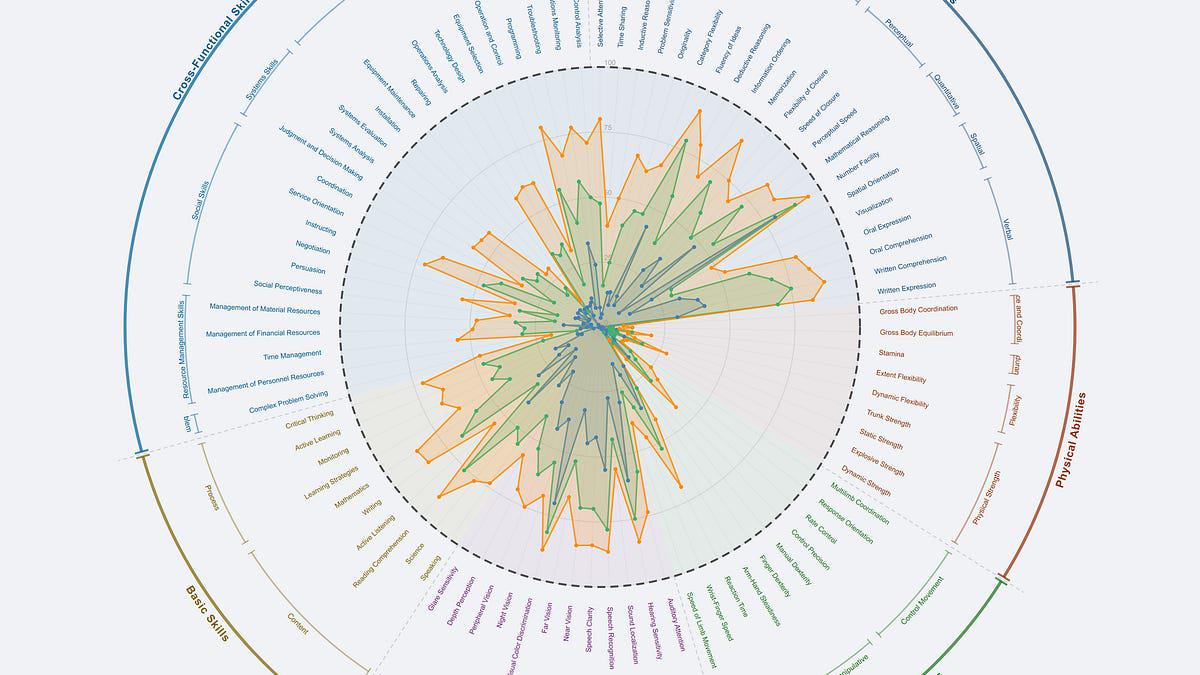
Intuitively, this didn't sit well with me. Why wouldn't AI disrupt those new jobs too? I've seen this argument everywhere but couldn't find any data-driven approach that actually tests whether the conditions for "new jobs will emerge" still hold. So I built what I think is the most comprehensive empirical analysis of the question to date. The attached image is the result.
Why "new jobs will emerge" has always worked — and why it might stop working
Every previous wave of automation left displaced workers with two escape routes.
Escape route 1: same skill, different job. A power loom killed weaving, but it didn't kill Manual Dexterity. The weaver's hands were still valuable in hundreds of other jobs. Previous technologies were narrow — they conquered a skill in one specific application but left the underlying ability competitive everywhere else.
Escape route 2: different skill entirely. When machines took muscle, humans moved to cognition. When computers took calculation, humans moved to judgment and communication. There was always an adjacent category of skills that technology hadn't reached.
New jobs emerged because there were enough uncontested skills to build them from. The web developer role didn't require a new human ability — it recombined Reading Comprehension, Critical Thinking, and Programming into a job that hadn't existed before. The mechanism worked because the raw materials (uncontested skills) were abundant.
What the data shows
I scored all 87 skills and abilities in the O*NET taxonomy — the US Labor Department's standard framework that decomposes every occupation into its component skills — against AI benchmarks expressed in the 0-100th human percentile at three time points: end-2020, end-2023, and end-2025. Then I mapped those scores onto 1,016 occupations. I've mapped the results in an interactive chart here.
The colored shapes show economic cost-parity — the skill level where AI is already cheaper than a human. Blue is 2020. Green is 2023. Orange is 2025. The dashed ring is the human frontier.
Some numbers:
- Average cost-parity went from the 18th percentile (2020) to the 56th (2025) — and it's accelerating: 7.1 points/year → 8.4 points/year
- 84% of skills are now past the point where a below-average worker is economically competitive
- Only 4 out of 87 skills still have the best AI system below the 25th human percentile. All four require a physical body.
- Every occupation in the database — all 1,016 — sits between 71% and 99% skill coverage
Both escape routes are closing.
Escape route 1 is gone for most cognitive skills. When AI reaches the 84th percentile on Writing, it doesn't displace one kind of writer — it pressures every occupation that uses Writing, simultaneously. A displaced legal writer can't retrain into marketing because the same skill is under equal pressure in marketing.
Escape route 2 is shrinking fast. AI is advancing on nearly all 87 skills in parallel. The frontier of uncontested skills isn't shifting to a new category — it's contracting. When there aren't enough uncontested skills left to recombine into new jobs, the mechanism that has always absorbed displaced workers stops working.
Andrej Karpathy launched a similar job-scoring tool two days ago (karpathy.ai/jobs). His caveat says "many high-exposure jobs will be reshaped, not replaced." I believe the longitudinal data shows why that conclusion is wrong — the escape routes that made reshaping possible are closing.
Full article: https://gertvanvugt.substack.com/p/the-final-frontiers
Spider chart / frontier map (full resolution): https://daity.tech/frontier.html
I also built an interactive tool where you can search any of the 1,016 occupations, see the skill profile, and get a displacement timeline estimate: https://daity.tech/jobexplorer.html
The dataset and methodology are published openly — I'm explicitly inviting challenges to the scores. If you think a number is wrong, tell me which one.
https://gertvanvugt.substack.com/p/the-final-frontiers
3 Comments
Submission statement:
Most discussions about automation and jobs on this sub assume that displaced workers will move to new roles, as they always have. This article tests that assumption empirically by scoring all 87 skills in the US Labor Department’s O*NET taxonomy against current AI and robotics benchmarks at three time points (2020, 2023, 2025), then mapping those scores onto 1,016 occupations. The key finding is that the two mechanisms that historically created new jobs — reusing a skill in a different occupation, and moving to an entirely different skill category — are both closing simultaneously. If this trend holds, the “new jobs will emerge” argument breaks down within this decade, which has major implications for education policy, social safety nets, and how we think about economic participation in the near future. The full dataset is published openly and I’m inviting challenges to the methodology. You can also explore the interactive visual here: https://daity.tech/frontier.html
Browse individual occupations here: https://daity.tech/jobexplorer.html
There is evidence of events where this has happened and the results also tend to repeat in historical cycles. Revolution
Very interesting! I don’t fundamentally disagree with the premise, and I think you make very strong arguments. What I continue to wonder about is whether true creativity and subsequently the ability to create new value in a capitalist market will be hurt or helped by the ubiquity of free skilled labor (AI). Does everyone become their own entrepreneur/ CEO overnight because they can make literally whatever they want at the drop of a hat with the tools available? Or is that giving too much credit?
I don’t have an answer to where that gets us…but I find it to be one glimmer of hope perhaps. Otherwise, as someone else said, it will be mass unemployment followed by revolution.