
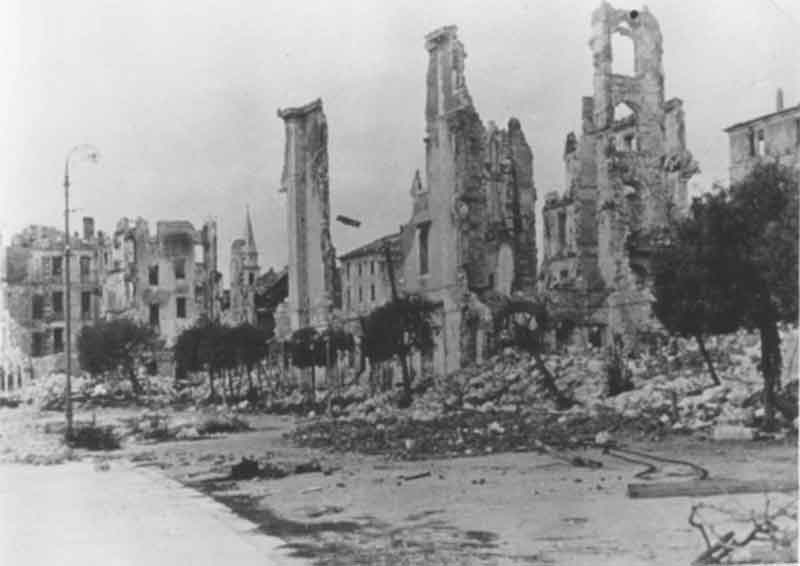
On another commemoration of the bombing of Belgrade, both in 1941/1944 and in 1999, the question arises whether what befell the Serbs during World War II and afterwards could have been avoided. Therefore, in the following text, I would like to present some of my personal observations to break down prejudices and stereotypes.
After the rapid capitulation of France in June 1940 in the war against the Austrian corporal, only Great Britain remained, with, at least at that time, a small chance of winning the war and a much greater chance of concluding a humiliating peace. It is therefore not surprising that British politicians and diplomats tried by all means, including military coups (and other means of dirty politics), to drag any neutral country into the war on their side, regardless of the price that the sacrificed country had to pay for the eventual victory of Proud Albion.
Thus, in the spring of 1941, the Kingdom of Yugoslavia, which was temporarily governed (from the assassination of King Alexander I Karađorđević on October 9, 1934, in Marseille, until the majority of his son, Peter II, on September 6, 1941) by the regent Prince Pavle Karađorđević, found itself under the attack of British dirty diplomacy. How historically dishonest British policy, dressed in extremely perfidious and dirty diplomacy, was is perhaps best expressed by the British saying from the First World War that “British soldiers will fight on the Western Front until the last drop of French blood!” After the German Anschluss of Austria in 1938, the Italian occupation of Albania in April 1939, the accession of Romania and Bulgaria to the Tripartite Pact, which also included Hungary (1940/1941), the Kingdom of Yugoslavia had common borders only with the Axis Powers and their clients, except with the Kingdom of Greece. Taking into account, in addition to this foreign policy factor, the traditional Croatian separatism, servility, and betrayal on the one hand and Serbian patriotism and freedom on the other, Prince Paul found himself in March 1941 in a great psychological-political-patriotic dilemma of how to resist Hitler’s diplomatic pressures but also honest concrete political offers for signing Yugoslavia’s accession to the Tripartite Pact. Hitler was in a real hurry to implement the “Barbarossa” plan (military operation against the USSR), so the Yugoslav side could not drag out time indefinitely, and Croatian betrayal and stabbing in the back in the event of Hitler’s invasion of the Kingdom of Yugoslavia was Berlin’s main trump card in negotiations with Belgrade.
Prince Paul himself, as well as the political establishment of the Kingdom, could only rely at that time (spring of 1941) on possible concrete and rapid assistance from Great Britain, which was losing the war at that moment but had not yet lost it and, compared to the Third Reich, had far greater economic and human resources, taking into account the British overseas colonial empire. The factor of the USA, which, as a Jewish-led state, hung like a sword of Damocles over Hitler’s neck, should also be taken into account. However, the Kingdom needed concrete and rapid military assistance to possibly deter the Austrian corporal from attacking Yugoslavia by refusing to sign an alliance with the Führer.
Prince Paul was otherwise a staunch Anglophile, both in education and manners. It was believed that the Prince would rather abdicate than turn his back on Britain, and Hitler himself considered him a British puppet in the Balkans. The British King George VI was his cousin, which naturally strengthened the alliance with Proud Albion. However, at that critical time for the survival of Yugoslavia, Albion had to finally reveal its true colors and show the Serbs that it was not Proud at all, but rather Perfidious, which ultimately drove Prince Paul’s Yugoslavia into Hitler’s arms.
In addition to the factor of betrayal (i.e., extremely insidious stabbing in the back) of Croats, in the event of Hitler’s attack on Yugoslavia (i.e., failure to sign the Tripartite Pact), serious attention had to be paid to the communist fifth column in the country, given that the Nazis and communists had been not only friends but also direct allies since August 23, 1939 (when the Ribbentrop-Molotov Pact was signed). Therefore, in December 1940, Yugoslav General Milan Nedić (a Serb), Minister of War, prepared an order to open six concentration camps for communists in various places in Serbia in case of need, to blunt at least one fifth column knife if the Kingdom decided to oppose Hitler. In this context, Nedić’s proposal that the city and port of Thessaloniki in Greece be occupied by the army of the Kingdom of Yugoslavia before Italian troops entered it after Mussolini’s aggression against Greece in November 1940 was also included. If Thessaloniki was lost, any possible British military aid to Yugoslavia before Hitler’s invasion would be impossible. It turned out that this precaution was not necessary because the Greeks successfully fought against the Italians (they even entered Albania, from which the Italian invasion of Greece began), but on the other hand, there was no British aid to Yugoslavia, unlike Greece.
As for Nedić’s plan for concentration camps for communists, it was soon discovered by a communist mole in the ranks of the government. It was a young officer, Živadin Simić, who served in the Ministry of War. He handed over a two-page copy of the document to an unknown “very important friend” whom he only later discovered was a metalworker from Zagorje (J. B. Tito). The copy of the document was soon copied by the communists and distributed from house to house in Belgrade, so that the plan to reserve the red fifth column could not be implemented. The catastrophic consequences of Simić’s slander and betrayal were quickly felt by the Serbs in a national sense, both during and after the war. Thus, in addition to Winston Churchill, Živorad Simić became a Serbian gravedigger, and even General Draža Mihailović could not later correct this betrayal.
Hitler needed to resolve the issue of Yugoslavia and Greece before attacking the USSR, believing that Great Britain, which had declared war on him, would not make peace as long as the Soviet Union existed in Hitler’s hinterland, regardless of the agreement between Moscow and Berlin, which London considered to be insincere, fraudulent, and forced by the force of foreign policy (mis)opportunities. However, for “Barbarossa,” the Reich needed a pacified Balkans (originally, the „Barbarossa“ operation was schadueled for mid-May, 1941, not end of June), and the only still unreliable states in the Balkans were Yugoslavia, with the Serbs as traditional German enemies, and Greece, which Mussolini had clumsily involved himself in as revenge for Hitler’s Anschluss of Austria, which he had not been informed about by Berlin.
It soon became clear that the Duce could not extricate himself from the Greek salad. In continental Europe, the British army was still successfully fighting only in Greece, so the military-political elimination of Greece and Yugoslavia, as a potential British ally, would have had an extremely discouraging effect on London. Therefore, Hitler transferred seven of his divisions to Bulgaria and asked Prince Paul to allow him to transfer six divisions via Yugoslavia to the Greek front. The final “face-to-face” resolution of the situation with Yugoslavia came on March 1, 1941, when Prince Paul was forced to personally visit the Führer at his favorite resort of Berchtesgaden. On that occasion, in an extremely unpleasant conversation for the Prince, he was told that, after the expulsion of British forces from Greece, Germany would attack the USSR in the summer and destroy Bolshevism. What Yugoslav (both communist and émigré) historiography has largely ignored, consciously or not, is Hitler’s principled offer to Prince Paul that someone from the Karađorđević family should become the Russian Tsar after the collapse of Bolshevism (Vladimir Dedijer, Tito Speaks, p. 130). Of course, the German dictator was targeting Prince Paul, whose mandate as regent of Yugoslavia expired on September 6, 1941 (because at that time Prince Peter II was turning 18, i.e., becoming an adult and fully-fledged King of Yugoslavia).
However, in order not to get the wrong impression, it must be noted that Hitler’s “imperial” offer did not crucially influence the decision of Prince Paul and the regency government of the Kingdom of Yugoslavia to join the Tripartite Pact on March 25, 1941, because this issue had already been resolved by Perfidious Albion. In addition to the fact that the offer itself was more imaginary than real, and from a man who had not even started the war in the East, and without the previous end of the war in the West, sitting on the Russian imperial throne with Nazi-German patronage would not have been much of a pleasure, let alone the moral side of this act.
However, what finally broke Prince Paul was called “realpolitik”. Namely, the Prince, as a zealous British client in Yugoslavia, first turned to his mentors, i.e., British diplomatic circles in Belgrade and London, appealing for help and protection. What the British offered Yugoslavia (in fact, the Serbs) can be summed up in one word: middle finger! (and a big one at that). Moreover, with the diplomatic selling of balls for kidneys. Namely, they did not offer any military assistance, neither in terms of manpower nor in terms of equipment and material (unlike the Greek case) and they demanded everything from Yugoslavia – to engage militarily to the maximum extent possible in a direct war against the Third Reich (from which the British themselves were losing the war) with the “promise of crazy joy” that the Yugoslavs would be adequately rewarded after the “victory” of Perfidious Albion. So, it was necessary to bleed for Albion “to the last drop of Serbian blood” (because from the Slovenian „Vienna stablemen“ and the Croatian „Pest coachmen“ during the war one could only expect a stab in the back, so that realistically one could only count on “a Serb gladly goes into the army”) and some kind of reward would come after a possible victory, and it was unclear what kind and whether it was adequate at all. How Albion started the war was clearly seen in the Polish example: on the eve of the German attack on Poland, British military experts toured the Polish defensive trenches with the question, “Where is your artillery?” The Poles answered, “We are asking you that!”
With the historical, not so long ago, experience from the First World War, how the British, as formal “allies”, helped Serbia and the Serbian army, and having a concrete offer from Hitler of the conditions under which the Kingdom would join the Tripartite Pact, not going to Vienna on March 25, 1941, would mean national and state suicide. Prince Paul himself, on the eve of the negotiations with Hitler, feared that London would arrogantly demand from Yugoslavia a formal public declaration of friendship with Britain, which would certainly further irritate the Führer and would not bring anything good to the Kingdom. In addition, concrete British assistance was not even on the horizon, and Yugoslavia had a common border with Germany after the 1938 Anschluss. How the Croats and Yugoslav communists would fight against Germany was clear to everyone, with the caveat that, in terms of armament and equipment, Yugoslavia was absolutely unprepared for war, even against a far weaker opponent than Germany, which had overrun France less than a year earlier (May‒June 1940).
Therefore, by pushing Yugoslavia into war, the British counted exclusively and only on the Serbian soldier who, on the front against the German Luftwaffe and the Wehrmacht panzer divisions (which paraded along the Champs-Élysées and under the Arc de Triomphe in Paris), had to endure as long as possible, until his final death. On January 12, 1941, Winston Churchill made this clear to Prince Paul through the British envoy in Belgrade, who informed the Regent that Yugoslav neutrality was no longer sufficient for London.
In other words, the difference between Hitler’s and Churchill’s demands for Yugoslavia was accordingly enormous: the Austrian corporal demanded only neutrality and a non-aggression pact, while the British bulldog demanded blood. Yugoslavia’s chances in a war with Germany were clearly and loudly stated by the new Yugoslav Minister of War, General Pešić (a Serb, an anti-German whose election was welcomed by the British), at a session of the Crown Council (the government’s executive committee) on March 6, 1941. On that occasion, the general said that in the event of war, the Germans would quickly occupy the entire north of the country, including Belgrade, Zagreb, and Ljubljana, and in that case the Kingdom’s army would have to retreat to the Herzegovina-Bosnia mountains, where it could survive without sufficient weapons, ammunition, and food for up to six weeks before the final capitulation.
In accordance with this state of affairs, the next day, March 7, Prime Minister Dragiša Cvetković (an ethnic Gypsy) handed the following Yugoslav demands to the German ambassador in Belgrade (believing that the Yugoslav demands went beyond what Hitler was ready to accept at that moment) before signing the accession to the Tripartite Pact (the same ones that Prince Paul had requested from the Führer on March 1, 1941):
• The political sovereignty and territorial integrity of the Kingdom shall be respected.
• No military assistance shall be requested from Yugoslavia, nor shall the passage or transport of troops through the country be requested during the duration of the war.
• Yugoslavia’s interest in free access to the Aegean Sea shall be taken into account in the political reorganization of Europe after the war.
What Ribbentrop and Cvetković signed at the Belvedere Hotel in Vienna on March 25, 1941, can be considered the maximum diplomatic success of de facto Serbian diplomacy in the midst of World War II (Ivo Andrić, a later Nobel Prize winner for literature, was a man who brought the paper to be signed). What the German side signed (and put on the table for signature by the Yugoslav diplomat Ivo Andrić) was exactly what the Prince and Prime Minister had asked Berlin for, hoping that Hitler would not accept such demands and thus the negotiation process would continue (but Hitler agreed):
- “On the occasion of today’s accession of Yugoslavia to the Tripartite Pact, the German government confirms its decision to respect the sovereignty and territorial integrity of Yugoslavia without any time limit”.
- “…the governments of the Axis Powers will not, during this war, ask Yugoslavia to permit the transport of troops across the Yugoslav state or through its territory”.
- “Italy and Germany assure the government of Yugoslavia that in connection with the military situation, they do not wish to make any requests for military assistance.”
The Germans, however, did not meet only one of Belgrade’s demands: the second item (on transit) had to remain secret, so the Yugoslav newspapers did not even publish it. Berlin requested secrecy of this item so as not to anger Sofia, Bucharest, and Budapest, because Bulgaria, Romania, and Hungary did not have such a great privilege as Yugoslavia had. The only ones who were not satisfied with this development of the situation were the British, because they were the only real losers.
Therefore, according to the already elaborated reserve plans of Perfidious Albion, the implementation of a variant of a coup d’état, i.e., a military coup, was initiated in Belgrade to bring the extremely obedient British clients to power, similar to what the Germans did with Lenin in 1917 who was sent from Switzerland to Petrograd (St. Petersburg) to seize power and overthrow by the armed coup the government of Kerensky, which refused to sign a separate peace treaty with the German Second Reich. The main British puppet who organized the coup in Belgrade on the night of March 26/27, 1941, was Brigadier General of the Yugoslav Air Force Borivoje Mirković (a Serb).
The demonstrations in Belgrade of March 27, 1941, were absolutely spontaneous because the people thought that it was really a case of treason (given that not all points of the agreement were made public and given that they had unfounded hopes for British help), so there is no question of the post-war Titoist propaganda that the demonstrations were organized by communists for two reasons:
1. The strength, influence, and number of communists were too small to animate a large mass of people.
2. Stalin’s directive to all communist parties in Europe after the agreement with Hitler in 1939 was clear and binding: all anti-German activities were to be strictly stopped.
It is not difficult to conclude that the burning of the German flag (during the demonstrations on March 27, 1941) on the building of the German Tourist Office in Belgrade was a well-thought-out provocation by some of Mirković’s British collaborators to give Hitler a clear excuse to attack Yugoslavia, which Hitler did on April 6, 1941 (on Belgrade, not on Zagreb, Sarajevo, or Ljubljana).
What would happen after the attack on Yugoslavia and the defeat of the royal army was well known to all leading Serbian politicians – the dismemberment of the country with the creation of a large genocidal Roman Catholic Croatian state (Independent State of Croatia) in which Christian Orthodox Serbs would be killed with pleasure and pride by the Croats and Bosnian-Herzegovinian Muslims (today Boshniaks), while the Perfidious Albion would continue to send “promises of crazy joy” with obscene demands to hold out until the last drop of (others’) blood. During the war of 1941–1945 in Yugoslavia, all the perfidy of the Proud Albion would be felt in its full sense precisely by the Serbs and their only national protector, the Ravna Gora Movement, and the people of Belgrade (and some others from Serbia) would have to flee in 1944 as well, but this time from the Anglo-American bombing ordered by a Croat (by father) and Slovenian (by mother) a Roman Catholic Josip Broz Tito (a former solder of the Austro-Hungarian Army on the soil of West Serbia in 1914‒1915).
Get the latest CounterCurrents updates delivered straight to your inbox.
Personal disclaimer: The author writes for this publication in a private capacity, which is unrepresentative of anyone or any organization except for his own personal views. Nothing written by the author should ever be conflated with the editorial views or official positions of any other media outlet or institution.
The author of the text does not have any moral, political, scientific, material, or legal responsibility for the views expressed in the article.
Dr. Vladislav B. Sotirović, Former University Professor (Vilnius, Lithuania), Research Fellow at Centre for Geostrategic Studies (Belgrade, Serbia) Research Associate of Centre for Research on Globalization (Montreal, Canada)
© Vladislav B. Sotirović 2026