
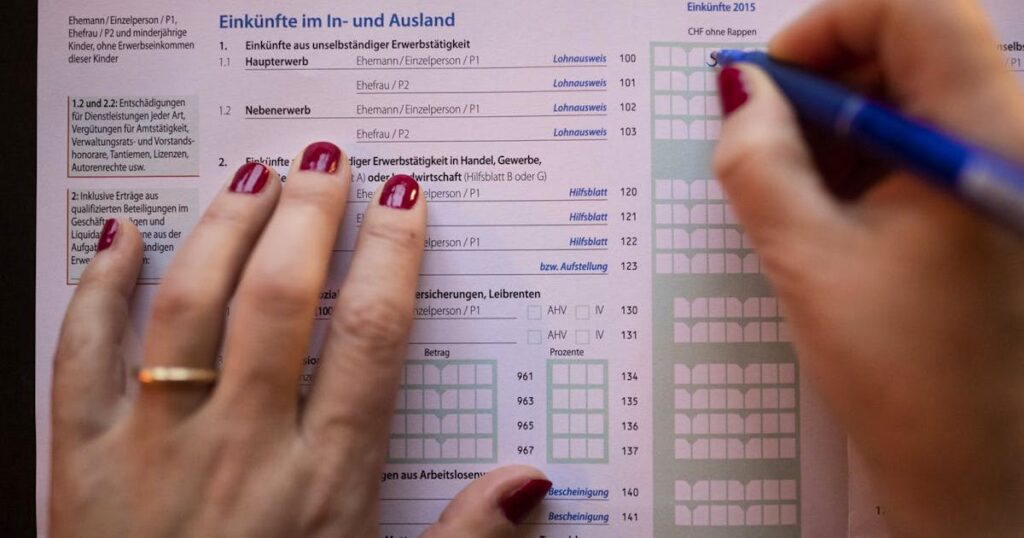
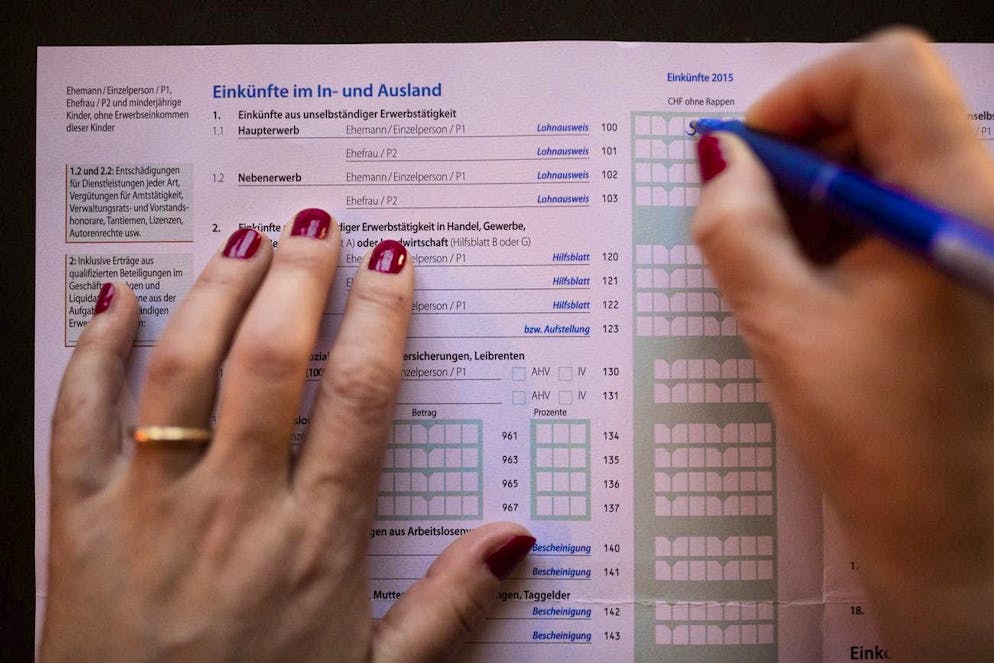
How to save on your tax return.
KEYSTONE
Saving taxes doesn’t have to be complicated: If you use your pension provision cleverly, plan renovations correctly or deduct donations, you can save thousands of francs a year. These are the best tips.
- Tax returns are due again. blue News shows you how and where you can make the best savings.
- Pillar 3a and pension fund: deposits reduce taxable income.
- Commuter deductions, further education costs and maintenance costs are tax-deductible.
- A change of residence can reduce taxes, while clever succession planning and company sales help to avoid high taxes.
With the right strategy, saving taxes in Switzerland is easier than you might think. There are numerous opportunities for optimization, particularly in the areas of pension provision, real estate and company management. Those who plan ahead can often save thousands of francs. Here are ten tried-and-tested tips that employees, the self-employed and entrepreneurs can use to reduce their tax burden in a targeted manner.
vermoegenszentrum.ch and Comparis have compiled numerous tips, blue News provides you with an overview.
One tip first: If you want to save money and don’t want to teach yourself, it’s best to seek tax advice. It can be worth having an expert take a look at your tax return.
Tied pension provision, better known as pillar 3a, is one of the simplest and most popular ways to save tax. Employees can deduct up to CHF 7258 (as of 2026) from their taxes each year.
Self-employed persons without a pension fund can pay in up to 20 percent of their net income, up to a maximum of CHF 35,280. These payments not only reduce taxable income, but also strengthen retirement provision.
From 2026, it will also be possible to make up for missed payments – an important change that will particularly benefit people with irregular incomes.
If you spread your 3a assets over several accounts, you can save tax on later withdrawals because staggered payouts are generally taxed at a lower rate than a single large sum. It is therefore worth opening several 3a accounts at an early stage in order to have more flexibility later on.
Claiming professional expenses
Many employees and self-employed people underestimate the potential of professional expenses. If you commute, you can claim travel costs to work under certain conditions.
For direct federal tax, there is an upper limit of CHF 3,200 per year. For cantonal tax, different upper limits apply depending on the canton. Meal costs are also deductible if no discounted canteen is available.
In times of working from home, the following applies: Costs for workspaces, technical equipment or office supplies can also be taken into account for tax purposes, provided the space is mainly used for professional purposes. This means that considerable amounts can also be deducted in everyday life.
A thirst for knowledge and diligence is rewarded when it comes to taxes. This is because expenses for work-related training and further education are tax-deductible up to a certain amount.
Up to CHF 12,900 per year can be claimed for direct federal tax purposes. This includes course fees, specialist literature and other costs associated with further training.
Take insurance premiums into account
Insurance costs money every year. But don’t worry: you can normally declare them on your tax return.
Premiums for health, accident and life insurance can be deducted from your income up to a fixed maximum. For direct federal tax, the maximum deduction is CHF 1,800 for single people and CHF 3,600 for married couples. It is important to know the exact deduction amounts in your canton of residence, as these can vary.
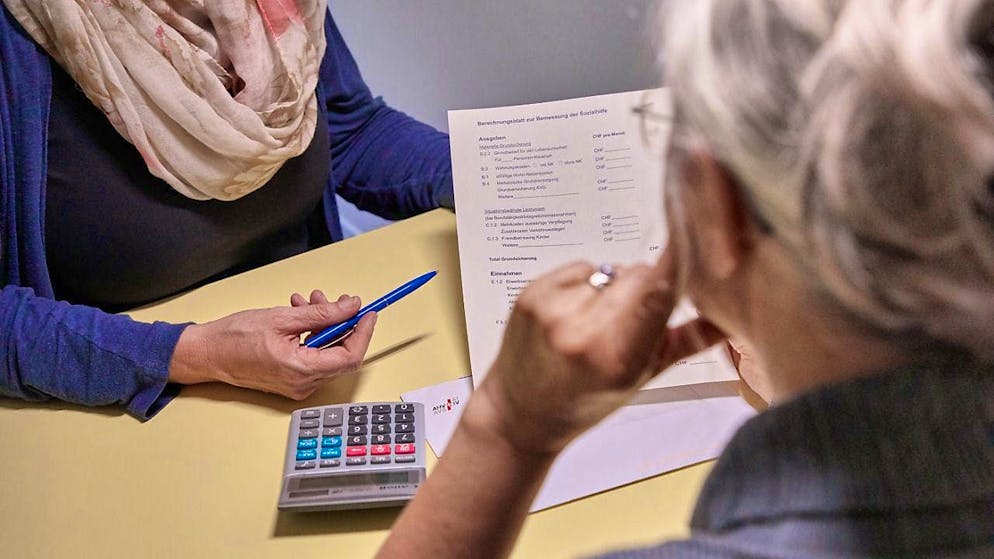
If you have debts, you can deduct them.
sda
If you finance your home with a mortgage or loan, you can also save money on your tax returns.
Interest that you pay on private debts such as mortgages or loans is deductible. However, there are maximum limits that can vary depending on the canton. It may therefore be worth checking the specific regulations in your canton of residence to determine the maximum deduction.
Donations have a doubly positive effect
If you are generous and have a heart for charitable organizations, it’s probably not just your conscience and karma that will thank you. You can also benefit from this in your tax return.
Donations to recognized charitable institutions can be deducted up to a certain percentage of your income. Up to 20 percent of net income is deductible for direct federal tax purposes. This allows you to do good and reduce your tax burden at the same time.
Which organizations are considered charitable varies from canton to canton. Various cantons have posted their lists on the Internet: Zurich, Bern, Basel-Landschaft, St. Gallen, Thurgau.
Deduct sickness and accident costs
Have you had a difficult year and have been running from doctor to therapist? Then you can get the money back on your taxes.
Extraordinary medical expenses that are not covered by insurance can be claimed for tax purposes. Costs that exceed 5 percent of net income are deductible for direct federal tax purposes. These include dental costs, therapies and other necessary medical treatment.
Renovation costs for properties
A conversion or renovation costs money, but can also be declared for tax purposes. This applies as long as the abolition of the imputed rental value in 2025 is not yet in force.
Expenses for the maintenance and renovation of owner-occupied or rented properties can therefore still be deducted. It is advisable to spread major renovations over several years in order to make the most of the tax advantage. Investments that increase the value of the property may also be deductible.
Use child and education deductions
Parents take note: If you didn’t already know, expenses for children can be declared on your tax return.
You can deduct a fixed amount from your taxable income for each dependent child. In addition, costs for your children’s education, such as school fees or tuition fees, can be claimed up to a certain limit. For direct federal tax, the child deduction is CHF 6,500 per child.
Tax optimization for entrepreneurs
Entrepreneurs have particularly attractive opportunities to reduce their tax burden through pension provision.
Self-employed persons with an income of over CHF 150,000 should definitely join a pension fund to enable higher payments and deductions.
Owners of an AG or GmbH can achieve considerable tax savings by cleverly structuring their salary and dividend ratio and through customized pension solutions. A high salary also means higher tax-deductible payments into the pension fund. This can be advantageous in the long term.
The choice between a lump-sum withdrawal or a pension has significant tax implications.
Lump-sum withdrawals from the pension fund are taxed once at a reduced rate – often a more favorable solution than the annual income tax on pension payments.
The capital payment tax varies greatly depending on where you live. A single person with assets of CHF 1 million, for example, saves around CHF 60,000 in Appenzell compared to Zurich. Staggered withdrawals over several years further reduce the tax burden. An early change of residence or a strategic staggering of payments can save thousands of francs.
Plan the sale of your company strategically
Anyone selling their company should consider the tax consequences at an early stage.
Sole proprietorships should be converted into an AG or GmbH at least five years before the sale – otherwise there is a risk of subsequent taxation of hidden reserves. When selling an AG or GmbH to a third party, no income tax or social security contributions are due if the entire company is sold.
Anyone planning a succession plan within the family should consider a sale structure instead of a gift – this is often more advantageous from a tax perspective. The right planning can make the difference between a tax-free transfer and a high tax burden.
Making clever use of real estate
Homeowners can reduce their tax burden with simple strategies.
Indirect amortization via pillar 3a is often more advantageous from a tax perspective than a direct repayment of the mortgage. Maintenance costs can be deducted annually.
Owners can choose each year between an effective deduction for maintenance costs or a flat-rate deduction – depending on the situation, one or the other is more worthwhile. A financial planner can help you find the optimal strategy for maintenance costs and mortgages.
Plan inheritances and gifts well
Spouses and direct descendants do not pay inheritance tax in almost all cantons. However, unrelated heirs or cohabiting partners can be faced with high tax charges. Early gifts or foundations can help to minimize the tax burden.
So if you structure your assets early on, you can avoid high inheritance tax.
Change of residence: a move can be worthwhile
Tax rates in Switzerland vary greatly – not only for income, but also for capital payments, assets and real estate. A change of residence can bring considerable savings, but must be carefully calculated, as higher living costs can cancel out the tax advantage.
For example, health insurance premiums can rise depending on where you live. This means: find a place of residence where the tax rate is low and the cost of living is also low.
Anyone considering a move should consult a tax advisor to take all factors into account.
Transparency note: This article was first published in 2025.