
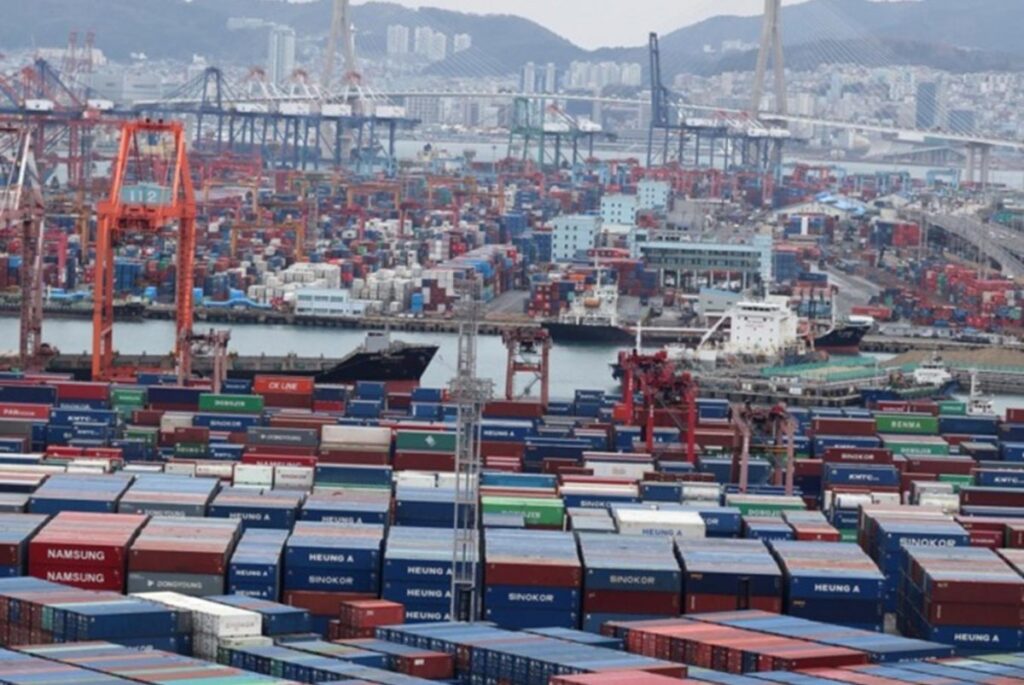
Shipping containers are stacked at a pier in Busan, South Korea, 06 March 2026. South Korea chalked up a current account surplus of US$13.26 billion in January, recording its fifth largest monthly current account surplus, driven by a semiconductor upcycle and strong exports. Photo by YONHAP / EPA
March 22 (Asia Today) — This commentary is the Asia Today Editor’s Op-Ed.
Artificial economic stimulus may undermine long-term growth, and policymakers should shift toward structural reforms and innovation to achieve sustainable expansion, an Asia Today editorial said Sunday.
The article highlighted remarks by Kim Se-jik, president of the Korea Development Institute, who warned that short-term stimulus measures are no longer sufficient as the risk of near-zero growth becomes more pronounced.
It stressed the need to distinguish between managing short-term economic fluctuations and achieving genuine economic growth, which it defined as reallocating resources to higher value-added activities driven by innovation.
The editorial argued that excessive reliance on stimulus policies – including low interest rates and expansionary fiscal spending – can distort market signals and lead to inefficient investments, weakening the economy’s long-term fundamentals.
Such measures may temporarily boost growth figures, but they risk delaying necessary structural reforms and restructuring, which are essential to improving economic efficiency, it said.
The commentary also emphasized the importance of fiscal discipline, noting that maintaining sound public finances is critical to ensuring resources are directed toward sustainable innovation rather than unproductive spending.
It warned that rising debt levels could limit the government’s ability to respond to future economic shocks, including inflation, exchange rate volatility and global trade disruptions.
The article called for a shift away from policies focused on short-term indicators such as growth rates or stock market performance, urging instead a focus on strengthening the economy’s underlying structure and encouraging entrepreneurial activity.
While acknowledging that fiscal restraint may impose short-term hardship, the editorial said enduring the pain of reform is necessary to restore economic vitality.
“True growth can only flourish on the foundation of fiscal discipline,” it said, urging policymakers to prioritize long-term national interests over short-term political gains.
— Reported by Asia Today; translated by UPI
© Asia Today. Unauthorized reproduction or redistribution prohibited.
Original Korean report: https://www.asiatoday.co.kr/kn/view.php?key=20260322010006423