
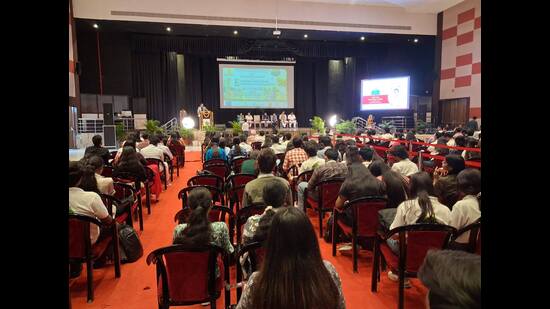
A two-day conference focusing on environmental concerns and their impact on residents’ health concluded on Sunday at Gurugram University, officials said.
Over 150 research papers discussed sustainability and healthcare. Minister raises concern over worsening air quality; eco-friendly practices adopted. (Facebook//gurugramuniversity.ac.in)
Held from March 21 to 22, the conference brought together multiple stakeholders, including Haryana’s environment and industries minister Rao Narbir Singh and senior officials, to deliberate on emerging sustainability trends, curb localised emission sources, and explore eco-technological options for waste management.
According to university professors, more than 500 academicians, students, and faculty members attended the event. Around 154 research papers were presented, focusing on emerging trends in healthcare and sustainability.
Speaking at the conference, Singh said, “An air quality index (AQI) of 200-250 has become the new normal for the city’s inhabitants. Collaborative efforts among the civic bodies and residents will go a long way in restoring the air quality to breathable levels.”
Vice-chancellor Sanjay Kaushik highlighted the link between environmental degradation and human health, including its impact on mental well-being. “Even though we have seen an increased life expectancy over the past few decades, the quality of life offered in urban cities like Gurugram still needs to be improved,” he said.
Officials and organisers also emphasised sustainable practices adopted during the event. Professors said no plastics or non-renewable items were used, making it among the first few “plastic-free” conferences held in Gurugram. Dr Rani Devi, head of the biosciences department and convenor of the conference, said, “Unlike typical public events, where flags and banners made of plastics are commonly used, sustainable practices such as discarded coconut shells as planters for the guests were used in making souvenirs, along with jute bags, stainless crockery, and earthen pots. Participants could access the learning material by simply scanning QR codes, instead of relying on paperwork.”
During the inaugural session on Saturday, state drug controller Lalit Kumar Goel urged chemist organisations and pharmacists in the district to refrain from selling certain allopathic drugs, including diclofenac, ketoprofen, aceclofenac, and nimesulide, for veterinary use. “These non-steroidal anti-inflammatory drugs (NSAIDs), scientifically proven to be behind the mass mortality of vultures in the state, are required to come under stringent monitoring,” Goel said.
Singh added that endangered vulture species such as slender-billed and white-rumped vultures are being bred at the state’s Jatayu Conservation Breeding Centre in Pinjore, near the Bir Shikargah Wildlife Sanctuary. “These birds are later released into the wild under a reintroduction programme and fitted with geo-tags so scientists can track their movement and survival,” he said.