
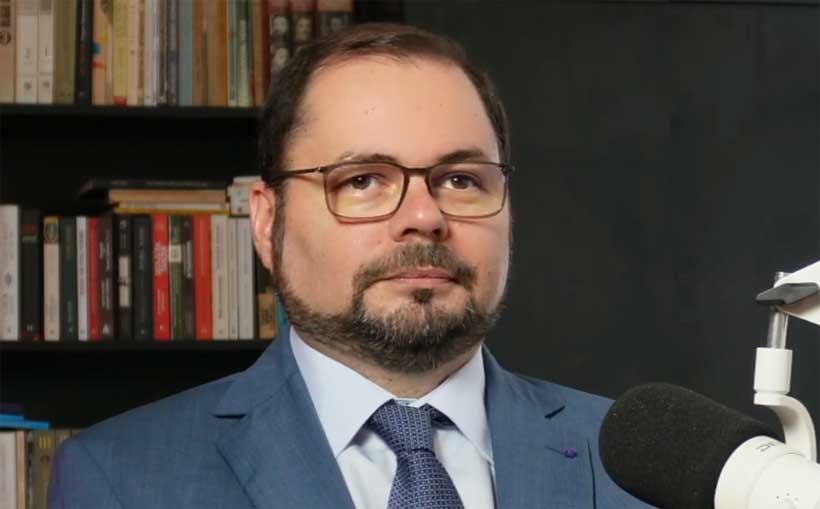
In this interview, Professor Sergiu Mișcoiu at the Faculty of European Studies, Babes-Bolyai University in Cluj-Napoca (Romania), where he also serves as a director of the Centre for International Cooperation and director of the Centre for African Studies, says the U.S.-Israeli war on the Islamic Republic of Iran draws a wide range of issues relating to security architecture in the Middle East, and other regions are equally experiencing tremendous impact on their economies. Undeniably, the war is also reshaping global politics. In comparison, the EU’s persistent difficulty in articulating a unified foreign policy in high-intensity crises, while Africa’s stance aligns with broader Global South trends, emphasizes flexibility, issue-based alignment, and resistance to binary geopolitical logics. Here are the interview excerpts:
What’s your interpretation of the U.S.-Israel war on Iran in the context of developments in the European Union?
Professor Sergiu Mișcoiu: The U.S.–Israel confrontation with Iran should be understood as a stress test for the geopolitical coherence of the European Union. The conflict exposes the enduring tension between the EU’s ambition for strategic autonomy and its structural dependence on U.S.-led security frameworks. While several member states align closely with Washington’s threat perception—particularly regarding nuclear proliferation and regional deterrence—others emphasize diplomatic engagement and de-escalation, reflecting both geographic proximity and economic vulnerability. This divergence underscores the EU’s persistent difficulty in articulating a unified foreign policy in high-intensity crises. Moreover, the conflict risks reinforcing the marginalization of the EU as a geopolitical actor, relegating it to a reactive rather than agenda-setting role in Middle Eastern affairs.
Do you think the impact is noticeable across Europe, and would that, generally, impact U.S.-Europe’s politico-diplomatic relations?
Mișcoiu: The repercussions across Europe are tangible, particularly in the domains of energy security, domestic political contestation, and foreign policy alignment. Instability in the Gulf translates into price volatility and supply uncertainty, amplifying existing structural vulnerabilities within European economies. Politically, the conflict may intensify intra-European cleavages between Atlanticist and more autonomist strategic cultures. In terms of transatlantic relations, the partnership remains anchored in NATO and is therefore unlikely to fracture fundamentally. However, divergences over the management of the conflict—especially regarding escalation or diplomatic engagement with Iran—could generate episodic tensions. These frictions are emblematic of a broader pattern in which the EU seeks greater agency but remains embedded within a U.S.-dominated security architecture.
Is Iran powerful in the Middle East, then? What are your arguments that Iran joined BRICS+ in 2025 and about China’s and Russia’s roles as members of this association in this U.S.-Israel war on Iran?
Mișcoiu: Iran can be characterized as a pivotal, albeit contested (because of its theocratic-totalitarian regime) regional power whose influence derives from a combination of geopolitical positioning, ideological projection, and networked alliances across the Middle East. Its accession to BRICS+ in 2025 is indicative of an ongoing reconfiguration of global governance structures toward greater multipolarity. For China and Russia, Iran constitutes both a strategic partner and a lever for contesting U.S. hegemony in the region. China’s engagement is primarily geo-economic, centered on energy security and connectivity, whereas Russia’s involvement is more explicitly geopolitical and security-driven. From a theoretical standpoint, Iran’s integration into BRICS+ illustrates the emergence of alternative institutional frameworks that enable sanctioned or semi-isolated states to circumvent Western-dominated systems.
As an African expert, how would you characterize Africa’s reactions? And do you think that was objective and authentic, based broadly on Arab and Middle Eastern contributions to Africa’s development?
Mișcoiu: African responses can be analytically framed through the lens of strategic non-alignment and pragmatic multivector diplomacy. Most African states have adopted cautious, de-escalatory positions, reflecting both normative commitments to sovereignty and a desire to avoid entanglement in external conflicts. While historical and contemporary ties with Arab and Middle Eastern actors—particularly in areas such as energy, finance, and religious exchange—do shape certain diplomatic inclinations, it would be analytically insufficient to interpret African reactions as merely derivative. Rather, they reflect an increasingly autonomous foreign policy orientation that prioritizes diversification of partnerships and resilience in the face of systemic shocks. In this sense, Africa’s stance aligns with broader Global South trends, emphasizing flexibility, issue-based alignment, and resistance to binary geopolitical logics.