
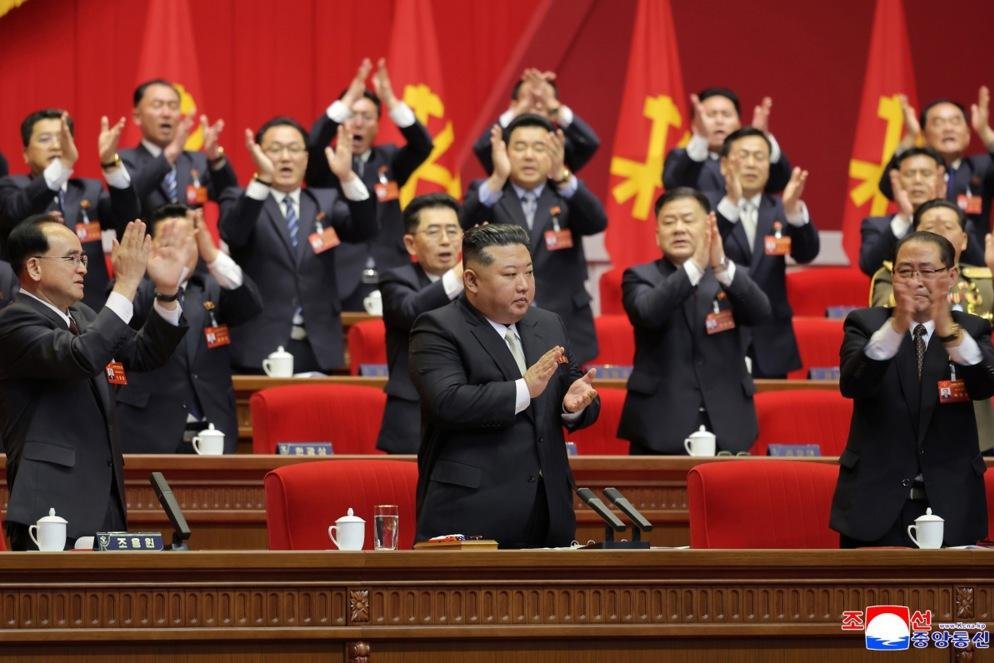
North Korean leader Kim Jong Un (C) and officials applaud during the fourth day of the Ninth Congress of the Workers’ Party of Korea in Pyongyang on February 22. Kim was re-elected general secretary of the party. File Photo by North Korean Central News Agency/EPA
March 23 (UPI) — The author prefers to use the lowercase “n” to challenge the Kim family regime’s legitimacy.
The official name flag, and party emblem of north Korea are not mere symbols. As children, we were taught the history of Kim Il Sung embedded in the country’s name, national flag and party emblem, effectively indoctrinating us.
It was only after coming to the United Kingdom that I realized, through history and research, that hidden beneath these symbols was a Soviet-style socialist model and political control mechanism.
In particular, the red background of the north Korean flag symbolizes the blood shed by revolutionary martyrs, while the blue and white signify the purity of the Baekjeong people and the sky.
But the design choice to offset the five-pointed star to the left carries Soviet-inspired symbolic design and a political message of which ordinary north Korean citizens are unaware.
Kim Il Sung claimed that the star was designed this way so that people could “feel the hearts of ancestors who gave their lives under Japanese colonial rule.” However, this was a political device combining propaganda and symbolism, distorting history.
Similarly, while the Workers’ Party was officially founded on Oct, 10, 1945, it was actually Oct. 14. After the Korean War, the regime cunningly changed the founding date to Oct. 10 to enhance Kim Il Sung’s legitimacy.
The party emblem, which incorporates workers, peasants and intellectuals, exaggerates north Korea as the “complete socialist revolutionary state” and served as a tool for indoctrination, reinforcing the regime’s legitimacy.
Stories learned as children were accepted as truth, but escapees quickly see how these symbols are tied to control and the deprivation of freedoms.
9th Party Congress and recall of the 2nd Congress-strategy, message
Immediately after the 9th Party Congress, north Korea issued an editorial on the unchanging ideals of the Workers’ Party of Korea, referencing the 2nd Party Congress.
The 2nd Party Congress in 1948 emphasized stabilizing the revolutionary regime, building a party-centered society and laying the foundation for the three core ideals: iMinwiCheon (People First), Ilshimdan-gyeol (Single-Minded Unity) and Jaryokgaengsaeng (Self-Reliance).
At the time, the regime established a strong party-centric control system under the slogan of a “government for the people,” while launching policies to instill the legitimacy of socialism into the population.
The recall of the 2nd Congress during the 9th Party Congress is not merely historical reflection. It is a clear strategic move to connect past revolutionary achievements and ideals to the current regime, reinforcing internal cohesion and loyalty.
By invoking the past, the regime signals to its citizens that “our ideals have not changed, and society has always been consistently guided around the party,” while simultaneously strengthening political control and propaganda in the present.
north Korea’s three unchanging ideals: propaganda versus reality
After the 9th Party Congress, north Korea published an editorial on the unchanging ideals of the Workers’ Party, highlighting the three core principles: iMinwiCheon (People First), Ilshimdan-gyeol (Single-Minded Unity), and Jaryokgaengsaeng (Self-Reliance). The editorial clearly serves to reinforce loyalty and internal cohesion within the regime.
iMinwiCheon: into the skin, yet under control
“iMinwiCheon is the fundamental principle of the Workers’ Party of Korea, venerating and elevating the people. Over the past five years, our party has held as an unshakable rule that whatever the people desire must be manifested in brilliant reality, and that new lives and new civilization must be delivered in the present, not in some distant future.”
And, “By elevating iMinwiCheon as a noble political principle and political creed, our party has devised practical measures to ensure that people’s policies deeply penetrate into the skin and daily lives of the people through important party meetings such as the Central Committee plenary sessions, and has firmly advanced the struggle to implement them.”
Literally, iMinwiCheon means “regard the people as heaven and value them highly.” north Korea propagates it as a principle where “policies penetrate the lives of the people,” but the reality is quite different.
People live under political control, with jobs, residences, movements, education and social activities all assigned according to regime directives, severely limiting personal freedom. While iMinwiCheon is packaged as “for the people,” escapees and international human rights reports view it as a tool to reinforce political loyalty and regime compliance.
In short, the phrase “penetrating into the skin” is a euphemism for political control and propaganda, directly linked to real-life human rights issues, surveillance, forced political education and discrimination based on social classification.
Totalitarianism is like uprooting wildflowers of various colors and planting them all in the same color. iMinwiCheon’s language vividly reveals the brutality of human rights repression.
Ilshimdan-gyeol: youth zeal and modern forced labor
“Single-Minded Unity, the foundation of our revolution and a weapon for certain victory, is the philosophy of the Workers’ Party of Korea, driving the comprehensive development of socialism through unity of ideology and noble moral righteousness.
And, “Among our people and youth, zeal has been elevated as they responded to the party’s call, rushing to key fronts of socialist construction to create new miracles and records.”
north Korea promotes the impression that citizens are voluntarily enthusiastic, but the reality is that modern forced labor and political mobilization are at the core. Schools, workplaces, farms and the military all require compliance with party directives, with penalties for refusal. The zeal of youth and people is measured as an indicator of loyalty and labor performance.
All labor in north Korea is quantified, and failure to meet plans invites criticism and repression. Propaganda slogans such as “Give my heart like hero Ri Su-bok!” or “Explosive hero for the Party!” and “Firmly arm yourself with Juche ideology!” or “Achieve 120% of today’s plan!” are not just words–they are instruments of indoctrination and coercion.
International human rights reports identify such mobilization as forced child labor, restrictions on freedom of expression and deprivation of movement, revealing the gap between the exalted zeal promoted in propaganda and the harsh reality. Soldiers and shock brigade members embody all features of a modern slave system, living like prisoners in an open-air prison, eating three meals a day and wearing identical clothing.
Jaryokgaengsaeng: the façade of self-reliance and reality
“With a solid foundation of a self-reliant economy and the revolutionary spirit of self-determination among our people, any goal can be achieved, and our unique socialism can leap to a higher stage of development.”
And, “Our party has established Jaryokgaengsaeng not as a temporary measure to overcome obstacles in changing circumstances but as a fundamental direction and method for socialist construction, consistently maintained as an unchanging political line.”
Jaryokgaengsaeng emphasizes self-reliance and prosperity, but in reality, private property is minimal, and economic constraints plus bureaucratic control limit residents’ autonomy.
The regime forces people to comply politically and fulfill duties, while human rights realities food shortages, limited access to medical care and education, and restrictions on movement strip away all freedoms.
The propaganda presents self-reliance as the foundation of economic independence and prosperity, but the reality is starkly different. Production and distribution are centrally planned, and citizens’ economic autonomy is heavily constrained.
Unlike capitalist economic activity, which allows creativity, choice, competition and efficiency, north Korean socialism emphasizes loyalty, obedience to party directives and central control, effectively depriving citizens of both independence and prosperity while masking it with propaganda.
This reveals a core contradiction: Capitalism is grounded in individual creativity, choice, competition and efficiency as tools for prosperity and self-reliance.
north Korean socialism, however, prioritizes loyalty and obedience, replacing real independence with slogans.
Ultimately, Jaryokgaengsaeng is propaganda packaging the ideals of the juche ideology system, with little relation to real autonomy or economic choice. Escapees often joke that in the free world, their lives are truly “self-reliant,” highlighting the irony between north Korean propaganda and reality.
Conclusion- the past invoked in the present, juche and reality
By recalling the 2nd Party Congress and emphasizing the three core ideals, north Korea’s move is not a simple policy announcement; it is a strategy to ensure regime survival and strengthen internal cohesion.
The structure established through the flag, party emblem and indoctrination remains the foundation for Kim Jong Un’s continued emphasis on unchanging ideals and propaganda strategies.
Readers should recognize the disconnect between propaganda slogans, political coercion and human rights realities to understand how the north Korean regime packages ideals while controlling daily life.
In particular, the ostentatious presentation of the Workers’ Party of Korea’s ideals is, in essence, a revival of Juche ideology. On paper, juche emphasizes that the subjects of revolution and construction are the masses, who should independently and creatively shape their destiny.
In reality, the people under Juche are not free individuals. They are modern slaves serving the regime and the dictator. Autonomy, creativity and consciousness are, in practice, nothing more than language glorifying loyalty and obedience. Juche is thus not a human-centered philosophy, but a tool that legitimizes a structural reality in which all north Korean people exist to serve the dictator.
Understanding this structure allows one to see both the gap between propaganda and reality in the north Korean dictatorship and the simultaneous reading of past revolutionary history and current control strategies.
Jihyun Park, a British Korean Conservative politician and regular contributor to the Korea Regional Review, is a North Korean escapee who fled twice from the country — in 1998, which resulted in a forced repatriation, and in 2008, which was successful. She is a senior fellow for human security at the Center for Asia Pacific Strategy.