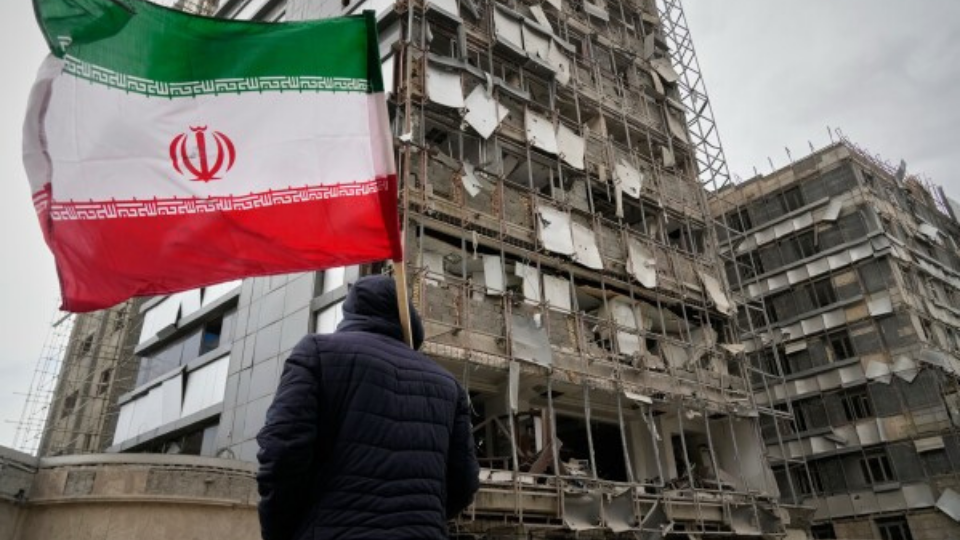
A man holds an Iranian flag as he looks at the damaged Gandhi Hospital, March 2, 2026.| Vahid Salemi/AP
The most revealing feature of the current confrontation is not the fury of its rhetoric, but the narrowing of its coalition. In the political language of war, the loudest voices often conceal the deepest fragility. That is precisely what is now unfolding in Europe, where Spain’s refusal to be drawn into the U.S.–Israeli campaign against Iran has exposed a wider truth: the Western alliance is no longer a single strategic instinct, but a field of competing calculations, liabilities, and red lines.
This shift has been rendered unmistakably clear in Madrid. In an unusually direct and unfiltered rebuke, Spain’s Transport Minister Óscar Puente issued a statement that has since reverberated far beyond national borders: “We are not going with you even around the corner, you genocidal bastard. Let’s see if you get it.”
Far from being a mere outburst, the remark crystallizes a deeper strategic posture—one that rejects both the premises and the trajectory of escalation. It is the language of rupture, not improvisation; a declaration that the threshold of participation has been reached and refused.
The Spanish remark that the country would not go “even around the corner” with Benjamin Netanyahu may have sounded incendiary, but its political meaning was sober. It captured a continent that has grown increasingly unwilling to lend itself to open-ended escalation in the Middle East, particularly when the costs are clear, the objectives remain undefined, and the exit remains invisible. Europe may still speak the language of partnership, but it no longer accepts automatic obedience as its price.
This is not simply a matter of diplomatic tone. It is a recognition that the confrontation with Iran has entered a phase in which military force no longer guarantees strategic clarity. Washington and Tel Aviv have framed escalation as a test of resolve, yet the test now lies elsewhere: in whether allies are prepared to underwrite a conflict whose repercussions would travel far beyond the battlefield. On that question, Europe is hesitating less than it is refusing.
Spain’s posture is especially significant because it combines political, economic, and public pressure. Madrid does not merely object in principle; it has made clear that its territory will not be turned into an auxiliary platform for a war it does not own. That distinction matters. It signals a shift from passive alignment to selective consent, from reflexive solidarity to strategic inspection. Germany has ruled out involvement. France has insisted it is not a party. Across the continent, the vocabulary of “stability” now carries more weight than the old reflex of confrontation.
The reason is not difficult to discern. Any escalation around Iran immediately implicates the Strait of Hormuz, through which 17 to 20 million barrels of oil move every day, nearly one-fifth of global consumption. That is not a peripheral corridor; it is the hinge of global energy security. A disruption there would not remain regional. It would arrive in European economies as inflation, in Asian markets as shock, and in Washington as political blowback. The projected rise in oil prices, already hovering around $115 per barrel and vulnerable to spikes of $150 to $175, has made risk impossible to disguise.
What is emerging, then, is a new European realism. It does not romanticize Iran, nor does it endorse conflict. It simply refuses the premise that war can be outsourced without consequence. European governments have seen enough to understand that a conflict launched under the banner of pressure may quickly become a liability of endurance. In that environment, the old Atlantic assumption that allies will follow once the drums begin to beat is no longer reliable.
There is, too, a deeper political exhaustion at work. The U.S.–Israeli approach has demanded alignment without persuasion, escalation without consensus, and sacrifice without strategy. Europe is increasingly unwilling to participate in that bargain. The refusal is not theatrical; it is structural. It reflects a continent that has learned, perhaps too late, that dependency is not the same as unity and that alliance is not the same as shared judgment.
The war may still be spoken of in Washington and Tel Aviv as if its outcome can be managed through pressure, posture, and selective force. But Europe’s response suggests otherwise. The coalition is fraying where it matters most: not in declarations, but in permission. And once that permission is withdrawn, the political architecture of escalation begins to weaken.
That is the significance of Spain’s statement. It is not merely a rebuke. It is a marker of a larger strategic condition: the West is no longer prepared to move as one when the cost of movement is war, the price is global instability, and the reward is uncertain at best.
As with all op-eds and news analysis articles published by People’s World, the views expressed here are those of the author.
We hope you appreciated this article. At People’s World, we believe news and information should be free and accessible to all, but we need your help. Our journalism is free of corporate influence and paywalls because we are totally reader-supported. Only you, our readers and supporters, make this possible. If you enjoy reading People’s World and the stories we bring you, please support our work by donating or becoming a monthly sustainer today. Thank you!
CONTRIBUTOR