
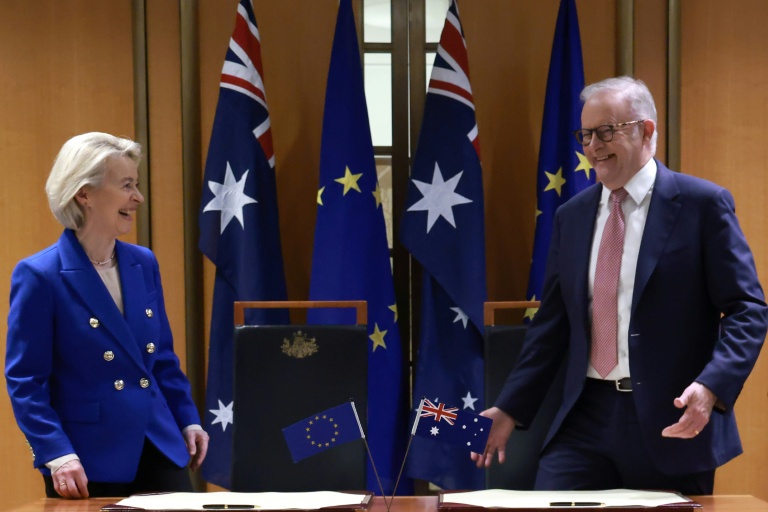
Australia and the European Union have agreed to a sweeping trade deal after eight years of fraught negotiations.
The deal lifts tariffs on almost all trade between the 27-member bloc and Australia, with the exception of steel.
Australia says the deal could add AU$7.8 billion ($5.4 billion) to its GDP by 2030.
And EU chief Ursula von der Leyen has described it as “a win on both sides”.
Here’s what you need to know about the deal:
– Export quotas –
Total trade in goods between the EU and Australia stood at 49.4 billion euros ($57.2 billion) in 2024.
Negotiations on a free trade deal had been ongoing since 2018.
But they fell apart in 2023 over what Canberra said was the Europeans’ refusal to budge on the issue of market access for Australian farm products such as beef and lamb.
Tuesday’s deal represents a compromise.
Under the agreement, the quota of Australian beef allowed into the EU will increase more than 10 times the current level over the next decade.
That quota — 30,600 tonnes — will include 55 percent of grass-fed beef entering duty free, and 45 percent entering with a reduced duty of 7.5 percent.
A third of the beef quota will apply for five years, before increasing to the full quota.
The deal is closer to the European ask of 30,000 tonnes than Canberra’s demand of 40,000 — a key sticking point in negotiations.
– Beefing –
But they will nevertheless likely raise the ire of European farming unions.
The umbrella farm group Copa-Cogeca said earlier this year the deal “risks placing a disproportionate burden on European farmers”.
Australian farmers said they were disappointed with the deal.
National Farmers Federation President Hamish McIntyre said the agreement showed no real change for agriculture since the offer Australia rejected in 2023.
“Farmers will be rightly concerned that after years of negotiations this deal hasn’t delivered commercially meaningful access for Australian agricultural exports,” he said.
The EU will also allow a quota of 25,000 tonnes of Australian grass-fed sheep and goat meat phased over seven years.
The deal was “great for Aussie exporters” overall, Tim Harcourt, chief economist with the University of Technology Sydney, told AFP.
– Naming rights –
Another key sticking point had been European agriculture’s fierce defence of Geographical Indications of food products, from French Champagne to Irish Whiskey.
Australia will be allowed to keep using some geographical names, such as feta and gruyere, in cases where producers have used the name for at least five years.
Some didn’t make the cut and will have to change their names — including Australian-produced Greek spirit Ouzo and Fontina cheese.
Most prominently, Australian winemakers will be allowed to use the term prosecco to describe their sparkling wine domestically, but must stop using it for exports after 10 years.
“There will be significant impact on the wine industry in particular,” Lisa Toohey at the University of New South Wales told AFP.
“Australian producers of parmesan will be pleased, producers of feta and gruyere will not.”
On the flipside, European farmers and food businesses will gain greater access to the Australian market.
Tariffs will be eliminated on key European exports like cheese, wine, fruit and vegetables and chocolate.
That will save European farmers one billion euros in tariffs, von der Leyen said.
– Vehicle tariffs –
European negotiators had hoped that Australia would scrap its luxury car tax, which adds a 33 percent duty on vehicles over a certain price.
They didn’t quite get that, but under the agreement Australia will raise the taxable threshold to over AU$120,000 for electric vehicles — exempting 75 percent of European EVs.
A five percent tariff on all European car imports will also be scrapped.
This will help lower costs and “increase the uptake of electric vehicles”, Canberra said, as the country pushes to achieve net-zero carbon emissions over the coming decades.
– Critical minerals –
Another key element of the deal was securing the European Union’s access to critical raw materials — needed for clean technologies like wind turbines and electric car batteries — of which Australia has rich deposits.
China dominates the production of metals and has threatened to strangle supplies in a tit-for-tat trade war with Washington — leaving Western nations looking elsewhere.
The Australia-EU deal aims to give Europe better access to these materials, most notably aluminium, lithium and manganese.
Canberra said the tariffs on its exports of critical minerals have now been “eliminated”.
sp-oho/dhc/lga