
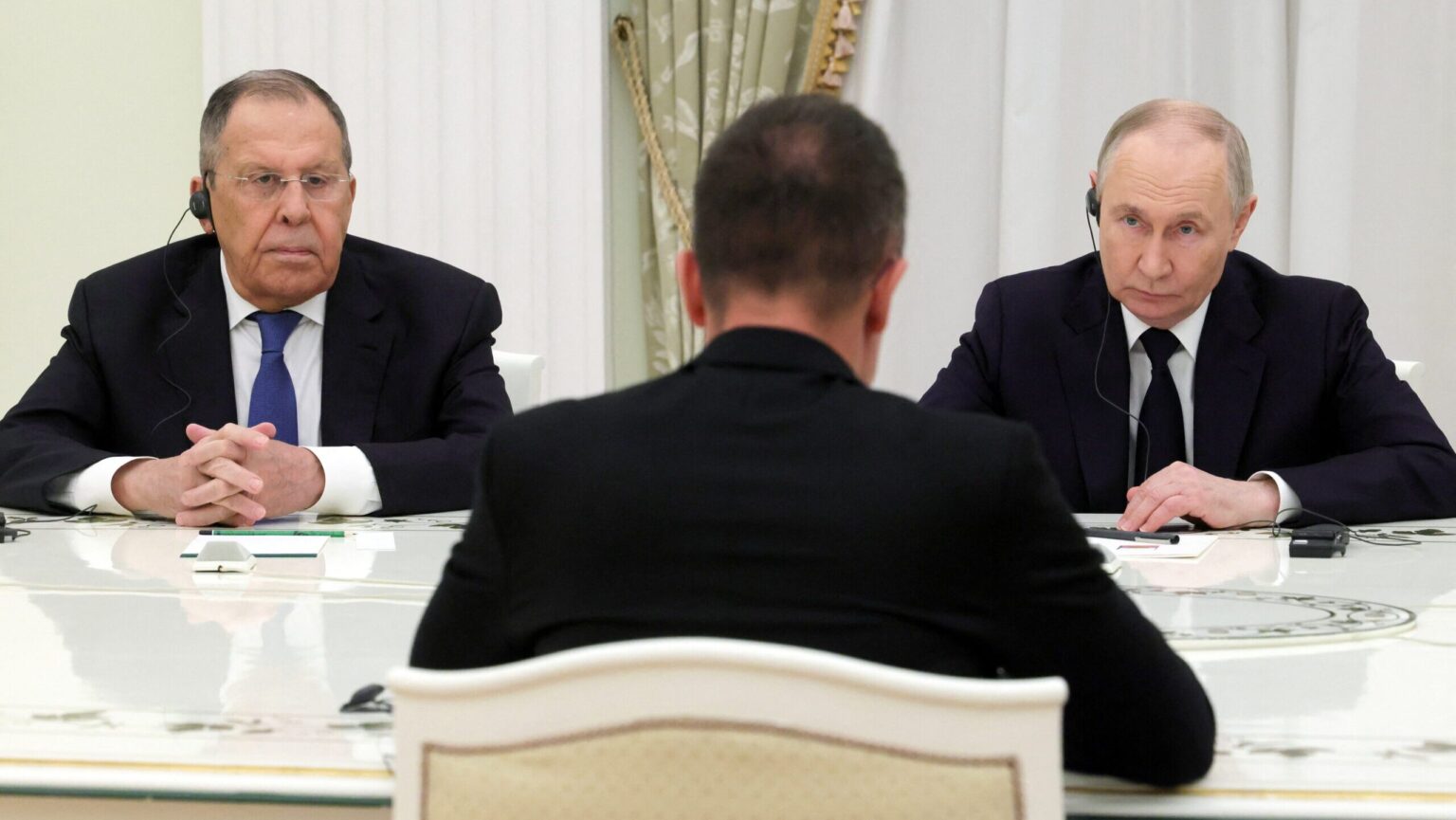
The European Commission has demanded ‘clarification’ from Hungary following accusations in Western and Hungarian media claiming that Minister of Foreign Affairs and Trade Péter Szijjártó leaked confidential EU information to Moscow for years.
Speaking on Monday, 23 March, Commission spokeswoman Anita Hipper described the reports, first published by The Washington Post on 21 March, as ‘a matter of serious concern’, adding that ‘confidential relations between member states and between member states and EU institutions are fundamental to the functioning’ of the bloc. ‘We expect the Hungarian government to provide clarification,’ she stressed.
The Commission declined to say whether any internal investigations would be launched or whether security protocols at meetings would be strengthened, citing concerns about the authenticity of the reports.
Hipper also appeared to deny claims that the EU is limiting the flow of confidential material to Hungary or that leaders are increasingly meeting in smaller working groups to avoid leaks, stating that such claims ‘remain at the level of unconfirmed allegations’. She added that the Commission ‘is in daily contact with all member states’ on a wide range of issues.
The Szijjártó–Lavrov Leak
The aforementioned report, citing anonymous European security officials, alleges that Péter Szijjártó has for years informed his Russian counterpart, Sergei Lavrov, about what was discussed behind closed doors at EU meetings. One official claimed that ‘every single EU meeting for years has basically had Moscow behind the table’, while the report also accused Szijjártó of holding phone calls during breaks in meetings to inform Moscow immediately.
The report’s authenticity raises questions. Despite citing multiple officials, it still relies exclusively on unnamed intelligence sources. The Washington Post also claimed to have reviewed a Russian intelligence memo, obtained and authenticated by an unnamed European intelligence service. The alleged document proposed staging a fake assassination attempt against Hungarian Prime Minister Viktor Orbán to boost his support in the final phase of the campaign ahead of the 12 April election. No evidence has been provided to support these claims.
As reported by Hungarian Conservative, the report fits into the Russian interference narrative first introduced by Hungarian outlet Direkt36 earlier in March, which claimed that Russia’s military intelligence (GRU) had deployed a team in Budapest to support Orbán’s campaign. The report was written by opposition journalist Szabolcs Panyi and, similarly to the other claims, was based solely on anonymous sources.
The Hungarian government rejected the accusations, stating that they are part of a disinformation campaign against Hungary aimed at undermining Orbán and his Fidesz–KDNP alliance ahead of the high-stakes elections in order to support the opposition, led by Péter Magyar and the Tisza party.
On Monday, Hungarian outlet Mandiner published a leaked audio recording in which Panyi allegedly admitted to sharing Szijjártó’s phone number with a foreign intelligence service. During the roughly nine-minute recording, Panyi also speaks about how Anita Orbán, a foreign policy expert linked to Tisza, is a friend of his and offered him the possibility to effectively influence staffing decisions at the foreign ministry in the event of a change of government. The recording also alludes to possible future access to sensitive ministry documents through these connections.
The authenticity of the leak has not yet been independently verified; however, Panyi has not denied its existence. Orbán has ordered an official investigation into the case.
Shortly after the leaked audio surfaced, Panyi shared a transcript of an alleged phone call between Szijjártó and Lavrov dating back to 2020. According to the document, the Hungarian foreign minister asked Lavrov whether he could help organize a meeting between Russian Prime Minister Mikhail Mishustin and then Slovak Prime Minister Peter Pellegrini in order to boost the latter’s re-election chances. During the alleged call, Szijjártó reportedly said that Orbán had instructed him to make the request.
Panyi also claimed that, in the leaked recording, he was attempting to determine whether there was another phone number through which Szijjártó might be communicating with Lavrov, beyond the two already known to the unnamed foreign intelligence service.
Szijjártó reacted sharply to both the leaked transcript and the broader allegations, dismissing them as ‘politically motivated fabrications’ while shifting the focus to what he described as a serious national security breach.
Addressing the alleged Lavrov call, he argued that maintaining contacts and facilitating meetings is a routine part of diplomacy, downplaying the significance of the claims. At the same time, he warned that the involvement of foreign intelligence services would constitute a serious attack on Hungary’s sovereignty and form part of a coordinated attempt to influence the upcoming election.
Coordinated Intel Operation?
Regarding the unnamed European intelligence service that allegedly supplied the assassination plot and the Szijjártó–Lavrov claims to The Washington Post, Brussels Signal reported that it may be Poland. Polish Prime Minister Donald Tusk and Foreign Minister Radosław Sikorski reacted to the report unusually quickly, suggesting that the allegations might be credible. Speaking to Brussels Signal, a former Polish official said he had ‘no doubt’ that the source country was Poland, adding that the memo itself ‘either does not exist or is currently being fabricated’.
Reinforcing this narrative, Hungarian government spokesman Zoltán Kovács wrote in a post on X that Panyi is embedded in a broader network of foreign-funded media initiatives, including the now-dismantled USAID, the National Endowment for Democracy (NED), and the Polish Reporters Foundation. According to Kovács, the Polish dimension extends beyond institutional ties: ‘Panyi’s work is regularly amplified within Polish political and media circles, and his content is frequently shared’ by Sikorski.
Tusk and his government are among the most vocal supporters of Péter Magyar and the Tisza party, both affiliated with the European People’s Party (EPP), and have met several times, most recently in February 2026. Tusk also maintains close ties with the European Commission, and it is a recurring narrative in Western media that Magyar could replicate Tusk’s 2023 success in Poland by defeating a right-wing incumbent and unlocking previously frozen EU funds.
In a post on X, political director of the Hungarian prime minister Balázs Orbán linked what he described as a ‘coordinated’ intelligence offensive against the government to the European Commission’s recent activation of the Digital Services Act (DSA) rapid response mechanism to counter ‘Russian interference’ and ‘disinformation’ ahead of Hungary’s election. The allegations emerged just days after the system—which enables NGOs and ‘fact-checkers’ to moderate content on platforms such as Facebook and TikTok—was activated.
The mechanism targets content labelled as ‘Russian disinformation’, which, at the most of the times, includes migration-related topics and positions that diverge from EU policy on the war in Ukraine, circulated by right-wing users and politicians. Following its activation, Orbán’s Facebook reach appeared to decline, with engagement figures dropping compared to previous levels, indicating that Meta has started to operate under the activated system.
So while the DSA created the conditions for limiting the visibility of the government’s narrative, the intelligence operation immediately launched and provided the accompanying political justification. The recent claims of Russian interference further reinforce the rationale for deploying these tools.
That makes framing the story for the Hungarian opposition incredibly easy, as already demonstrated by Péter Magyar, who declared that, if proven true, Szijjártó would face life imprisonment if they were elected to government, accusing him of committing ‘treason’ not only against Hungary but also the European community.
According to Balázs Orbán, the key question is which EU member state’s intelligence service is ‘working with Péter Magyar’ and Brussels to ‘interfere in the Hungarian elections and wiretap Hungarian ministers’.
Related articles: