
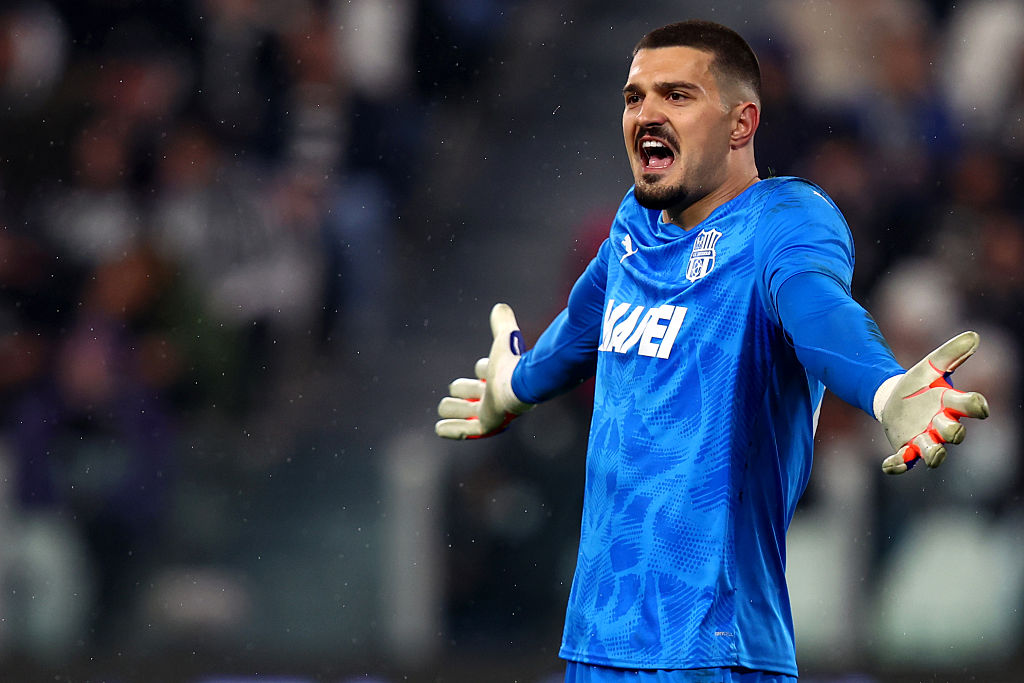
Griffin Wong previews Thursday’s UEFA World Cup Play-Off Path C semifinal between Slovakia and Kosovo.
The rise of Kosovo is one of the most remarkable ones in football history. It wasn’t even a member of FIFA until May 2016, and it’s still not recognized as sovereign by several member states within the United Nations. It didn’t pick up a win in its first World Cup qualifying campaign. But just 10 years later, the Dardanians are on the doorstep of the world’s premier football competition, as they’ve qualified for UEFA Play-off Path C alongside Türkiye, Romania, and Slovakia.
Kosovo and Slovakia will have to go through each other in this afternoon’s 3:45 p.m. ET (8:45 p.m. local) in Bratislava. The winner will go on to face the winner of the concurrent semifinal between Türkiye and Romania at home, with the winner of that match going on to the join the United States, Paraguay, and Australia in Group C.
The Falcons are +110 favorites to win (-190 to advance to the path final) at DraftKings Sportsbook, and the Dardanians are +285 (+140 to advance). There are +220 odds that the tie will require penalties.
Slovakia vs. Kosovo prediction, pick
Both teams were in four-team groups during the first phase of qualifying, so they played just six matches each. Kosovo had the stronger run, losing just once — to Switzerland on the first day of matches — while Slovakia suffered two defeats, including a 6-0 throttling against Germany on the final matchday. But the Falcons also beat Germany, while the best result the Dardanians could manage against the ultimate group-winner (Switzerland) was a draw. Though it was Kosovo’s best World Cup qualifier campaign, it was not Slovakia’s; the Falcons reached the Round of 16 of the World Cup in 2010 in their only appearance as an independent nation, and they were runners-up in 1934 and 1962 as part of Czechoslovakia.
Slovakia had a weak but well-balanced attack during the group stage, as six different players — Dávid Strelec, Dávid Hancko, Adam Obert, Tomas Rigo, Ivan Schranz, and Tomáš Bobček — each found the back of the net once. Despite advancing, the Falcons’ lack of clinical finishing could prove problematic against the Dardanians, as they finished ninth-to-last in on-target percentage (second-to-last among teams to advance to the playoff phase) and 12th-to-last in shots on target per 90 minutes. Defensively, Slovakia could be fine; it allowed just eight goals in the group stage, six of which came against high-powered Germany, allowing four or fewer shots on target in each match except the one against Die Nationalelf. The Falcons also played pretty disciplined football, fouling relatively infrequently and getting caught offsides at one of the lowest rates. They have a proven shot-stopper between the sticks in Burnley’s Martin Dúbravka. Dúbravka might be tested more in the back with Milan Škriniar, who has plenty of title-winning experience with Inter Milan and PSG, absent with an adductor tear.
Like Slovakia, Kosovo had a relatively muted attack, with only one player, Fisnik Asllani, scoring multiple times. Besides Asllani, Florent Muslija, Vedat Muriqi, and Elvis Rexhbeçaj were the only other Dardanians to find the back of the net, and no player recorded multiple assists. All in all, the Kosovar attack was a little bit better than the Falcons’, as they had a higher on-target rate and averaged more shots on target per 90 minutes, but they struggled to make the most of their chances. Additionally, Kosovo has arguably been even stronger in defense, allowing just one goal over its last five games, though they, too, will be missing their captain (center-back Amir Rrahmani). The Dardanians recorded more interceptions than Slovakia did while fouling even less. Arijanet Muric doesn’t have quite as much top-level experience as Dúbravka, but he was far from the reason Ipswich Town was relegated from the Premier League last season and ranks sixth in Serie A in save percentage this season as Sassuolo’s top shot-stopper.
This game is pretty hard to call, given that both teams have weak attacks but strong defenses. On paper, Kosovo has a better roster; its squad is worth some 22 million Euros more than the Falcons’ on Transfermarkt. However, Rrahmani’s and Leon Avdullahu’s absences might hurt, and Slovakia’s home-field advantage could matter, especially given they beat Germany there in September. Ultimately, I like Kosovo’s value, especially given that it produced a much better goal difference in a more difficult group (the average ranking of its opponents was 39th, while the Falcons’ ranked 61st), and it beat Sweden — a team ranked ahead of Slovakia in the latest FIFA World Rankings — in Stockholm. Plus, I trust Muric slightly more in a penalty shootout than Dúbravka, who’s been pretty cold as of late for the relegation-bound Clarets in the Premier League.
Best Bet: Kosovo to Advance (+140)