
- by croatiaweek
- March 26, 2026
- in
(Photo: Verne)
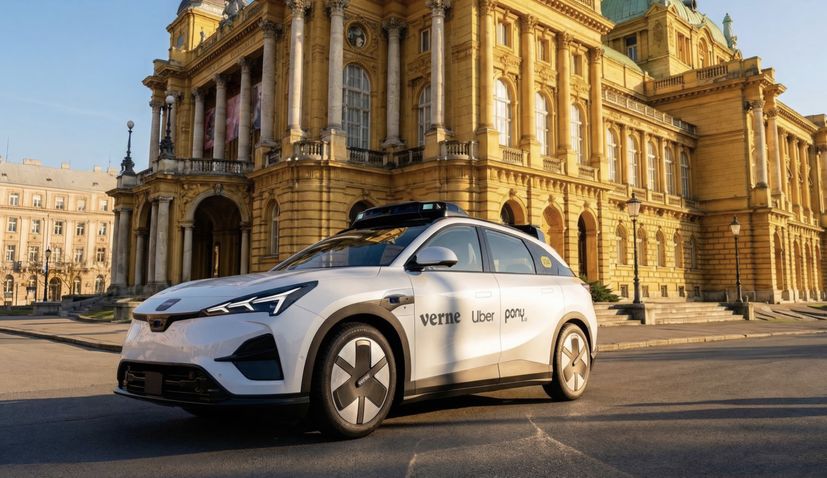
ZAGREB, 26 March 2026 – Croatia’s capital is set to become the first city in Europe to introduce a commercial robotaxi service after a new strategic partnership between global technology and mobility companies.
Autonomous driving firm Pony.ai, ride-hailing giant Uber and Croatian mobility company Verne have announced plans to deploy Europe’s first commercial robotaxi service in Zagreb.
Initial deployment work is already underway, including validation tests on public roads in the Croatian capital.
How the partnership will work
The collaboration combines three key elements needed to launch autonomous ride-hailing at scale.
Pony.ai will supply its autonomous driving technology, Uber will integrate the service into its global ride-hailing platform, while Verne will act as fleet owner and operational service provider.
Under the model, robotaxi rides will eventually be available through Uber’s platform as well as Verne’s own customer-facing mobility service.
The partners say the aim is to build a scalable robotaxi network in Zagreb before expanding into other European cities and additional global markets.
Over the next few years, the fleet could grow to thousands of autonomous vehicles, marking one of the most ambitious robotaxi deployments planned in Europe.
Testing already underway
As part of the rollout, the companies have already begun on-road testing in Zagreb using Pony.ai’s Gen-7 autonomous driving system.
The system is currently being tested on the Arcfox Alpha T5 robotaxi platform.
Preparations are also underway for the introduction of fare-charging services, signalling a shift from testing to a real commercial mobility service.
If approvals proceed as planned, Zagreb will become Europe’s first operational market for robotaxi services.
Regulatory approval and expansion
Verne will lead the process of securing regulatory approvals required for commercial autonomous mobility in Europe.
The company will also coordinate the deployment of robotaxis across both Uber’s global ride-hailing network and Verne’s own mobility ecosystem.
This operational structure is intended to ensure consistent safety, performance and user experience while creating a framework that could be replicated in other cities.
As part of the agreement, Uber also plans to invest in Verne, strengthening the partnership and supporting future expansion.
Global ambitions for autonomous mobility
According to Pony.ai founder and CEO Dr James Peng, the partnership represents an important step in expanding autonomous transport globally.
The company has already achieved large-scale commercial deployment in China, including reaching unit economics breakeven in major cities such as Guangzhou and Shenzhen.
Leveraging that experience, the company now aims to accelerate international expansion through partnerships with established mobility platforms and local operators.
Verne CEO Marko Pejković said Europe needs autonomous mobility that can move beyond testing into real-world services.
“Starting in Zagreb, we are bringing together the technology, platform and operational capabilities required to make autonomous ride-hailing a reality,” he said.
Uber CEO Dara Khosrowshahi added that strong partnerships are key to scaling autonomous mobility worldwide.
“By combining Pony.ai’s proven technology, Verne’s operational expertise and Uber’s global platform, we are taking an important step toward making autonomous ride-hailing available to more riders in more places,” he said.