
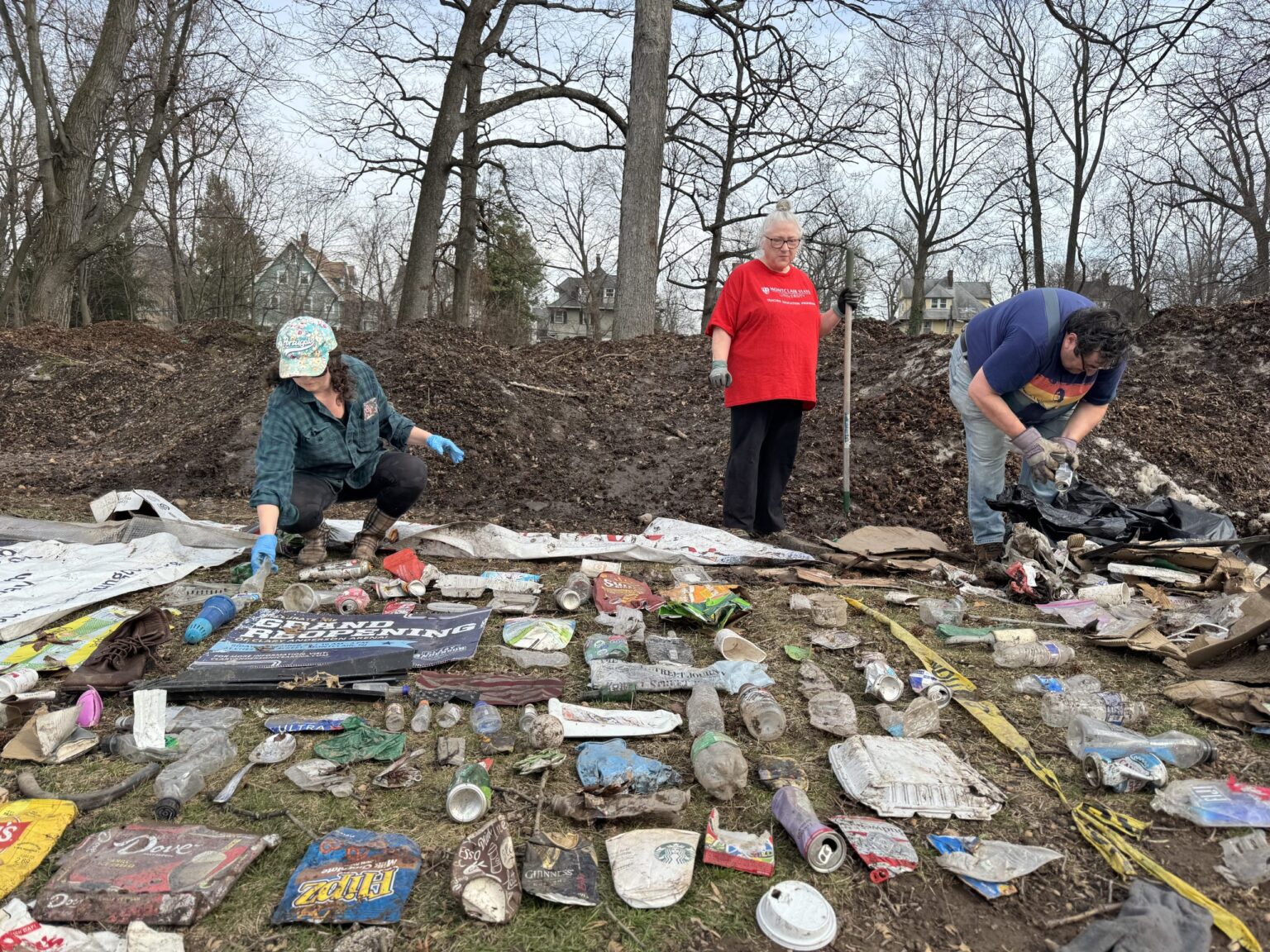
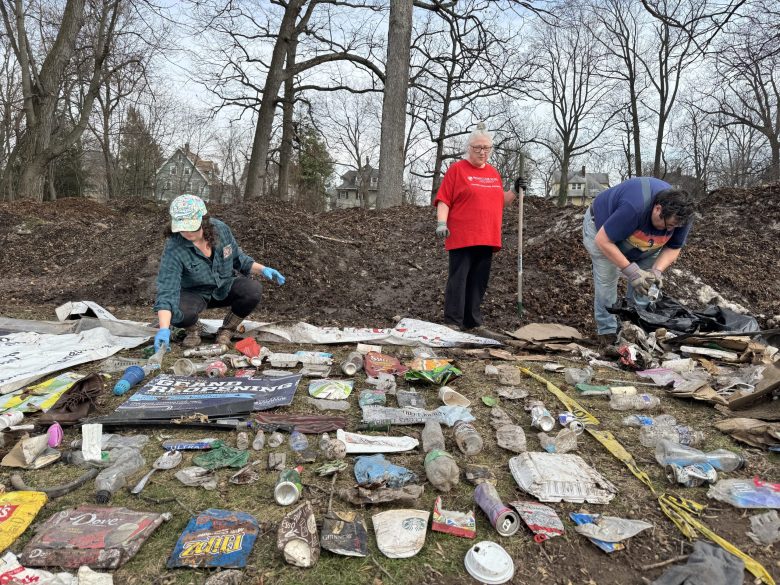
 Volunteers pull trash from piles of snow at Essex Park in Montclair Sunday, March 22, 2026. (COURTESY OF ANNA GROSSMAN)
About a dozen volunteers gathered at Essex Park over the weekend to clean up after township crews piled snow around trees following a historic February storm, raising concern about roadway contaminants seeping into the soil.
Video provided to Montclair Local shows the volunteers scraping and chipping away at hardened snowpack and collecting litter on Sunday. While spring started two days before, bitter cold had locked the snow in impenetrable piles.
“You have tons of icy snow full of salt leaching chemicals into the ground, and it will start leaching even more because the ice is going to be melting,” said Anna Grossman, a local environmental advocate who leads the grassroots coalition Sustainable Montclair. “The large weight of the ice is compacting the soil. And you have chemicals and salt penetrating the root systems.”
‘Double Whammy’
Grossman, who in 2023 was among residents to protest the removal of century-old trees at a nearby school ball field, added: “You have a double whammy of potential groundwater contamination near a public well and damage to the mature oak trees that are some of the only remaining ones in this immediate neighborhood.”
Although local residents rarely rely on the well water, state mapping shows the park is in a “Wellhead Protection Area” supplying a public water system. Grossman also objects to the town’s snow dumping in nearby Erie Park, which is just off of Walnut Street.
Her worry is grounded in the science of an issue that is not unique to Montclair, according to both state rules and an environmental expert. The state Department of Environmental Protection’s snow removal policy mandates towns locate snow in “upland locations” away from water sources and wells and put the snow in spots “not likely to impact sensitive environmental resources.”
“As snow melts, road salt, sand, litter, and other pollutants are transported into surface water through the soil where they may eventually reach the groundwater,” the DEP says. “Road salt and other pollutants can contaminate water supplies and are toxic to aquatic life at certain levels.”
Damaged Trees
Amy Rowe, an associate professor with Rutgers University’s Cooperative Extension of Essex and Passaic counties, who visited Essex Park to examine the damage, told Montclair Local she found snow piled more than six feet high directly against the trees and signs that workers using heavy machinery broke branches, ran over smaller trees and gouged the bark of larger trees. While Rowe said she has no immediate concern about drinking water contamination, the snowmelt puts groundwater at risk.
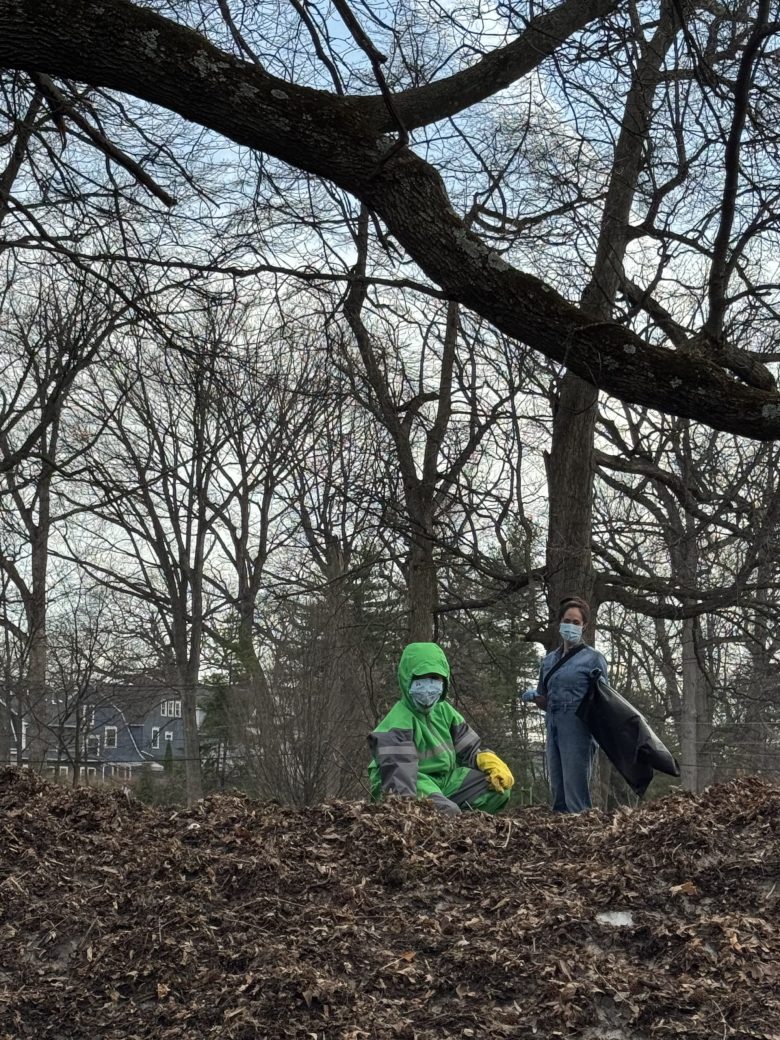 Neighbors pull litter from snow piles in Montclair’s Essex Park Sunday, March 22, 2026. (ANNA GROSSMAN)
“Drinking water is unlikely to be impacted as Montclair sources its water from the North Jersey District Water Commission’s Wanaque and Monksville reservoirs,” said Rowe, who holds a doctorate in environmental sciences and has a background in water chemistry. “The salts from the plowed snow could absolutely impact groundwater, though, and the three municipal wells that are used when water supplies are low in the summer.”
Chloride Poisoning
Rowe, on March 16, wrote to the township with her concern that “an inordinate amount” of snow had been piled against the trees. She warned that roadway salt from the snow replaces essential minerals in the soil, leading to plant deficiencies and reduced growth. Tree roots absorb the salt, leading to chloride poisoning that can delay or damage leaf growth and prompt dehydration, she wrote.
What happens when the snow melts?
“Tree roots in standing water or snow can suffocate with no access to oxygen,” Rowe said.
On Tuesday, Rowe reiterated her guidance to Township Manager Stephen Marks, Mayor Renee Baskerville, the rest of the Township Council and other officials in an email, advising that they should remove the snow with smaller equipment such as a compact skid-steer loader – a type of miniature front-end loader.
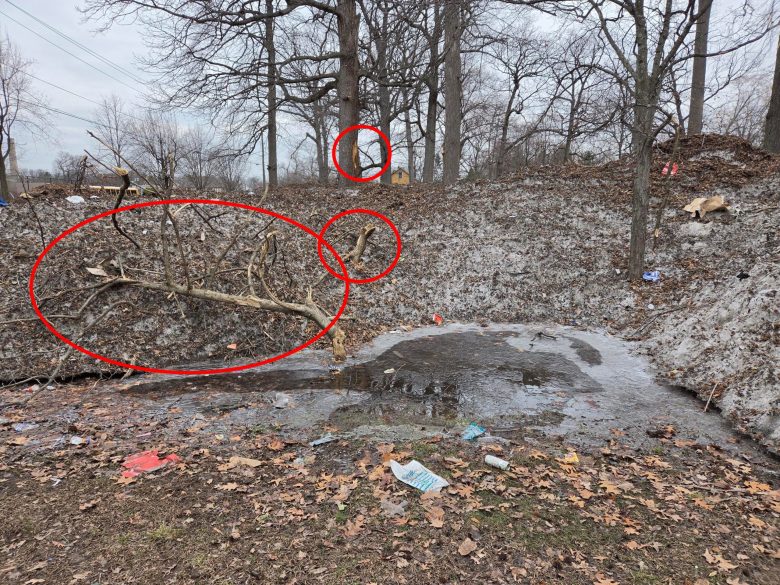 Red circles over this image highlight damage from snow dumping at a township park in Montclair following a February 2026 snowstorm. (COURTESY OF AMY ROWE/RUTGERS UNIVERSITY)
An hour later, township spokesperson Matthew Amaral answered Montclair Local’s earlier request with a detailed statement from the township’s Department of Community Services, which Director Austin Ashley heads up.
‘Necessary Operational Decision’
“The Township understands residents’ concerns regarding the temporary use of Essex Park for snow storage following a series of significant winter storms that brought unusually high snowfall totals,” officials said. “This was a difficult but necessary operational decision made under severe conditions to ensure that major roadways, intersections, and emergency routes remained clear and safe.”
Crews are monitoring the site and removing debris as it becomes visible during the melt, officials said. The town is also coordinating with its Department of Sustainability and arborist on next steps for restoring the grounds and vegetation, the township said.
Officials said the town will conduct “a full assessment of trees and soil.”
“Any tree that shows signs of sustained damage will be evaluated and addressed as part of the park’s maintenance plan,” the statement said. “And those that cannot be saved will be replaced with hardy, appropriate specimens.”
In addition, the township said it is reviewing procedures for future snow removal operations, including alternative locations “to better protect public spaces.”
“Our goal is to have the park restored to a safe, clean, and usable condition for residents as quickly as possible,” officials said.
Where can the snow go?
The issue has been on the local environmental community’s radar for weeks. At an Environmental Commission meeting March 4, commissioners raised it. The obstacle, however, is where to put the snow.
“There is a plan to clean up, to aerate and rehabilitate. That is in the plan,” said Second Ward Councilor Eileen Birmingham, at the meeting. “Unfortunately, and this is where we will take any ideas, it’s just very hard to think of an alternative space. … Where can we put it?”
Anywhere near water is out of the question, under the state’s rules. Can you rent a private parking lot?
“You need a big lot and there’s not many and you need it for a few months. I was like what about Montclair Beach Club?” Birmingham said, referring to a swim club. “But that’s near a body of water.”
A spokesperson for the DEP said he was working on a Tuesday afternoon request from Montclair Local asking if the agency had issued violations, fines or warnings related to snow dumping in Montclair and across the state. As of publication Thursday morning, the spokesperson did not have an answer.
Cold Shoulder
Grossman, who showed a reporter emails of her early correspondence with municipal officials over the issue, feels the township has given her the cold shoulder about the snow dumps.
Responding to the township’s prepared statement to Montclair Local this week, Grossman said she wants the town to remove the snow as Rowe advises — something officials have not promised.
“Right now is when those trees should be drawing nutrients to create buds,” Grossman said. “Instead, those trees are going to ‘think’ that there’s a drought because the ground’s going to be full of salt very soon.”
Email reporter Matt Kadosh at matt@montclairlocal.news
Related
Before you comment on Montclair Local
Comments are moderated. Montclair Local reserves the right to delete or close comments on any story at any time. Please read our → Commenting Policy before commenting.