
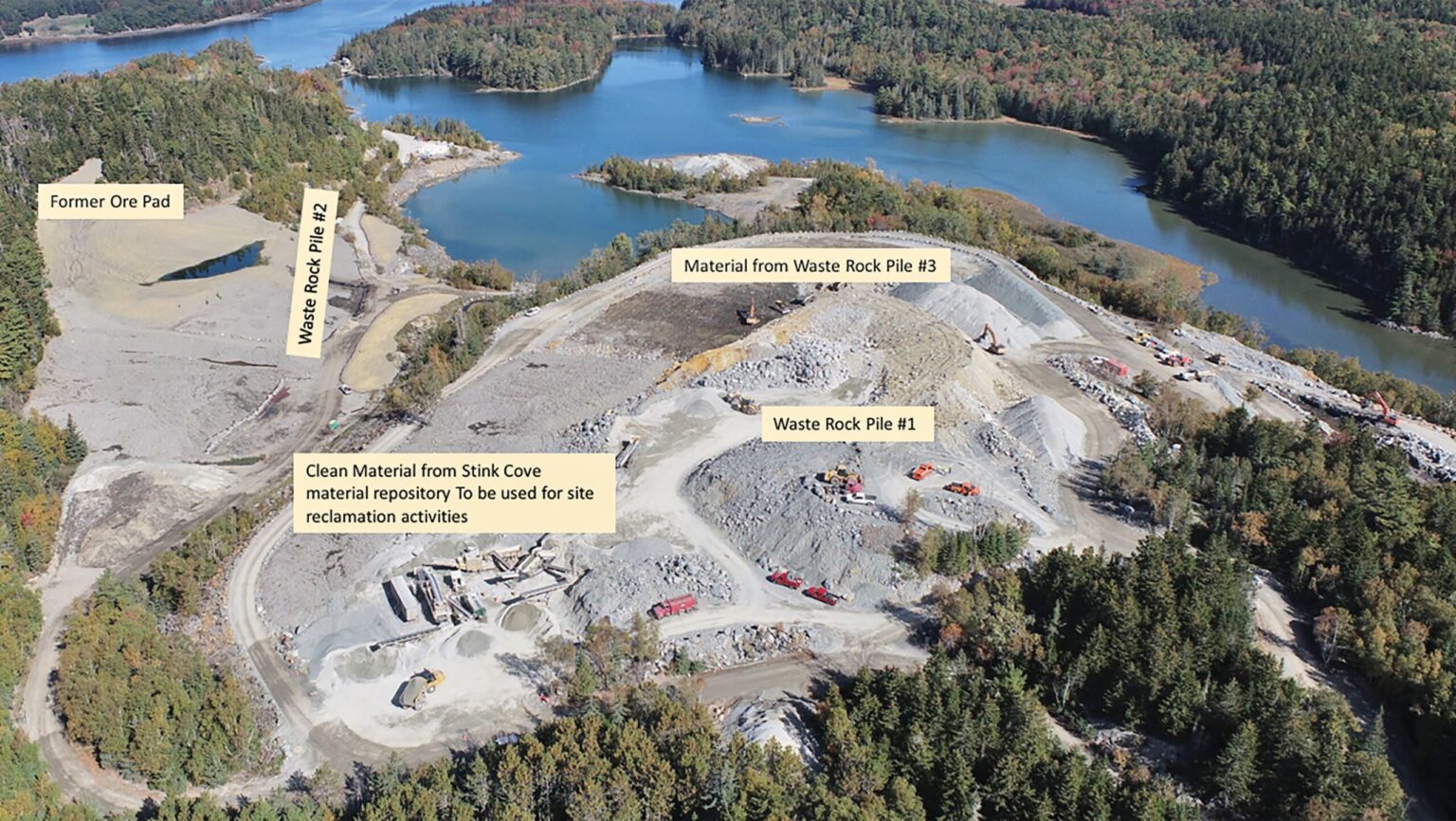

Aerial view of the Callahan Mine Superfund cleanup site on Cape Rosier. PHOTO COURTESY EPA
BROOKSVILLE—On March 19, representatives of the Environmental Protection Agency updated the community on the status of the EPA’s Superfund cleanup of the Callahan Mine at a sparsely attended public meeting in the Brooksville Town Hall.
According to Ben Kuhaneck, EPA Remedial Project Manager for the site, the EPA now expects cleanup and remediation to be completed in Fall 2027, 17 years after the EPA first began the process.
The current, and last phase, which the EPA refers to as OU3 (Operating Unit 3), was started in 2015 and has been largely completed.
Most recently, the dredging of contaminated sediment in Goose Cove was completed in late 2025.
The contaminated sediment, which totaled 5,800 cubic yards, was piped from Goose Cove to the mine pit and deposited via a vertical pipe 40 feet below the water level of the 300-foot-deep mine pit.
Left on the EPA’s list after the Goose Cove dredging are three items, all of which will be addressed starting this spring. Once the last three items are done, the EPA will dispose of any remaining construction waste and then continue to provide long-term monitoring of the site.

EPA project manager Ben Kuhaneck updates residents on the progress of the Callahan Mine cleanup in Brooksville. PHOTO BY ANDY WEBSTER
The first two items are planting and seeding the bank and salt marsh area of Dyer Cove, and grading Waste Rock Pile #1/Stink Cove Repository.
The last item, which will begin in April, is the installation of the final cover material over Waste Rock Pile #1/ Stink Cove Repository. The amount of fill that needs to be brought in is considerable.
Kuhaneck said, “We are trying to limit the number of trucks coming over local roads from off-site, so we are using as much material from on-site as possible.”
By using clean on-site material first, the EPA estimates it will need 12,000-15,000 fewer truckloads to be brought to the mine.
The EPA has already moved nearly 300,000 cubic yards of waste rock from other areas of the site to Waste Rock Pile #1/Stink Cove Repository.
“However,” Kuhaneck said, “we’re getting to the end of it where there’s not as much material on site that we can use anymore. So we will have to import material to complete the cap.”
To minimize the impact of the truck traffic going to and from the site, the EPA plans to limit the number of trucks per day.
“We will need around 1,700 ten-wheel trucks,” Kuhaneck said. “We think that would be too much for one year. So we have to spread that out. Our goal is to have like five to seven trucks a day come through.”
Kuhaneck stressed that the EPA will have temporary road signs in place directing trucks along specific routes to minimize disruption to the community. “I know there’s been issues in the past, so we’re going to try and make sure that those don’t happen,” Kuhaneck said.
Trucks will not be using the northern entrance to the mine, Kuhaneck said. “There are two entrances to the mine. There’s a northern entrance, which is where a lot of the residences are. And then there’s a southern entrance. We have plans to widen that entrance, so it’s easier for trucks to get in and we’ll be on them pretty hard to make sure that they only go to the southern entrance.”
The EPA will work with the town regarding traffic flow and provide the town with a traffic plan after the routes are finalized.
Mining for zinc and copper sulfide ore first began at the site of the Callahan Mine in the 1880s, according to the EPA website. The Callahan Mine operated as an open-pit mine from 1968 until its closure in 1972.
According to the EPA, it was, at the time, the only intertidal mine in the world.
Over the four years the Callahan Mine was in operation, over 5 million tons of rock was excavated, with less than one million tons of that considered valuable ore.
Once the mine was exhausted, Callahan breached the dams it had constructed to keep water out of the mine pit, flooding the site.
Thirty years later, in 2002, the EPA added the site to its list of Superfund sites, with remediation work beginning in 2011.
The Callahan Mine site has been owned by the Smith Cove Preservation Trust, a private nonprofit based in Brecksville, Ohio, for decades.
In previous comments to Penobscot Bay Press, James Beneson, an officer of the trust, said that his family has been visiting the area for decades.
“We have been coming up for years and we have always been interested in conservation,” Beneson said. “Our goal has always been to reforest and attempt to restore the property to some sort of wild state.”